

Vernon Brock: The American Champion Who Changed Latin Dancing
Six national titles, two celebrated partnerships, and a theatrical style that pushed competitive Latin in a new direction
Look across Vernon Brock’s championship career and one fact stands out immediately: he was not the champion of a single partnership.
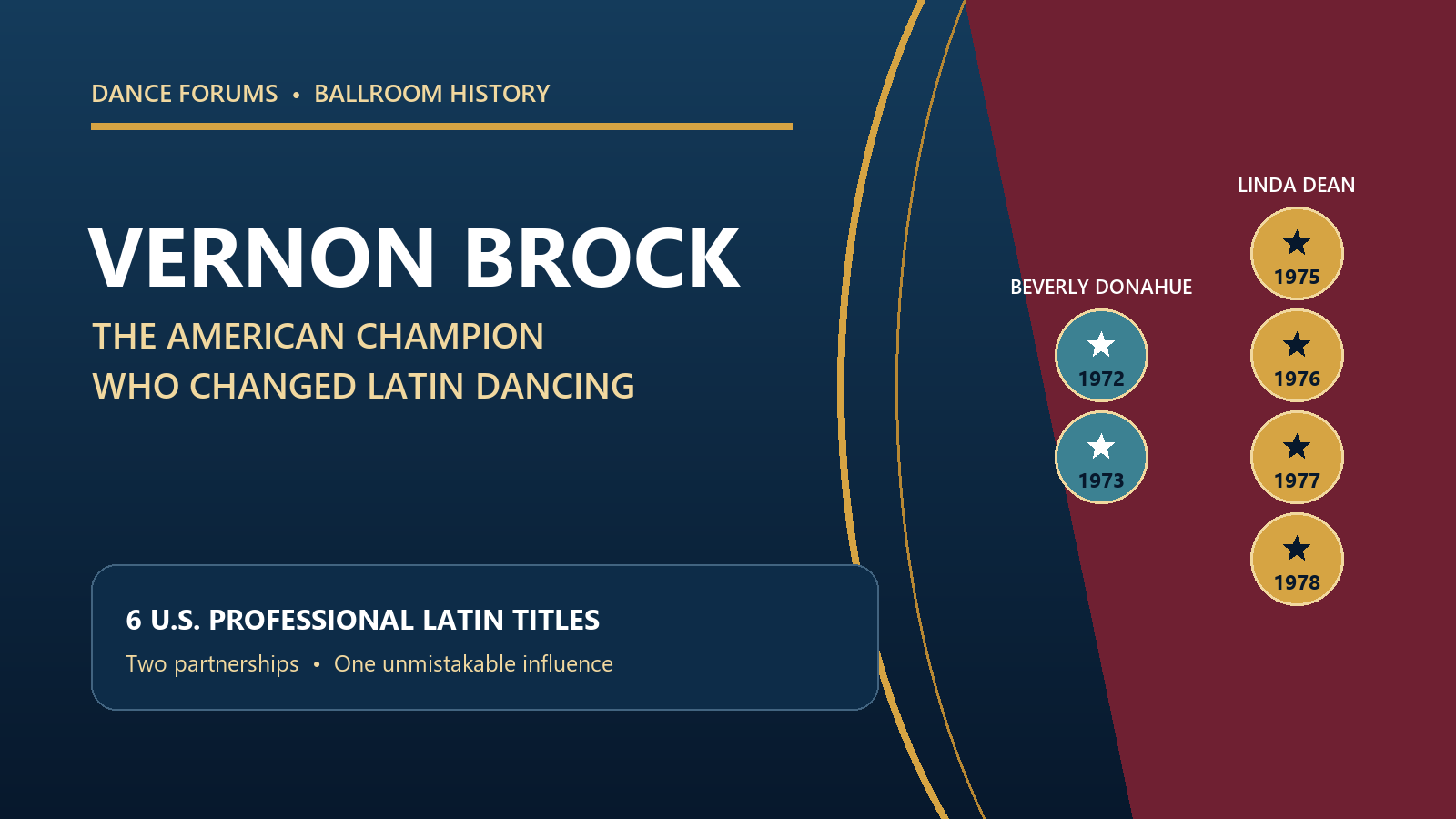
Brock was the U.S. Professional Latin champion in 1972 and 1973 with Beverly Donahue, then again from 1975 through 1978 with Linda Dean. That is six national titles with two defining partners, separated by a single year.
The title count establishes his success. It does not explain his importance.
Brock belonged to the group of American dancers who brought a freer, more theatrical and strongly rhythmic interpretation of Latin dancing onto floors still governed by British technique and taste. His jazz-stage background, appetite for showmanship and willingness to use choreography that did not look like everyone else’s made him exhilarating to audiences—and sometimes difficult for judges to place. His career also forms the chapter immediately before Ron Montez and Elizabeth Curtis began their seven-title run.
Decades later, dancers still tell the story of the night at Blackpool when not making the final may have made Vernon Brock and Linda Dean more famous than winning it would have. In a Dance Forums hall-of-fame discussion, members immediately placed the couple among the dancers who changed the direction of Latin dancing.
At a glance
| Full search name | Vernon Brock, ballroom and Latin dancer |
| National record | Six U.S. Professional Latin championships |
| Championship partners | Beverly Donahue (1972–73); Linda Dean (1975–78) |
| International standing | British Open Latin finalist; World Championship finalist with Dean |
| Known for | Jazz-inflected movement, showmanship, musicality and adventurous choreography |
| Later influence | Teaching, coaching, choreography and the Fred Astaire professional system |
Six titles, two partnerships
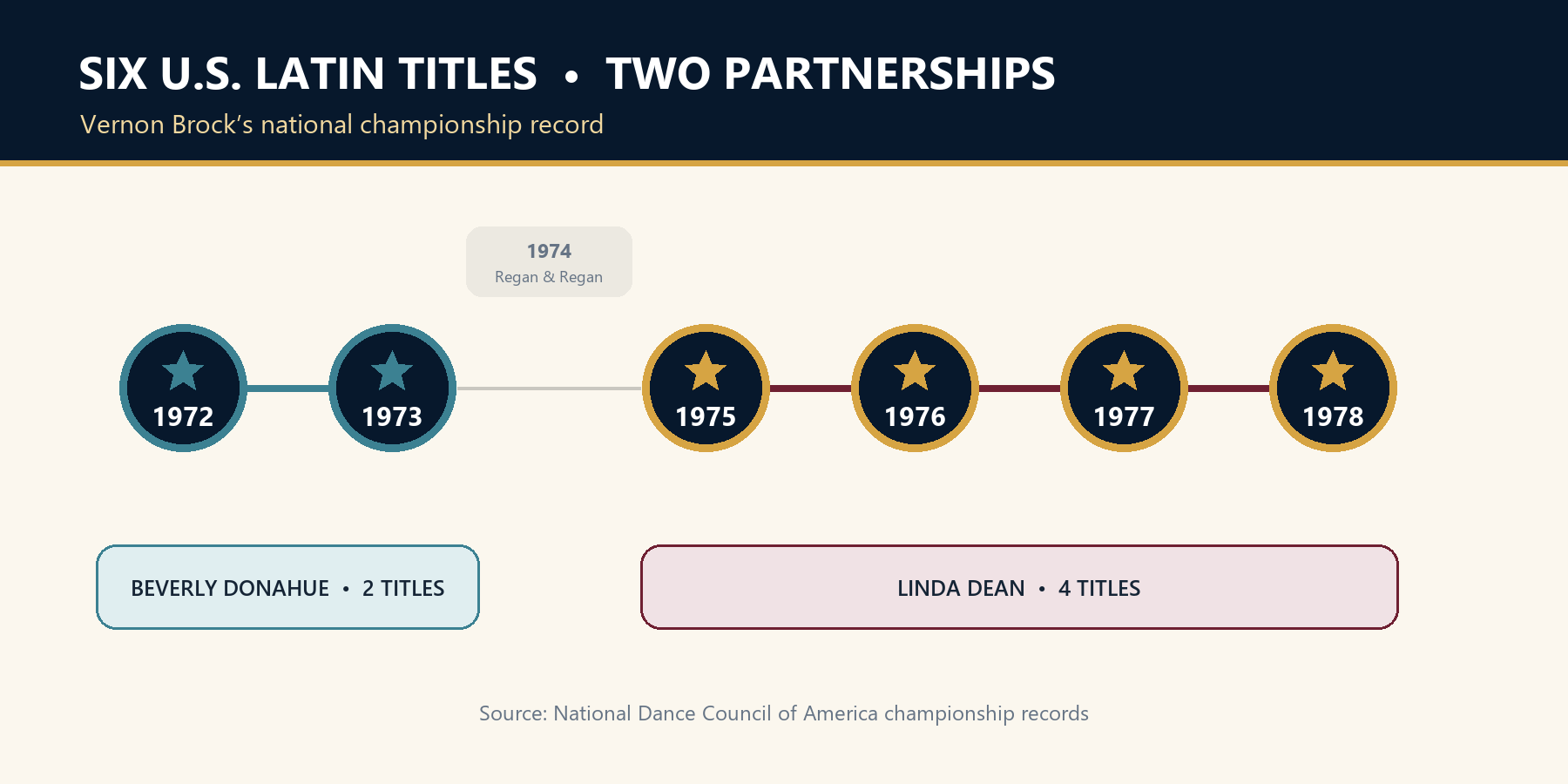
The formal championship record shows the two-partner arc clearly. Treating Brock and Dean as if they were his whole competitive history would erase the earlier breakthrough with Beverly Donahue. Treating the six titles as if Brock won them alone would erase two formidable women.
The better way to read the record is as a career with chapters.
With Donahue, Brock became the U.S. champion in 1972 and successfully defended the title in 1973. After Frank and Victoria Regan took the championship in 1974, Brock returned with Dean and began a four-year run from 1975 through 1978. The following year, Montez and Curtis began the partnership profiled earlier in this series.
Those consecutive lineages—Brock and Donahue, Brock and Dean, then Montez and Curtis—helped establish a recognizably American presence in the international Latin world.
From the jazz stage to the ballroom floor
Detailed public documentation of Brock’s early life is surprisingly scarce. The institutional record is clearer about the qualities he brought with him.
The USC Ballroom Dance Team’s historical archive describes Brock as unusual among leading ballroom figures because his background was in jazz and stage dancing. It also records his service on the national board of Fred Astaire Dance Studios.
That stage foundation helps explain the language used by nearly everyone who remembers him: pizzazz, excitement, character and showmanship. Where many competitors concentrated on presenting technique in a familiar form, Brock treated choreography as an event. He did not merely want a dance to be correct. He wanted it to land in the room.
The distinction was not technique versus entertainment. Brock competed at the highest level of International Latin and became a British Open finalist. His contribution was to insist that technique could carry the force, risk and visual imagination of theatrical dancing.
Beverly Donahue and the first breakthrough
Beverly Donahue was Brock’s partner for the first two national titles. Historical accounts place their most influential British appearance even earlier.
Dance historians have described a 1971 practice session at Blackpool where Brock and Donahue’s movement stopped the room. To British eyes, the combination looked like a collision of Latin rhythm and American musical theater—an approach that one history of rumba compared to West Side Story entering competitive Latin.
They were not alone in this American movement. Bob Medeiros and Sheryn Hawkins, Sam Sodano and Pat Hogan, and later Brock and Dean formed part of a cohort that placed American rhythm, hip action, club-dance influences and Broadway-scale expression beside the established British technical system. Dance historian Brigitt Mayer’s account of Bob Medeiros describes these American partnerships as raising the bar with a style almost diametrically opposed to the prevailing British interpretation.
Brock and Donahue then won the U.S. Professional Latin championship in 1972 and 1973. The national record shows that the impact was not merely a sensational practice-floor story; it was backed by sustained competitive success.
Donahue’s career did not end with that partnership. She later won five consecutive U.S. Professional Ten-Dance championships with Al Franz from 1975 through 1979, another reminder that partners in these histories were major competitors with careers of their own.
Linda Dean before Vernon Brock
Linda Dean arrived in the Brock partnership with an unusually broad dance background and a national championship already behind her.
A 2006 Fred Astaire profile of Dean says she began ballet, tap and jazz at five and entered ballroom at twenty through a Fred Astaire teacher-training class in Philadelphia. With George Hendricks, she competed at the first United States Ballroom Championships and returned in 1972 to win both the American Style and Theatrical divisions. The NDCA championship record confirms those two 1972 titles.
That résumé made her more than a technically qualified replacement partner. Dean understood American Style, theatrical presentation and International Latin from inside. When she joined Brock in 1975, the partnership brought together two dancers already inclined to cross the neat borders between ballroom categories.
They won the U.S. Professional Latin title in their first year together and retained it for the next three.
Blackpool 1976: famous for not making the final
The most repeated Brock–Dean story comes from the 1976 British Open at Blackpool.
According to Dean’s Fred Astaire profile, spectators stopped to watch the pair rehearse. Their performance created intense audience support, yet they did not advance into the final. The response was loud enough—stamping feet and booing—that Dean later observed they received more attention for being left out than the winners received for winning.
The result and the reputation point in different directions. Judges did not place the couple in the final, but dancers and spectators saw something they believed mattered. Retellings often credit their flashy choreography with influencing what appeared on the floor in subsequent years.
That influence should be described with care. Ballroom history is full of stories that grow cleaner and more dramatic with each retelling. We can document Dean’s firsthand recollection, Brock’s established jazz background, the couple’s championship record and the fact that contemporary dancers still debate the event. We cannot reduce the entire evolution of Latin dancing to one result at one Blackpool.
What the story reliably demonstrates is a real artistic tension: innovation may be visible before the judging system knows how to reward it.
The Duel of the Giants
One year later, Brock and Dean returned to London for an event built around audience judgment.
The Royal Albert Hall’s official archive lists Vernon Brock and Linda “Deane” against South African dancers Peter van Reenan and Rosalie Meister in the 1977 Duel of the Giants. Dean’s account says the audience selected Brock and Dean as the winners.
The contrast with Blackpool is almost too perfect. In 1976 an established judging system left them outside the final while the crowd protested. In 1977 a public vote at the Royal Albert Hall rewarded them directly.
Their partnership ended in 1979, although Dean recalled that the pair continued presenting shows until 1984.
Watch Vernon Brock dance
The first archival video below shows Brock and Dean in a national-championship performance. The footage is not high-definition, but it preserves what written descriptions struggle to communicate: attack, contrast, body rhythm, theatrical timing and the sense that every phrase is meant to reach the audience.
Vernon Brock and Linda Dean perform at the U.S. Ballroom Championships. Archival footage uploaded by Mark James & Karen Lupo.
The second video places Brock inside a wider American tradition. Mambo Mania brought together Brock, Bob Medeiros, Ron Montez, Sam Sodano and Lee Santos—five dancers whose competitive and teaching careers helped connect ballroom Latin to mambo, American Rhythm and social-dance roots.
The first Mambo Mania, featuring Vernon Brock, Bob Medeiros, Ron Montez, Sam Sodano and Lee Santos. Archival footage shared by Enio Cordoba.
The teacher behind the showman
Brock’s reputation for spectacle can obscure how seriously he was taken as a teacher.
The Brigham Young University archive preserves a January 1977 record of Brock spending four days with the university’s ballroom team, teaching Latin routines for its upcoming trip to Blackpool. The archive’s photograph is open for research but does not provide blanket reuse permission, so it is linked here rather than reproduced without clearance.
The USC archive likewise records Brock working with its dancers, while dancer and teacher Enio Cordoba remembers a brief Brock coaching session as career-changing. Percell St. Thomass has written that Brock noticed him practicing jazz choreography and took an interest in his dancing. These recollections describe a coach who saw the whole performer, not only the syllabus figure.
His influence continued through choreography as well. An archival video credits Brock with the opening number of the 1985 Ohio Star Ball, and historical program records place him in Peter Maxwell’s Ballroom Dance Theater alongside Montez, Curtis and other leading figures of the period.
Where American Rhythm met International Latin
Brock’s career sits directly on one of the most interesting boundaries in American ballroom: the line between American Rhythm and International Latin.
Linda Dean’s own career crossed that line. She was a national American Style champion before becoming a four-time national Latin champion. Brock’s movement vocabulary drew from jazz, theatrical dance and American rhythmic traditions even while he competed in International Latin.
In a 2016 DanceWeek retrospective, Dean recalled that Brock resisted using the straight-leg action of International Latin as a default in American Rhythm. For rhythmical walks and basics, she argued, arriving on a softer bent knee produces a different look and feeling central to the American style.
That observation helps explain why Brock mattered. He did not treat all Latin-derived ballroom dancing as one interchangeable technique. He moved ideas across categories while preserving the character that made each category distinct.
Vernon Brock in the Dance Forums archive
Dance Forums did not begin until 2003, after Brock’s competitive era and after his death. Yet the archive shows how strongly his name persisted among dancers:
- In the 2004 ballroom hall-of-fame discussion linked near the beginning of this profile, members immediately nominated Brock and Dean for exceptional ability and repeated the belief that their choreography changed Latin’s direction.
- A 2005 “Whatever Became Of” conversation preserves a member’s memory of seeing Brock and Dean perform in Phoenix, while another member reports that Dean remained active as an Arizona-based judge and coach.
- In a 2003 discussion of professional examinations, a nervous teacher preparing to be examined by Dean introduces her simply as a “living legend.” The post captures how championship prestige becomes professional authority in the studio system.
- In 2024, a conversation about whether Blackpool had become Americanized returned to Brock and Dean’s 1976 appearance as an early example of American movement influencing International Latin.
- A 2021 forum post collected video of Brock with Montez, Curtis, Sodano and Buddy Schwimmer, preserving the informal teacher-to-teacher history that rarely appears in results books.
Some of these posts are recollections and opinions, not official records. Their value is different. They show which stories dancers carried forward, which names still signaled authority, and which questions remained alive long after the competitions ended.
Why the individual name belongs in the headline
Vernon Brock’s biography demonstrates why ballroom history cannot always be organized couple by couple.
The Brock–Donahue partnership opened the championship record and helped introduce a startling American approach abroad. The Brock–Dean partnership extended the titles, amplified the theatrical dimension and created the enduring Blackpool story. Dean then continued as a coach, examiner and adjudicator; Donahue built another national-championship partnership in Ten-Dance.
Brock is the thread connecting those chapters, but he is not the sole author of them.
That is the useful balance for dance history and for search: put the individual dancer’s name where readers can find it, then give every consequential partner her proper place in the story.
Media and research note
No historical portrait of Brock with clearly documented open reuse rights was found during preparation of this article. Dance Forums has therefore used original, non-portrait graphics and embedded archival video rather than an unattributed photograph or a synthetic face.
Championship years come from the NDCA. The Blackpool and partnership recollections come principally from Dean’s Fred Astaire profile and are cross-checked against institutional and historical sources where possible. Royal Albert Hall and BYU records document specific 1977 appearances. Forum posts are labeled and used as community memory rather than as substitutes for official results.