

Bob “Bobby” Medeiros: The Mambo Dancer Who Changed Ballroom Latin
How a Cambridge-born champion, Sheryn Hawkins and an unmistakably American sense of rhythm made history on the international floor
Bob Medeiros is one of those dancers whose name keeps resurfacing whenever ballroom people try to explain the difference between performing steps and truly embodying a dance.
In a 2013 Dance Forums discussion, a member who had seen him remembered that Medeiros made the character of each rhythm clear before he had even begun to move. The same post reduced the quality to one word familiar throughout Latin dance: sabor—flavor.
That memory points toward the real importance of Bobby Medeiros. He won the United States Professional Latin championship with Sheryn Hawkins, reached the top level at Blackpool and later danced internationally with Linda Dean. But his larger achievement was carrying the weight, musicality and social roots of American mambo into a competitive Latin world still largely shaped by British ideas of technique.
His story belongs beside those of Vernon Brock and Ron Montez and Elizabeth Curtis. Together, these dancers show that American Latin history was not one partnership or one style. It was a continuing conversation between club dancing, studio training, theatrical presentation and international competition.
At a glance
| Full name | Robert “Bob” or “Bobby” Medeiros |
| Born | July 23, 1938, Cambridge, Massachusetts |
| Died | May 12, 1993 |
| Championship partner | Sheryn Hawkins |
| Later international partner | Linda Dean |
| Major title | 1971 U.S. Professional Latin champion with Hawkins |
| Known for | Mambo roots, Cuban motion, musicality, coaching and an authentic American approach to Latin dancing |
From Cambridge to mambo
Public accounts of Medeiros’s earliest training are not as complete as the record of his mature career. The details that do survive are revealing.
Dance historian Brigitt Mayer’s biographical profile gives his birthplace as Cambridge, Massachusetts, and identifies him as being of Portuguese descent. Dance Beat describes him as an American mambo dancer with club roots and an Arthur Murray connection before he became an International Latin competitor.
That combination matters. International Latin was developing through a carefully documented British technical tradition. American mambo, meanwhile, lived in studios, nightclubs and communities where the music demanded a different relationship to weight and rhythm. Medeiros did not arrive as a blank student waiting to be given Latin character. He brought a character already formed through American social dancing.
Later recollections repeatedly return to the depth of his hip action, the grounded use of the body and his response to music. Those qualities were not decoration added to a ballroom framework. They were the foundation from which he interpreted that framework.
Sheryn Hawkins and the championship partnership
Medeiros’s defining competitive partnership was with Sheryn Hawkins. Any history that turns her into a footnote misses half the event.
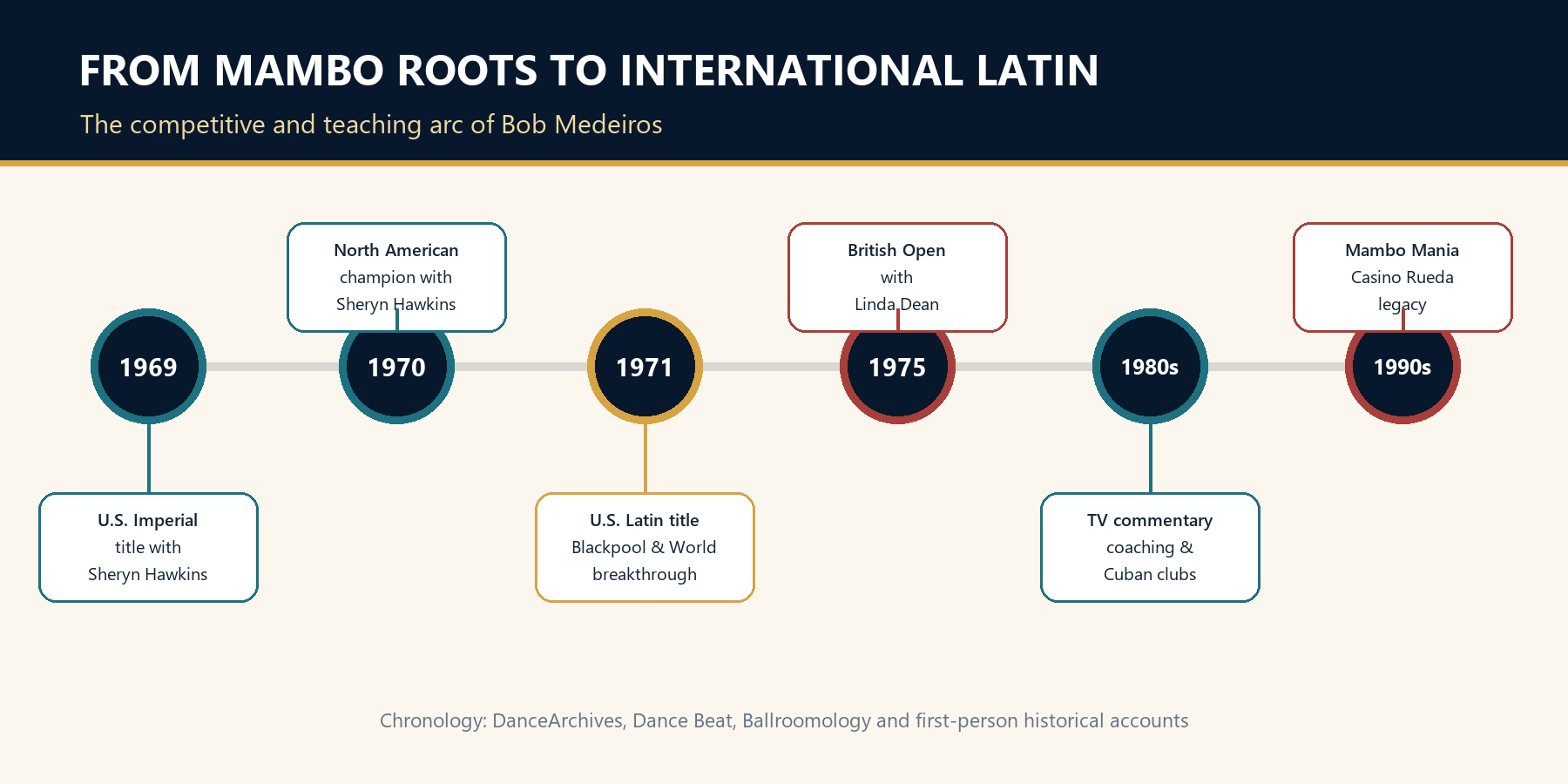
Their first International Style Latin competition is recorded in Atlantic City in 1969. That same year, according to Dance Beat’s history of the Medeiros Memorial Medal, the pair won the United States Imperial Championships. Medeiros kept that medal for the rest of his life.
They became North American champions in 1970. In 1971, the formal United States championship record lists Bob Medeiros and Sheryn Hawkins as the U.S. Professional Latin champions. Dance Beat places that victory at the inaugural United States Ballroom Championships.
The partnership map is short in years but unusually large in consequence.
It is tempting to describe Medeiros as a lone innovator because the surviving stories concentrate so strongly on his movement. Yet Hawkins was the partner with whom the breakthrough became visible. The look, timing and impact remembered by audiences belonged to a couple.
The Americans arrive at Blackpool
The British Open at Blackpool was more than another competition on the calendar. For American dancers of Medeiros’s generation, it was the floor where a different interpretation of Latin dancing had to meet the establishment on its own ground.
Mayer’s account credits Medeiros and Hawkins as the first American couple to make the British Open Professional Latin final. Her chronology places them seventh in both the 1971 British Open and the World Championship. The terminology can confuse modern readers because a seventh-place result may be described as a final or an extended final in historical accounts; the important point is that the partnership reached unprecedented territory for an American Latin couple.
They were also invited to perform at the Imperial championship dinner in London—an event Mayer says had previously been restricted to British subjects. That invitation suggests that their importance was recognized even when their dancing challenged local expectations.
Medeiros and Hawkins were not an isolated American curiosity. They were the leading edge of a small cohort whose contrasting approaches made the early 1970s unusually fertile. Sam Sodano and Pat Hogan brought their own competitive strength; Vernon Brock and Beverly Donahue added jazz-stage scale and adventurous choreography. Linda Dean would later dance with both Medeiros and Brock. The partnerships overlapped, learned from many of the same teachers and presented several answers to the same question: how could Americans master International Latin without becoming imitations of British couples?
That context also prevents “American style” from becoming a single vague label. Medeiros’s musical weight was not identical to Brock’s theatrical attack, just as Hawkins, Donahue, Dean and Hogan were not interchangeable partners. What connected the group was their willingness to place recognizably American sources—mambo, club rhythm, Broadway presentation and studio-system versatility—inside an international competitive form.
Ballroom history often frames the encounter as British discipline versus American freedom. The reality was more productive. Medeiros studied the established system, and later accounts describe an exchange with Latin technician Walter Laird. At the same time, he demonstrated that technique did not need to erase the club-born rhythm he already possessed.
The result was not the defeat of one style by another. It was a widening of what International Latin could contain.
Watch Bobby Medeiros and Sheryn Hawkins
Historical ballroom footage can be difficult to identify, and even harder to use responsibly. In this case, the provenance is unusually helpful.
Bonnie Diaz, a dancer whom Medeiros later coached and performed with, obtained his personal Super 8 competition films. Her Ballroomology preservation project had the films digitized, edited and narrated so later dancers could see Medeiros and Hawkins rather than merely read about them.
The preservation story is part of the history. Ballroom careers from this period often survive as scattered results, privately held reels and memories passed between teachers. A commercial broadcast may disappear while a student’s carefully stored film becomes the clearest surviving view of an important partnership. Diaz’s work does more than provide an attractive video for a biography: it restores Hawkins to the screen beside Medeiros and gives modern dancers evidence they can examine for themselves. The footage is presented as an archive, with its age and editing acknowledged, rather than detached from its source and reposted as unexplained spectacle.
Watch Bob Medeiros and Sheryn Hawkins in preserved competition footage on Vimeo.
Personal Super 8 film from the Medeiros archive, digitized and presented by Bonnie Diaz. The video’s privacy settings require viewing it on Vimeo rather than in an embedded player.
A shorter YouTube profile, linked by DanceArchives, places the dancing inside the broader story of “Mambo Bob.”
“Mambo Bob” Medeiros, a short historical video uploaded by Fred Bijster.
The film quality belongs to its era. Watch the relationship to the floor, the body rhythm and the refusal to make every dance look alike. Those are precisely the qualities later dancers remembered.
A second important partner: Linda Dean
Medeiros’s competitive history did not end with Hawkins, and Linda Dean’s did not begin with Vernon Brock.
Mayer’s chronology records Medeiros and Dean placing ninth at the 1975 British Open. That partnership is easy to lose because Dean joined Brock during the same year and went on to win four consecutive U.S. titles with him. It nevertheless matters for both dancers’ biographies.
For Medeiros, the result shows continued international relevance several years after the 1971 breakthrough. For Dean, it adds another chapter to a career that already included American Style and Theatrical titles with George Hendricks before the celebrated Brock partnership.
This is why individual profiles sometimes serve dance history better than couple-only profiles. A partnership is the unit that competes, but a dancer’s artistic education and influence travel from one partnership to the next.
The difference between learning steps and learning to dance
Medeiros became a coach whose influence reached far beyond his own results.
Enio Cordoba’s first-person account of his mentors describes Walter Laird recommending Medeiros. Cordoba found a teacher preoccupied with music and authentic Latin character. Before agreeing to work with him, Medeiros essentially asked whether the goal was learning to dance or merely learning to win. Cordoba chose dancing, and the relationship continued.
The distinction should not be misunderstood as contempt for competition. Medeiros had already won at the highest American level. It was a warning about confusing a result with the art that produced it.
That philosophy survives in stories told by other students as well: the syllabus can organize information, but it cannot supply musical understanding, partnership, instinct or character. Medeiros taught technique as a means of revealing a dance, not as a substitute for one.
From mambo to Casino Rueda
The later Medeiros also connected ballroom to the social Latin world from which much of his dancing had drawn its force.
Cordoba remembers being taken by Medeiros to Cuban clubs in Miami after competitions. In a separate history of the early Los Angeles salsa scene, he credits Medeiros’s Mambo Mania show with introducing Casino Rueda and says Medeiros later taught an early Los Angeles Rueda workshop under the name “Mambo Round.”
That recollection is valuable because it resists the idea that ballroom and social Latin developed in sealed rooms. Medeiros moved between competitive International Latin, American Rhythm, mambo clubs, performance shows and a Cuban social form that would become increasingly visible during the salsa boom.
His career was not a straight journey away from social dance and toward ballroom respectability. It was a repeated journey back to the music.
Television, performance and the public face of Latin dancing
Medeiros also helped translate ballroom for audiences who would never attend Blackpool.
DanceArchives records him appearing as a television commentator with Rita Moreno for the United States Ballroom Championships around the beginning of the 1980s. The surviving still photographs are striking: a champion rooted in mambo appearing beside a major stage and screen performer while explaining ballroom competition to a television audience.
He continued performing into the Mambo Mania era. Diaz’s Ballroomology video collection includes a circa-1992 reel of her performing with Medeiros, near the end of his life. He died in 1993 at fifty-four.
The dates make the scope of the career clear. Medeiros’s influence reaches from the formative years of American International Latin through the period when salsa and related club dances were finding new worldwide audiences.
Bobby Medeiros in the Dance Forums archive
Dance Forums began a decade after Medeiros died, yet members repeatedly invoke him when discussing questions that remain unresolved in ballroom dancing:
- In a 2005 International Style discussion, a teacher credited Medeiros with teaching the practical difference between American and International Latin action.
- A 2013 U.S. championship conversation remembers the clarity with which he differentiated the dances and the sabor he brought before taking a step.
- In a 2016 discussion of hip-lift technique, a member connected Medeiros’s Blackpool demonstration with the early British encounter with American Rhythm.
- A detailed 2018 Cuban-motion thread returns to the reported praise Medeiros received from British commentator Peggy Spencer.
- In 2019, members debating why salsa is not part of competitive Latin or Rhythm again used Medeiros’s mambo as evidence of how social forms can challenge ballroom categories.
These posts contain memories, opinions and approximate dates. They are not official results, and they sometimes disagree about the exact year of a demonstration. Their historical value is different: they show what working dancers continued to remember and which technical debates kept Medeiros’s name alive.
The medal that keeps the story in motion
Medeiros’s legacy is not preserved only in articles and old film.
The first-place medal he and Hawkins won at the 1969 United States Imperial Championships later became the Bob Medeiros Memorial Professional Latin Medal. It is awarded to the winning professional Latin couple at DBDC—A Legendary Celebration in Boston.
The object creates a direct line from Medeiros and Hawkins to dancers competing generations later. More importantly, the award’s stated ideal is not mere continuity. It celebrates American-influenced, internationally competitive Latin dancing—the synthesis Medeiros helped make possible.
Why Bob Medeiros still matters
Bob Medeiros did not become historically important by collecting the longest list of national titles. He won one U.S. Professional Latin championship.
He matters because that title sits inside a larger change. With Sheryn Hawkins, he showed that an American partnership could reach the top international field without sanding away its rhythmic identity. With Linda Dean, he continued that conversation across another partnership. As a coach, he pushed students toward music and authenticity. In clubs and shows, he kept ballroom connected to mambo and Cuban social dancing.
That is a different kind of championship legacy. It is measured in the range of movement that later dancers considered possible.
Media and research note
This profile uses preserved video supplied through the Medeiros–Diaz archive and a linked historical video rather than copying copyrighted photographs from other publications. The article’s graphics are original, non-portrait designs; no synthetic face is presented as Medeiros, Hawkins or Dean.
Competition dates and placements are cross-checked against the formal U.S. championship record and Brigitt Mayer’s published chronology. Dance Beat, Ballroomology and first-person accounts from Bonnie Diaz and Enio Cordoba provide context about performance, coaching and legacy. Dance Forums posts are explicitly identified as community recollections rather than treated as official documentation.