

Emeline Rochefeuille and the Art of Modern West Coast Swing
Some dancers are remembered first for their titles. Others are remembered for a single performance that travels through the dance world online. Emeline Rochefeuille belongs to a rarer group: dancers whose movement language becomes recognizable almost immediately.
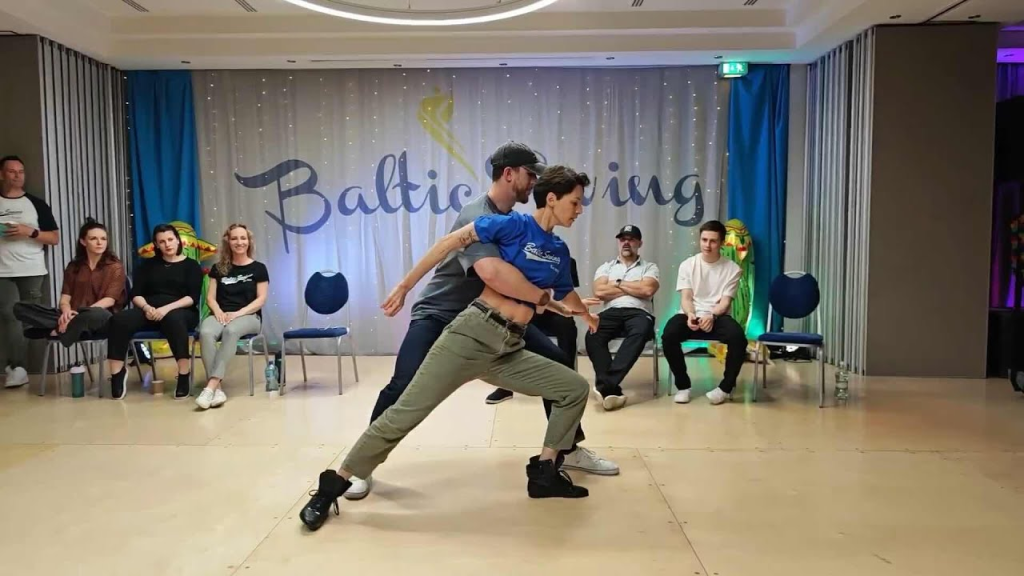
In modern West Coast Swing, Rochefeuille has become a reference point for fluidity, musical listening, and full-body expression. Her dancing can be soft without becoming vague, athletic without becoming stiff, and theatrical without losing the feel of partner conversation. That combination is a big reason dancers keep coming back to her videos, not just to admire them, but to study how she hears music.
From Réunion to West Coast Swing
Rochefeuille’s own biography on the J’Em website places her early life far from the usual American swing-dance map. She spent her first 17 years on Réunion, a French island in the Indian Ocean, where music and dance were part of everyday culture. The J’Em bio names Séga, Maloya, and Zouk among the rhythms that surrounded her as a child.
Her formal dance training began early as well. At age 12 she entered the competitive dance world through ballroom at Verodanse Studio, with a particular focus on Solo Latin. That background still matters when you watch her West Coast Swing. The articulation through her torso, hips, arms, and head is not decorative afterthought; it is part of how the dance is built.
West Coast Swing entered the picture in 2009, while she was studying sociology and anthropology. After seeing Jordan Frisbee and Tatiana Mollmann on video, she took an introductory class in Montpellier and quickly became involved in the local WCS scene. Her biography credits the Mad Swingers association, Jérôme Fernandez, and Maxence Martin as important parts of that development.
For a while, dance and professional life ran side by side. Rochefeuille worked as a research executive in advertising at Ipsos Paris while also competing, teaching, deejaying, photographing, and traveling for dance. By the end of 2016, that balance had shifted toward a full-time dance life.
The J’Em Partnership
The partnership with Jakub Jakoubek is central to Rochefeuille’s public artistic identity. According to the J’Em story, the two first met at Westie On The Promenade in 2015, but the decisive moment came later, at Budafest in January 2016. A shared dance there felt different enough that it became the beginning of a deeper creative connection.
By June 2016, they were hired together for a styling workshop weekend in Budapest. The students noticed the chemistry and encouraged them to form a partnership. In January 2017, at Budafest, J’Em was officially announced.
Their early routine to “Chandelier” helped establish them internationally, but what makes the partnership compelling is larger than one routine. J’Em’s work moves across teaching, choreography, improvisation, performance, judging, and deejaying. Their teaching description emphasizes comfort, confidence, curiosity, movement exploration, and joy, all of which are visible in the way they dance.
What Makes Her Dancing Distinctive
Rochefeuille is often described as musical, but that word can become too small. Her musicality is not only about hitting accents or pausing on breaks. It is about texture. She seems to notice whether a sound asks for stretch, rebound, suspension, collapse, breath, or sharpness. The result is dancing that can feel composed even when it is improvised.
Her movement also shows how wide the modern West Coast Swing vocabulary has become. A CopperKnob profile describes Rochefeuille and Jakoubek as movement artists shaped by influences including contemporary, modern, urban dance, Zouk, and contact improvisation. Those influences help explain the spirals, off-axis shapes, soft redirects, and sculptural moments that often appear in her dancing.
That fusion is also why she can be so interesting to discuss. For some dancers, she represents the expressive future of West Coast Swing. For others, she raises questions about where WCS ends and adjacent movement languages begin. Either way, her dancing makes the conversation concrete. You can see the debate in the body, not only in words.
Competition, Improvisation, and Artistic Range
Rochefeuille’s artistic reputation is supported by serious competitive credentials. At The Open Swing Dance Championships in 2024, Jakub Jakoubek and Emeline Rochefeuille won the Classic Routine Division, and Rochefeuille also placed third in Champion Jack & Jill with Sean McKeever.
Those two formats show different sides of the same dancer. A Classic routine can be shaped, rehearsed, revised, and polished until every phrase has a clear arc. A Champion Jack & Jill asks for a different kind of mastery: immediate adaptation to a partner, a song, and the moment. Rochefeuille’s appeal comes partly from the way she can bring artistry into both settings.
The same quality appears in widely shared social and Jack & Jill clips. A Dance Forums discussion of a Budafest “Macarena” Jack & Jill with Jordan Frisbee captures why she catches people’s attention. Even music that could become a novelty can become a playground for timing, humor, and interpretation.
Why Dancers Study Her
For followers, Rochefeuille is a study in active responsiveness. She does not appear to wait for the dance to happen to her. She receives information, redirects it, colors it, and completes it with her own timing and tone. The useful lesson is not to copy her shapes exactly. It is to develop enough balance, mobility, and listening that personal choices can emerge without fighting the partnership.
For leaders, watching her is just as valuable. Her dancing rewards space, patience, and musical generosity. High-level West Coast Swing is not a monologue delivered through patterns; it is a responsive conversation. Rochefeuille makes that visible because her best moments often happen when the lead gives the dance enough air.
For social dancers in general, the deeper lesson may be attention. She appears to notice the breath before a lyric, the length of a note, the silence after an accent, and the shift between groove and melody. That kind of musicality is not a trick layered on top of the dance. It is the dance.
Beyond One Category
Rochefeuille’s work also reaches beyond West Coast Swing competition. CopperKnob lists her as a line dance choreographer, and the J’Em media page includes routines, improvisations, short dance films, collaborations, music videos, and special-event performances. That broader creative world helps explain why her WCS often feels cinematic. She is not only executing a dance form; she is shaping an image, an atmosphere, and an emotional arc.
Why She Matters
Emeline Rochefeuille matters to modern West Coast Swing because she shows how expressive the dance can become while still depending on partner connection. She stands at the intersection of competition, improvisation, fusion, and performance. That position makes her inspiring, but it also makes her useful. She gives dancers something specific to watch when they are asking what musicality, styling, and conversation can look like at a high level.
Not every West Coast Swing dancer will want to move the way she moves. That is fine. The point is not imitation. The point is possibility. Rochefeuille reminds us that technique is not only footwork, timing, and connection. It is also the ability to make the whole body available to music.