

María Nieves: The Dancer Who Helped Take Argentine Tango to the World
From the neighborhood clubs of Saavedra to Broadway, María Nieves made tango history through musical instinct, force of personality and an unmistakable partnership
When María Nieves died on April 19, 2026, the Dance Forums memorial thread did more than record the death of a famous performer. Members immediately returned to the movement that had helped ignite the modern worldwide Argentine tango boom—and began debating how that movement looks to dancers today.
That response is appropriate. Nieves was never merely a name in a cast list. She learned in Buenos Aires social clubs, developed one of tango’s defining twentieth-century partnerships, reached American television and Broadway, survived an extraordinarily difficult personal and professional separation, and remained a vivid public presence into her late seventies and eighties.
Dance Forums’ comprehensive history of Argentine tango explains the much larger social, musical and political story. This profile brings the focus to one dancer within that history—and treats her as an artist in her own right, not simply as the woman beside Juan Carlos Copes. The companion profile of Juan Carlos Copes examines his separate development as a dancer, choreographer and teacher.
At a glance
| Full name | María Nieves Rego |
| Born | September 6, 1934, Saavedra, Buenos Aires |
| Died | April 19, 2026, age 91 |
| Formative dance world | Neighborhood clubs and milongas in Buenos Aires |
| Defining partnership | Juan Carlos Copes, beginning when they were teenagers |
| Broadway credits | New Faces of 1962; Tango Argentino in 1985 and its 1999 revival |
| Also known for | Tanguera, Assassination Tango, Our Last Tango and the 2011 Buenos Aires revival of Tango Argentino |
| Signature legacy | A powerful, musical and individual model of the female tango dancer on the international stage |

A childhood in Saavedra
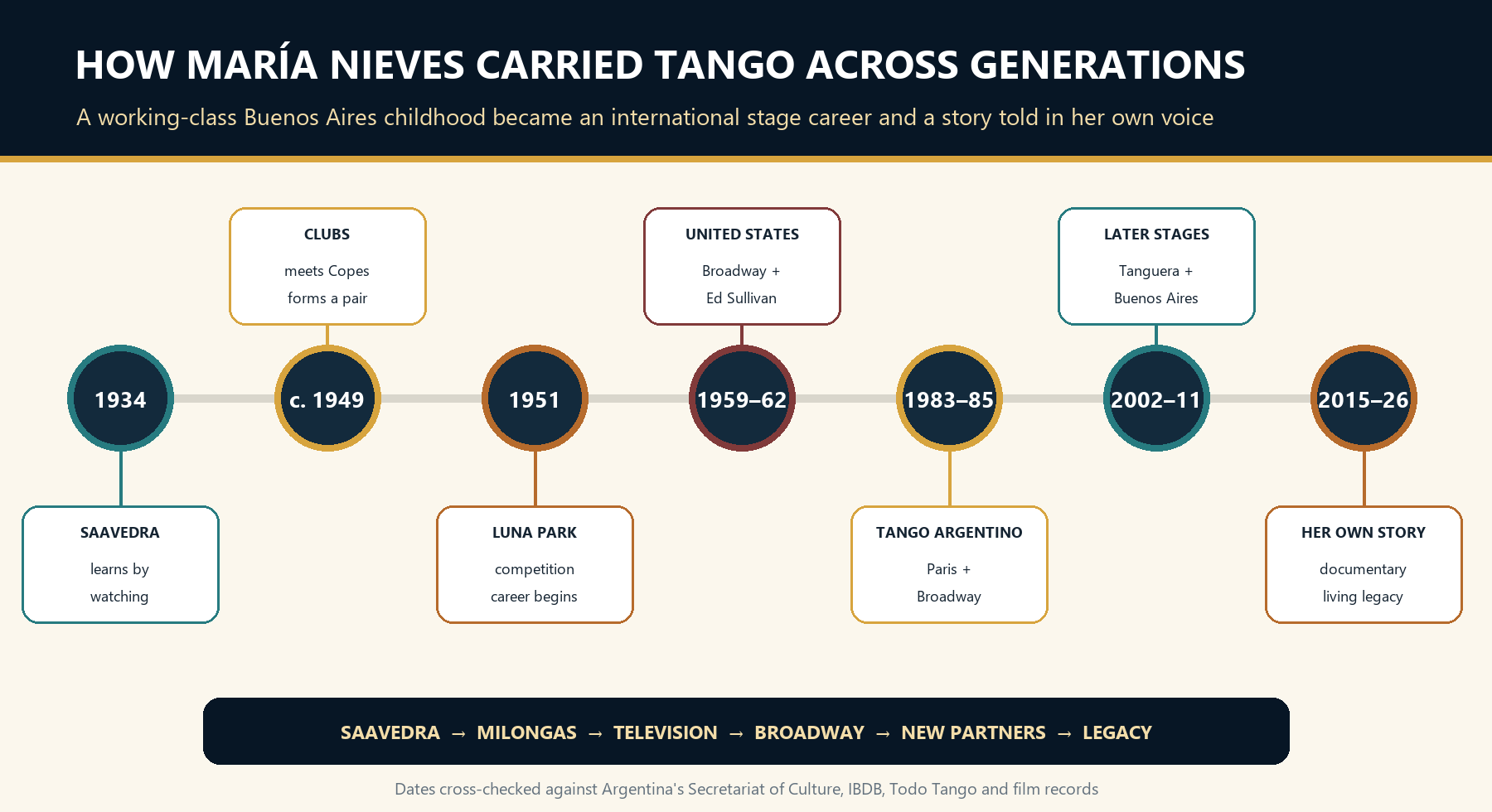
Nieves was born to a poor family of Galician immigrants in Saavedra, a working-class neighborhood of Buenos Aires. The polished international performer came from circumstances with little polish and very little security.
In a long 2003 interview preserved by Todo Tango, she described leaving school after her father died and working as a live-in domestic servant while still a child. She also remembered hearing tango constantly on the radio and turning household objects into partners for her rhythmic imagination.
Her formal education was short. Her dance education was not. An older sister brought her into the orbit of Club Atlético Platense, and Nieves learned by watching experienced dancers. She studied how people walked, waited, shifted weight and answered an orchestra. By the time she began dancing publicly as a teenager, she had already spent years absorbing the form.
This matters because biographies often describe great dancers as if talent arrived fully formed. Nieves’s “natural” musicality was built through attention. The clubs were classrooms without diplomas, and the other social dancers were teachers whether or not they used that title.
Meeting Juan Carlos Copes
Nieves met Juan Carlos Copes when she was about fifteen and he was seventeen. They began dancing in clubs including Atlanta, All Boys, Mariano Moreno, El Pañuelito and Sin Rumbo. She danced for pleasure. Copes already imagined a professional future.
Their differences helped produce the partnership. Copes was analytical, ambitious and increasingly interested in choreography. Nieves was instinctive, fiercely musical and capable of making a planned sequence look emotionally immediate. The pair won a major competition at Luna Park in 1951, reportedly against hundreds of couples, and moved from neighborhood recognition toward cabaret and theater work.
The phrase “Copes and Nieves” became a single international brand, but it should not erase the two artists inside it. Even the forum’s discussion of how Nieves shaped the look of a boleo shows dancers noticing a contribution that cannot be described only as obedience to a lead.
Tango partnership is coordinated, but coordination is not anonymity. Nieves supplied timing, balance, line, attack, restraint and character. Copes could build the structure; she made audiences feel the life inside it.
Following was never passive
The older stage language around tango often assigns the man intention and the woman decoration. Nieves’s dancing resists that simplification. Her feet could be precise without becoming delicate in the weak sense of the word. She projected decisions through the partnership, and her pauses had as much personality as her rapid footwork.
Dance Forums members still argue about the vocabulary of active following and the gendered image of tango. Our Last Tango appears in that discussion because the film makes the power relationship impossible to ignore. The couple’s movement depended on two people; their public story was often narrated through one man’s ambition.
It is equally important not to force present-day technique onto historical bodies. In a forum thread about examples of good tango posture, members note the bent knees and changing vertical action in Copes and Nieves footage. What reads as dated to one contemporary viewer may have been dramatically modern in its own theatrical moment.
Historical film is evidence, not a universal rulebook. Nieves’s achievement was not that every dancer should copy her silhouette. It was that her body made a particular musical and theatrical argument with complete conviction.
New York, Broadway and American television
After work in Latin America, Copes and Nieves reached the United States in 1959. Their first Broadway production was the short-lived revue New Faces of 1962, where the official Broadway archive credits Nieves in several ensemble roles as well as a dancer.
They also appeared on The Ed Sullivan Show. For American viewers who knew tango through ballroom conventions or movie parody, the pair offered something sharper, faster and more grounded in the Buenos Aires performance tradition. Their television work placed Argentine dancers inside one of the largest mass-media showcases of the period.
Dance Forums’ Copes memorial thread points readers directly to their surviving 1962 Ed Sullivan footage. The clip is short, but it captures an important transition: movement formed in clubs had been condensed for a television camera and a national audience.
Watch Copes and Nieves on The Ed Sullivan Show
Notice the speed, low center, sharp changes of direction and sense of forward momentum. This is a staged number, not a sample of ordinary floorcraft at a crowded milonga. The performance is best read as a demonstration of how the pair translated tango for the medium in front of them.
Juan Carlos Copes and María Nieves on The Ed Sullivan Show in 1962. Embedded for historical study; Dance Forums does not claim ownership of the broadcast.
The clip is also a reminder that the pair’s American breakthrough did not begin with Tango Argentino in the 1980s. They had already worked in New York theater and television two decades earlier. The later boom expanded a path they had been building for years.
Tango Argentino and the worldwide revival
The pivotal production was Tango Argentino, conceived and directed by Claudio Segovia and Héctor Orezzoli. It opened in Paris in 1983 with singers, musicians and multiple dance couples representing different approaches to the form. Copes and Nieves were central figures, but the show’s power came from an ensemble that included Virulazo and Elvira, Nélida and Nelson, Gloria and Eduardo Arquimbau, the Dinzels, the Mayorals, the Rivarolas and others.
The Broadway production opened at the Mark Hellinger Theatre on October 9, 1985, and ran for 199 performances. The official Broadway production record lists Nieves in the opening-night cast and records Tony nominations for Best Musical, Best Direction and Best Choreography. The choreography nomination named the company’s dancers, a useful recognition that the movement did not emerge from one hand alone.
The timing mattered. Argentina’s military dictatorship had ended in 1983. International audiences were newly encountering living performers whose work was more diverse than the tidy tango images exported by earlier popular culture. Touring productions made people want to learn, and local practice groups, teachers and milongas followed.
Dance Forums members discussing the modern European tango boom remember dancers reconstructing movement from photographs and analog video after the touring shows arrived. Another history thread distinguishes that late-century revival from the first international tango craze of the early 1900s.
It would be too simple to say that one show single-handedly revived tango. Musicians, milongueros, emigrant communities, teachers, political change and other stage companies all mattered. But Tango Argentino supplied a spectacular ignition point, and Nieves was one of the people audiences remembered.
A famous partnership with a painful private history
Copes and Nieves married in Las Vegas in 1964. The marriage ended in 1973, but the professional partnership continued for more than two decades. They separated as a dance couple in the 1990s after nearly half a century of work together.
Retellings sometimes romanticize the hostility between them as fuel for great art. That makes a dramatic story, but it can flatten Nieves’s experience. Their shared achievement was real. So were betrayal, emotional injury and a professional structure in which leaving could mean surrendering the career they had built.
The Dance Forums discussion of Our Last Tango among tango films recognizes that the documentary is not simply a highlight reel. The memories are contradictory and painful. The film gives both dancers room to speak, but Nieves’s testimony is especially important because public histories so often centered the choreographer.
The artistic lesson is not that destructive relationships are necessary for intensity. It is that two people can create extraordinary work while experiencing the partnership very differently—and a responsible biography must hold both facts at once.
María Nieves after Copes
Nieves’s career did not end when the defining partnership did. In 2002, she appeared as the madam in the Buenos Aires musical Tanguera. Her Todo Tango interview from that period presents an artist fully capable of narrating her own life, tastes and survival.
She also appeared in Robert Duvall’s Assassination Tango. Dance Forums members have debated the film since the site’s earliest year, often finding the real dancers more compelling than the fictional drama. A 2003 thread remembers seeing Geraldine Rojas dance socially and discusses Nieves’s film world by contrast. That kind of conversation is valuable: film can introduce viewers to tango, but it cannot replace the social culture.
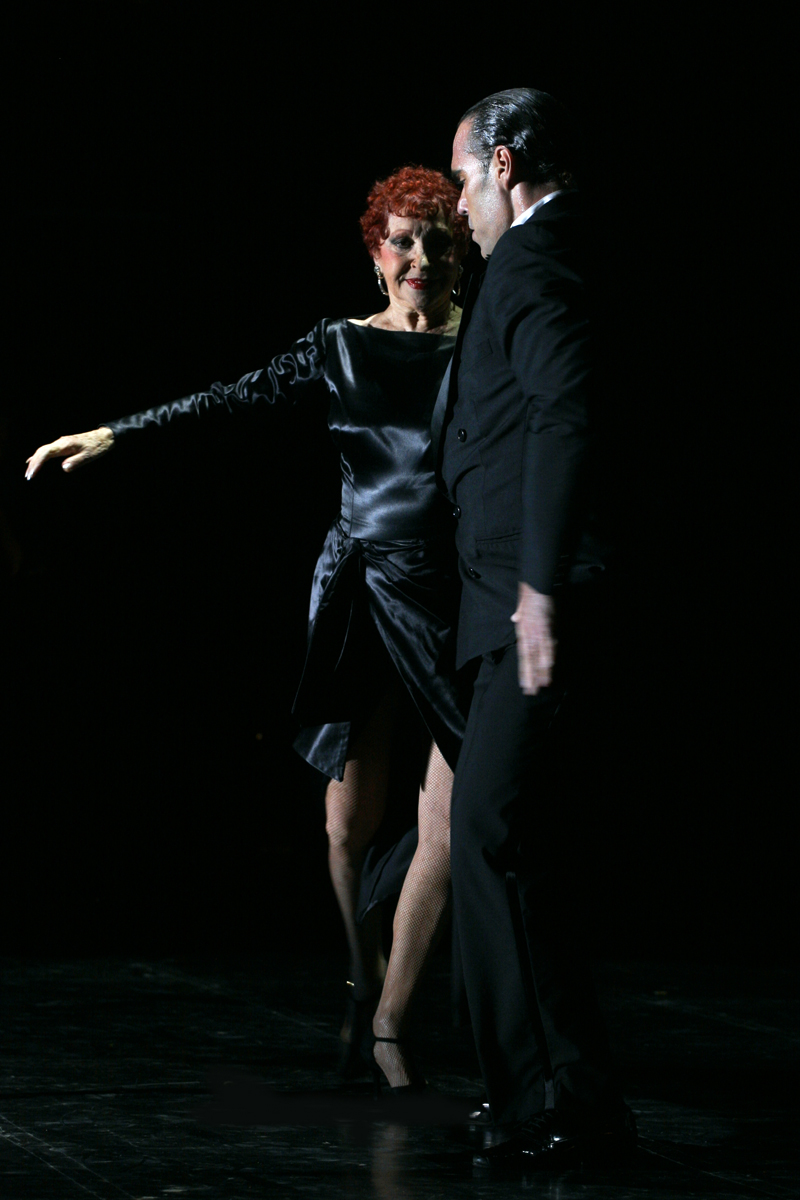
In 2011, Nieves returned to Tango Argentino for a large public performance at the Obelisk in Buenos Aires. Argentina’s official national tribute records an audience of more than 15,000 and describes the ovation she received. She danced with Junior Cervila, demonstrating again that her public identity was not locked to one partner.
Watch María Nieves in Buenos Aires in 2011
This performance is particularly useful beside the 1962 television clip. Nearly fifty years have passed. The speed and scale have changed, but her ability to organize attention through posture, timing and character remains.
María Nieves and Junior Cervila in the 2011 Buenos Aires presentation of Tango Argentino. The licensed photograph above records the same production.
The value of the clip is not nostalgia for a vanished golden age. It shows an older female dancer commanding a vast stage without disguising age or imitating a younger body. That visibility is itself part of her legacy.
Our Last Tango and the right to tell the story
German Kral’s 2015 documentary Our Last Tango combines interviews, archival footage and dramatized reconstructions by younger dancers. The Yamagata International Documentary Film Festival catalog describes it as a record of a fifty-year history of love and conflict; Film at Lincoln Center calls Copes and Nieves perhaps the most famous couple in tango history.
The film should not be treated as neutral chronology. Memory is selective, reconstruction is interpretation, and a beautifully photographed sequence can make an argument without stating it. Its importance lies in allowing the dancers’ incompatible experiences to remain visible.
Dance Forums members discussing the film as a language-learning resource describe laughing and crying as the interviews, reenactments and vintage film connect movement to embodied memory. That response explains why the documentary belongs in a dancer profile: the biography is not merely what happened. It is also how a person understands what dancing did to her life.
Official U.S. trailer for Our Last Tango, released by Strand Releasing.
María Nieves in the Dance Forums archive
The forum archive does something a conventional biography cannot: it shows dancers testing a historical reputation against technique, films and their own bodies.
- The 2026 María Nieves memorial thread records her death and immediately opens a discussion about the style that fueled the international boom.
- The Juan Carlos Copes memorial preserves a detailed account of their partnership and points to the 1962 television footage.
- A discussion of good posture uses Copes and Nieves to show that ideals change across styles and decades.
- A thread about lead and follow invokes Our Last Tango while questioning passive images of the follower.
- The tango-movie thread places the documentary among the films through which dancers encounter tango history.
- A member watching Our Last Tango in Spanish describes the physical recognition produced by its movement and memories.
- The early-tango-craze discussion distinguishes the early twentieth-century vogue from the revival sparked by later touring shows.
- A thread on tango’s European growth links Tango Argentino to the practice groups and communities that appeared after it.
- A technical conversation about enrosques, boleos and historical vocabulary singles out the grace Nieves brought to movement.
- A debate over tango and ballet uses her body to question the increasingly balletic look of stage tango.
Forum posts are not automatically historical proof. Their special value is that they preserve reception: what dancers noticed, disputed, remembered and tried to understand.
Why María Nieves still matters
María Nieves helped make Argentine tango internationally visible, but visibility alone is not her full legacy. She demonstrated that the follower’s role could be forceful without becoming crude, theatrical without losing musical detail, and collaborative without disappearing into the leader’s biography.
Her life also exposes the structures around performance. A girl who left school and entered domestic work became a Broadway dancer and an emblem of Argentine culture. Yet professional success did not erase economic origins, gendered power or personal pain. Those facts belong beside the ovations.
Most of all, Nieves remained recognizable. Across different partners, decades and stages, she did not become a generic image of “the tango woman.” Her attack, stillness, wit and survival made the role specific.
That is why she deserves a separate article. “Copes and Nieves” names a historic partnership. María Nieves names an artist.
Media and research note
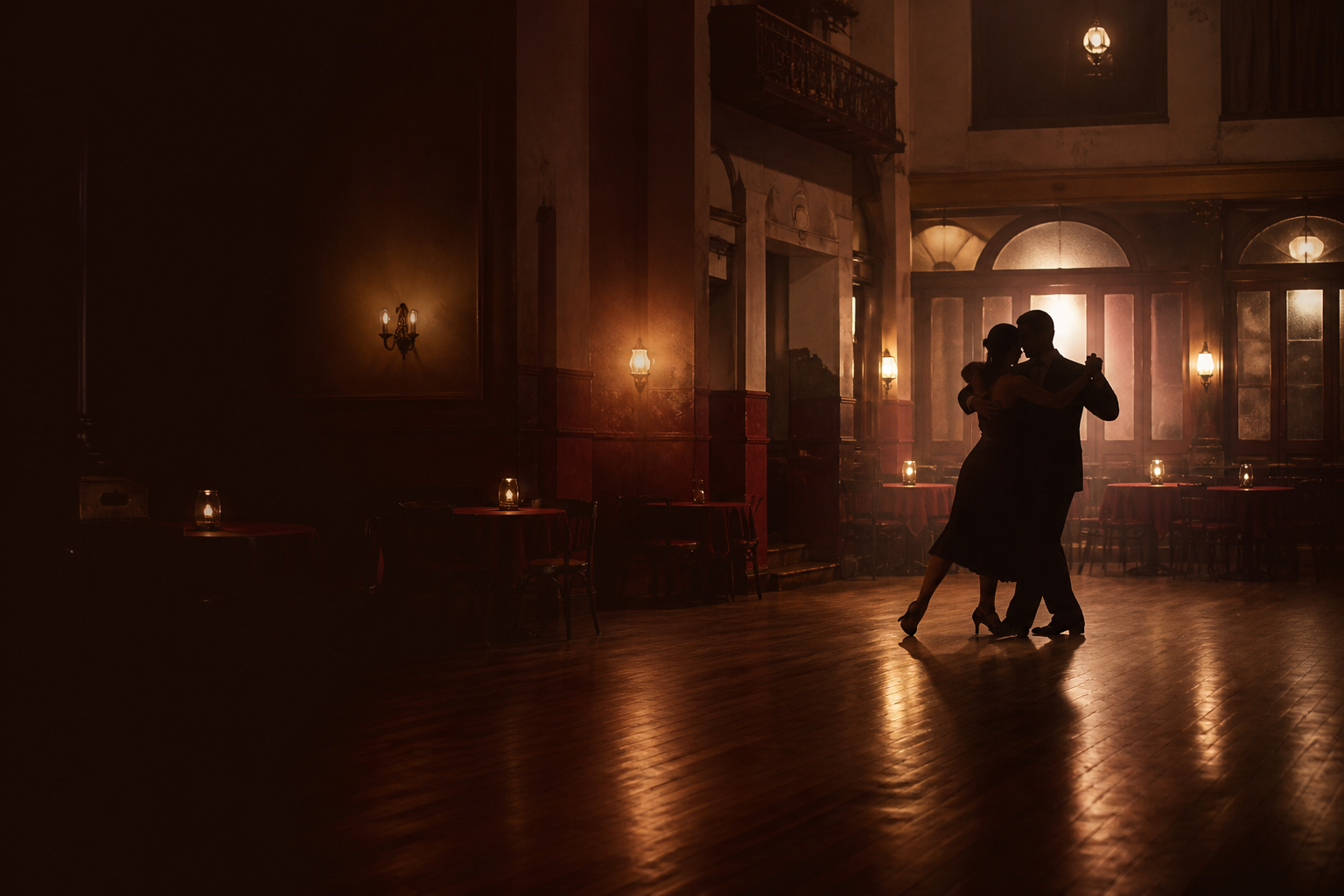
The featured image is an original, portrait-free editorial scene with anonymous silhouettes. It does not present a synthetic face as María Nieves, Juan Carlos Copes, Junior Cervila or any other real dancer. The inline 2011 performance photograph is a real image by Estrella Herrera for the Government of the City of Buenos Aires, available through Wikimedia Commons under CC BY 2.0; its source and license are linked in the caption.
Biographical facts were cross-checked against Argentina’s Secretariat of Culture, the Internet Broadway Database, a contemporary Todo Tango interview, official festival records and the documentary’s distributor and festival materials. Dance Forums links are treated as community commentary and research leads, not as the sole authority for dates or credits.