

Argentine Tango Glossary: Essential Terms for the Dance Floor and Milonga
From abrazo and cabeceo to sacada and tanda—plain-English definitions, practical cautions and discussions from the Dance Forums community
Argentine tango has a vocabulary problem and a vocabulary advantage. The problem is that teachers, cities and generations do not always use the same word in exactly the same way. The advantage is that every disagreement opens a door into how dancers actually understand the embrace, the music and the social floor. Dance Forums has preserved those conversations for more than two decades—from “Cabeceo and Other ‘Rules’” to detailed debates about teaching musicality.
This glossary is therefore not an official syllabus. It is a practical guide to words you are likely to hear in a class, práctica or milonga, with direct links to discussions where dancers test the terms against experience. Our history of Argentine tango supplies the larger story; the entries below help decode what people say once the music starts.
Ten terms every new tango dancer should know
| Term | Quick meaning |
|---|---|
| Milonga | A social tango event; also a musical genre and the dance done to it |
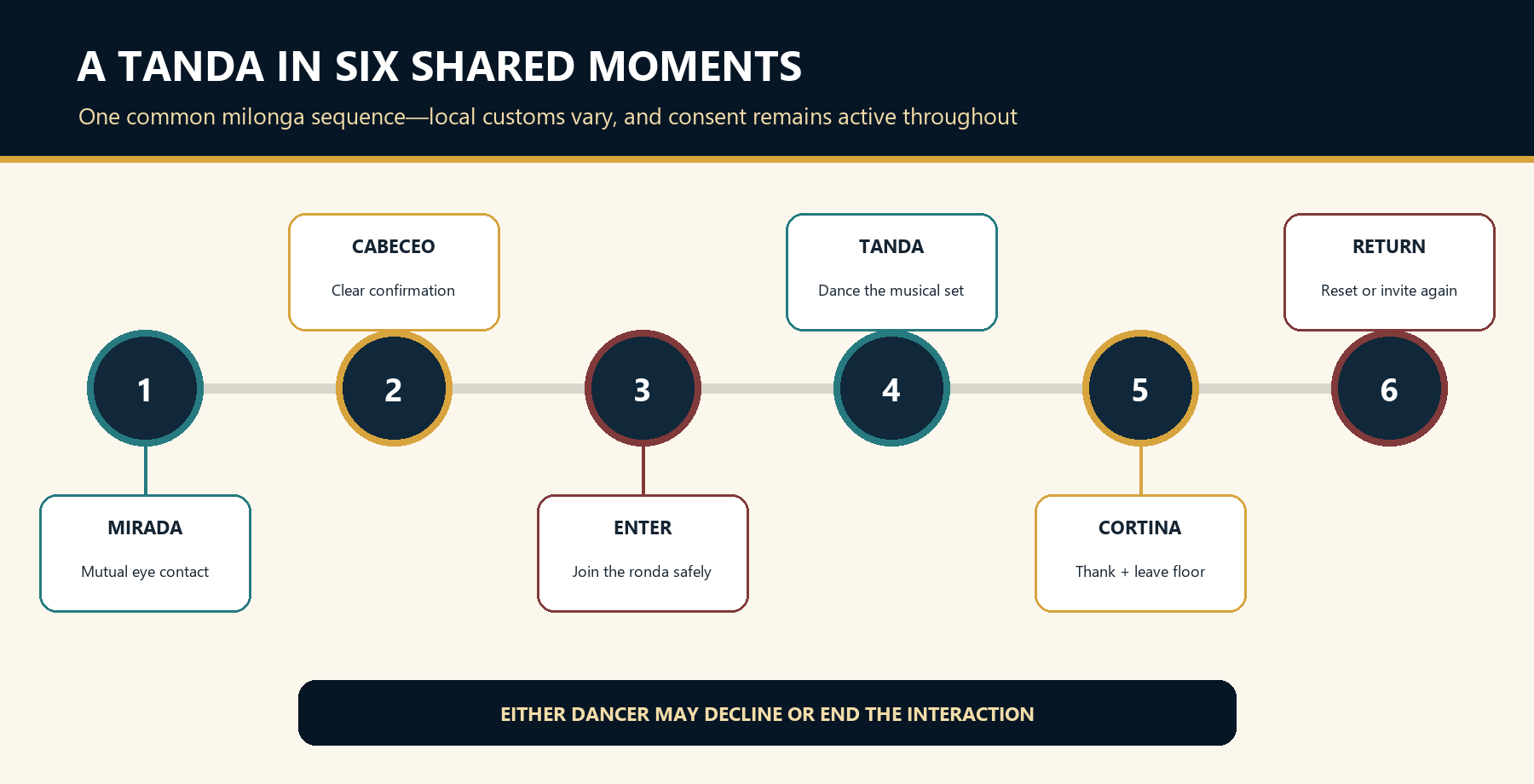
| Tanda | A set of usually three or four related songs danced with one partner |
| Cortina | A short musical break separating tandas |
| Mirada | Eye contact used to propose or invite an invitation |
| Cabeceo | The confirming nod or head gesture used with the mirada |
| Abrazo | The embrace or physical relationship of the partnership |
| Ronda | The counterclockwise circulation of couples around the floor |
| Ocho | A pivoting forward or backward step whose path suggests a figure eight |
| Giro | A turn, often with one partner traveling around the other |
| Sacada | A spatial exchange that creates the appearance that one leg displaces another |
Knowing the words does not mean you are expected to perform every figure. At a social milonga, a comfortable embrace, clear walking, musical listening and considerate navigation matter more than collecting vocabulary.
Social customs and the room
Milonga
Milonga has at least three common meanings. It can mean the social event where people dance tango, vals and milonga; the faster, rhythmically distinct musical genre; or the dance response to that music. Context tells you whether someone is “going to a milonga” or “dancing a milonga.” The thread “Dancing Tango to Milonga and Vals” explores how one movement vocabulary changes with three musical worlds.
Práctica
A práctica is a practice gathering. Unlike a formal class, it may have no shared lesson; unlike a milonga, stopping to repeat, discuss or troubleshoot is normally acceptable. Some prácticas are structured and teacher-led, while others resemble relaxed social dances. Ask about the local format rather than assuming that every práctica has the same rules.
Tanda
A tanda is a group of related recordings played together, commonly three or four songs by the same orchestra, period or musical character. Partners traditionally stay together for the full set, although consent and comfort always outrank custom. Compare the long-running “Tanda Etiquette” discussion with the more critical question “What is tango doing wrong: tandas?”. The disagreement is part of the culture, not a glossary error.
Cortina
A cortina—literally “curtain”—is a short piece of non-tango music between tandas. It tells dancers that the set has ended and gives them time to thank one another, leave the floor and seek another partner. DJs may use funny, dramatic or thematically linked snippets. Dance Forums members have traded ideas in “Music for Cortinas” and debated the custom in “Tandas and cortinas”.
Mirada
The mirada is the look: eye contact used to explore whether another person wants to dance. It allows either person to decline by looking away and can reduce the public awkwardness of a verbal refusal. It also becomes difficult in poorly lit rooms, awkward seating or at long distances. The forum asks exactly that practical question in “Optimal and Minimum Mirada/Cabeceo Distance and Angle?”.
Cabeceo
The cabeceo is the head gesture that confirms an invitation after mutual eye contact. Outside Buenos Aires, dancers often use “cabeceo” for the whole mirada–cabeceo exchange. It is a consent system only when both people communicate clearly; a stare, assumption or walk across the room is not acceptance. Forum members examine local variation in “How necessary is the cabeceo in your area?” and challenge rigid formulations in “Cabeceo and Other ‘Rules’”.
Códigos
Códigos are the social conventions of a milonga: how invitations work, when couples enter the floor, how the ronda moves, whether partners dance an entire tanda and how people leave the floor. They are practices, not one universal statute book. A traditional Buenos Aires venue, a queer tango event and a small studio night may share values while expressing them differently. The archive’s “Understanding codigos” and “Codigos—which are universal?” make that diversity visible.
Ronda and line of dance
The ronda is the circulating line of couples, normally moving counterclockwise around the room. Large floors may develop outer and inner lanes. Leaders are expected to enter safely, advance with the flow and avoid unpredictable lane changes or long backward travel against traffic. In “Floorcraft—leaving space behind a leader?”, dancers analyze how individual spacing decisions affect everyone nearby.
Floorcraft
Floorcraft is the skill of improvising safely inside the ronda. It includes awareness, step size, lane discipline, pausing without blocking and choosing movements appropriate to the available space. Good floorcraft is not merely a leader’s private technique: followers can sense danger, decline unsafe movement and help keep the couple compact. A crowded floor is not the place to prove that a high boleo is technically possible.
Tango DJ or TDJ
A tango DJ, sometimes shortened to TDJ, builds tandas and cortinas, manages energy across the evening and helps dancers recognize coherent musical choices. The role is more than pressing play. A good set balances familiarity, contrast, sound quality, room response and the three social genres.
Connection, posture and movement foundations
Abrazo
Abrazo means embrace. In tango it describes a responsive partnership rather than one frozen frame. The embrace may be close, open, parallel, offset or changing, depending on anatomy, comfort, music and movement. It should permit breathing, balance and communication without squeezing or hanging. Two useful forum discussions are “Abrazo—the Embrace” and “What are the technical elements of a pleasant embrace?”.
Connection
Connection is how partners exchange information through the embrace, timing, balance, tone and attention. It is not simply chest contact or arm pressure. Dancers use the word for both mechanics and the subjective feeling that a dance has become unusually coherent. That double meaning is why “The tango connection” ranges from technique to experience.
Axis or eje
The axis—eje in Spanish—is the organization of balance through the standing body. Most social tango asks each partner to maintain a usable individual axis even while the couple communicates closely. Colgadas and volcadas intentionally create off-axis relationships, but “off-axis” should not mean collapse. The thread “Axis and Balance” shows how quickly a simple definition becomes a practical debate.
Weight change
A weight change transfers support from one foot to the other. It may travel through space or happen almost in place. Because tango is improvised, both partners must know which leg is free without looking down. Many apparent “steps” are combinations of direction, pivot and weight change rather than memorized shapes.
Caminata or tango walk
Caminata means walking. Teachers often call the walk tango’s foundation because it reveals posture, projection, timing, balance, embrace and floorcraft at once. There is no single theatrical “tango walk” that every body must copy. Compare the foundational discussion “Tango Walks” with the stylistic images in “Man’s Walk: Porteños and Panthers”.
Cadencia
Cadencia can refer to rhythmic cadence, grounded pulse or a characteristic expressive quality in walking. Teachers use it differently, so ask what action they mean rather than treating the Spanish word as a complete technical explanation. In practice it usually directs attention away from merely arriving at a position and toward how weight moves through music.
Disassociation
Disassociation is relative rotation among the torso, pelvis and direction of travel. It helps create pivots, turns and walking outside the partner without forcing the arms. Some teachers prefer “torsion” or “spiral,” and bodies have different comfortable ranges. The goal is organized movement, not maximum twist.
Parallel and cross systems
In parallel system, partners change onto opposite-named feet together: one is on the left while the other is on the right. In cross system, they are on the same-named foot. A leader can change systems with an extra weight change, a crossed step or by letting one partner change while the other does not. The terms are analytical tools, not separate dances.
Salida
Salida literally means exit or departure and can describe the beginning of a movement. Many schools use it for the opening of an eight-count basic sequence, but social tango does not require that fixed pattern. The aptly named “Salida or not?” captures the long argument over whether a teaching sequence should be mistaken for tango’s universal basic.
Cruzada or the cross
Cruzada means crossing. In the most familiar teaching example, the follower crosses the left foot in front of the right, but crosses can occur for either role, in either direction and in many contexts. The cross is an organized response to direction, rotation and available space—not a position to force with the arms. See “Walking to the Cross (Cruzada)” and “The lead for the cruzada”.
Pivots, turns and traveling figures
Ocho adelante and ocho atrás
An ocho combines a pivot with a forward or backward step so that repeated movements trace a figure-eight-like path. Ocho adelante is forward; ocho atrás is backward. The free leg follows the body’s organization rather than being swung independently. Dancers compare pivot size, alignment and embrace in the long-running “Ocho technique” thread.
Ocho cortado
Ocho cortado means “cut” or interrupted ocho. The name commonly describes a compact rebound and cross used comfortably in close embrace and crowded spaces, but teachers may organize or count it differently. The Dance Forums Ocho Cortado thread is a useful reminder that even a familiar named figure contains choices.
Giro and molinete
Giro means turn. Molinete means windmill and often names the follower’s repeating forward–side–back–side path around the leader, though many dancers use the words interchangeably. Every step can be led and timed; the follower is not a motor obliged to continue once started. Compare “Introducing the Giro to Beginners” with “Giro or Molinette timing”.
Calesita
Calesita means carousel. One partner remains substantially on one axis while the other walks around, causing a controlled pivot. It can be tiny and social or expanded for performance. Balance and a comfortable embrace matter more than making a dramatic circle.
Enrosque
Enrosque means screw or twist. During a turn, the leader commonly pivots while the feet wrap or cross around one another. It depends on balance and rotation rather than squeezing the legs into a pose. The very popular thread “How to do enrosque (for a man)” collects exercises and competing explanations.
Lápiz and planeo
A lápiz (“pencil”) draws a small arc or circle on the floor with the free toe, often during the partner’s turn. A planeo (“glide”) describes a larger sweeping action of the extended free leg around the standing axis. Usage overlaps, and “Boleos vs. Planeos?” shows why visual demonstration often clarifies more than translation.
Leg interactions and off-axis movements
Sacada
A sacada is a spatial exchange in which one dancer steps into space the partner is leaving or about to leave, creating the appearance of displacement. It should not be a kick. Timing, direction and mutual movement make room for the entering leg. Beginners can start with the careful questions in “Sacadas for Dummies”.
Parada and pasada
A parada is a stop or check, often accompanied by one partner placing a foot along the path of the other’s movement. A pasada is the step-over that may follow. The visible feet are only part of the lead: the embrace and whole-body movement create the stop, invitation and continuation.
Mordida or sandwich
A mordida (“bite”), often called a sandwich, places a partner’s foot between the other dancer’s feet. It can emerge after a parada and may lead to a pasada, pivot or resolution. It should be placed rather than clamped; neither dancer’s foot needs to be trapped.
Barrida or arrastre
A barrida (“sweep”) or arrastre (“drag”) maintains foot contact while whole-body movement makes one foot appear to sweep the other along the floor. Teachers distinguish the two terms in different ways. The follower is not a loose object pushed by the leader’s shoe. The discussion “Barrida and weight change” gets to the essential coordination.
Gancho
A gancho is a hook: the free leg flexes around a partner’s leg when placement, direction and timing create the opportunity. It can be compact or theatrical. It should never be produced by yanking the partner into contact. “The Lead for a Gancho” and “Gancho accidents” are worth reading together.
Boleo or voleo
A boleo is a whipping or rebounding action of the free leg caused by a reversal of rotational or linear movement. Voleo is an alternative spelling used by some dancers; the forum has debated the word in “Boleo, not Voleo”. A boleo can remain low. The follower controls the leg’s safe height, and the room controls what is responsible. See “Low vs. High boleo—leader’s choice or follower’s choice?”.
Volcada
In a volcada, one partner moves into an inward off-axis relationship supported through the couple, often producing a forward-reaching or crossing free leg. It is a shared balance problem, not a trust fall. The partners must know how much weight and range they can manage. “Volcada—Strength or Technique?” begins with the right question.
Colgada
In a colgada, the partners create shared outward balance, leaning away from a common center while maintaining connection. The action may be small enough for social dancing or expanded for show. It requires explicit technical responsibility; no one should unexpectedly hang their full weight on a partner. The forum compares systems and mechanics in “Colgadas” and “Systems of leading voleos and colgadas”.
Adorno, decoración and embellishment
An adorno is a decoration or embellishment: a tap, trace, flick, pause, tiny cross or other expressive detail that does not derail the partnership. Either role can embellish. Good adornos respond to music and available time rather than announcing a separate performance. “How many adornos do you need?” and “Follower’s Embellishments” offer both technique and healthy skepticism.
Music and rhythmic language
Tango
In a milonga program, tango means the primary musical genre, distinct from vals and milonga tandas. It covers major rhythmic, lyrical and dramatic differences among orchestras and eras. Dancing “tango” therefore does not prescribe one emotional tone or movement vocabulary.
Vals criollo or tango vals
Vals criollo, vals porteño or tango vals is the Río de la Plata waltz tradition danced within tango culture. The three-beat meter encourages continuity and turns, but dancers do not have to step on every beat. Dance Forums asks “What should tango vals look and feel like?”, while our longer article explains the history and musical structure of vals criollo.
Milonga lisa and milonga traspié
Milonga lisa generally describes a direct, even rhythmic approach to milonga. Milonga traspié uses rebounds, double-time actions and small syncopated weight changes—traspié literally suggests a stumble or trip, but the dance is controlled. Both approaches can appear in one song. The thread “Milonga Syncopation” examines where rhythmic play becomes rushed movement.
Musicality
Musicality is the practice of hearing and expressing rhythm, melody, phrasing, texture, silence and orchestral character. It is not synonymous with hitting every accent. One couple may walk through a dramatic passage while another turns; both can be musical if their choices are coherent and shared. The forum’s “How to improve musicality” and “Teaching Musicality to tango dancers” contain years of exercises and disagreement.
Orquesta típica
An orquesta típica is the characteristic tango ensemble, commonly built around bandoneons, violins, piano and double bass, sometimes with a singer. Instrumentation and size vary by era and orchestra. Dancers often identify tandas by orchestra because rhythmic feel, phrasing and energy differ profoundly among D’Arienzo, Di Sarli, Pugliese, Troilo and their peers.
Bandoneón
The bandoneón is a free-reed bellows instrument central to tango’s sound. It is related to the concertina but has its own construction, fingering systems and expressive possibilities. Dancers hear it articulate rhythm, melody, breath-like phrasing and sharp accents.
Golden Age
The tango Golden Age usually refers roughly to the mid-1930s through the mid-1950s, when dancing, radio, recordings, orchestras and neighborhood social culture flourished in Buenos Aires. Exact dates vary. The label is useful for music programming but should not imply that tango stopped developing afterward.
Style labels—and why they need caution
Tango de salón
In Argentina, tango de salón can broadly mean social tango suitable for the ballroom floor. Elsewhere, “salon style” is sometimes taught as a more specific upright, elegant, walking-and-turning aesthetic with a flexible embrace. Those uses are not identical. Forum threads such as “Close embrace vs. Salon dandies” show why a label cannot replace watching the actual dancers.
Tango milonguero or estilo milonguero
Milonguero or milonguera first means a person of the milonga—a regular or experienced social dancer. Estilo milonguero later became a teaching and marketing label often associated with close embrace, compact movement and crowded floors. Not every Buenos Aires milonguero accepts the label as a distinct style. See “Milonguero style” and “The ten commandments of the milongueros” for very different uses of the word.
Tango nuevo
Tango nuevo can mean a late-twentieth-century analytical approach to tango structure, an open and elastic movement aesthetic associated with that investigation, or social dancing to newer/alternative music. Those meanings are often conflated. It is not simply “big moves,” and traditional tango is not simply memorized steps. Dance Forums has explored the distinction in “What is the difference between traditional tango and nuevo tango?” and “Motivations for studying Tango Nuevo”.
Tango escenario or stage tango
Tango escenario is tango organized for theatrical presentation. It may use choreography, projection, lifts, high boleos, frontal composition and more space than a social floor permits. Stage tango and social tango share vocabulary but solve different problems. Juan Carlos Copes was central to building that theatrical language; our profiles of Copes and María Nieves show how social knowledge traveled to television and Broadway.
Watch the vocabulary in context
The first video explains the invitation system; the next two show how familiar words become structured movement. Videos demonstrate one teacher’s organization, not the only correct version of a term.
What are cabeceo and mirada? A practical explanation of the milonga invitation system.
Giro vocabulary from ochos, demonstrated by Helen Wang Tango.
Sacadas from ochos in parallel and cross systems, demonstrated by Helen Wang Tango.
How to use this glossary
If a teacher uses a term differently, ask for a demonstration before deciding that one definition is wrong. Tango vocabulary grew through oral transmission, migration, performance, teaching businesses and translation. Some Spanish words name broad actions; English-speaking communities sometimes narrow them into branded figures.
On the social floor, clarity and consent outrank terminology. You do not need to know the word volcada to decline an off-axis movement, and knowing the word does not authorize a partner to lead it without appropriate technique. The same principle applies to códigos: customs should help people communicate, not pressure them to accept a dance or remain in an uncomfortable tanda.
Most of all, follow the forum links. A dictionary gives you a sentence; a long discussion shows how dancers with different bodies, teachers and local customs test that sentence in practice.
Sources and terminology note
Definitions were cross-checked against the Aires de Milonga Spanish glossary, the academic appendix to The Movement of Argentine Tango, the City of Buenos Aires oral-history publication De milongas y milonguer@s and the UNESCO description of tango as shared Río de la Plata heritage. Dance Forums threads are used as community knowledge, debate and practical testimony—not as proof that one participant’s usage is universal.
The featured image and milonga flowchart are original typographic graphics. They contain no AI-generated or synthetic portrait and make no identity claim about a real dancer.