

Frankie Manning: The Ambassador Who Kept Lindy Hop Moving
From the Savoy Ballroom and Whitey’s Lindy Hoppers to a worldwide revival built around rhythm, history and joy
When Frankie Manning died in 2009, Dance Forums members did not describe a distant historical figure. They remembered a man who had still been teaching, dancing and inspiring people around the world well into his nineties. The forum’s memorial thread opens with the famous Hellzapoppin’ sequence, then quickly turns personal: members recall his energy, warmth and influence.
That combination—historic importance and direct human contact—is the center of Manning’s story. He helped reshape performance Lindy Hop in Harlem, became a lead dancer and choreographer for Whitey’s Lindy Hoppers, spent decades outside show business, and then became one of the most important teachers in the international swing revival.
Dance Forums’ broader history of Lindy Hop places Manning within the larger African American social world that created the dance. This profile narrows the lens to one remarkable life without pretending that one person invented Lindy Hop by himself.
At a glance
| Born | May 26, 1914, Jacksonville, Florida |
| Raised | Harlem, New York |
| Formative ballrooms | Alhambra, Renaissance and Savoy |
| Major company | Whitey’s Lindy Hoppers |
| Important partners and collaborators | Frieda Washington, Ann Johnson, the dancers of Whitey’s Lindy Hoppers, the Congaroo Dancers and later revival teachers and communities |
| Signature contributions | Air-step development, ensemble Lindy choreography, teaching and historical transmission |
| Major honors | 1989 Tony Award for Black and Blue; 2000 NEA National Heritage Fellowship |
| Died | April 27, 2009, New York City |

Harlem before the title “Ambassador”
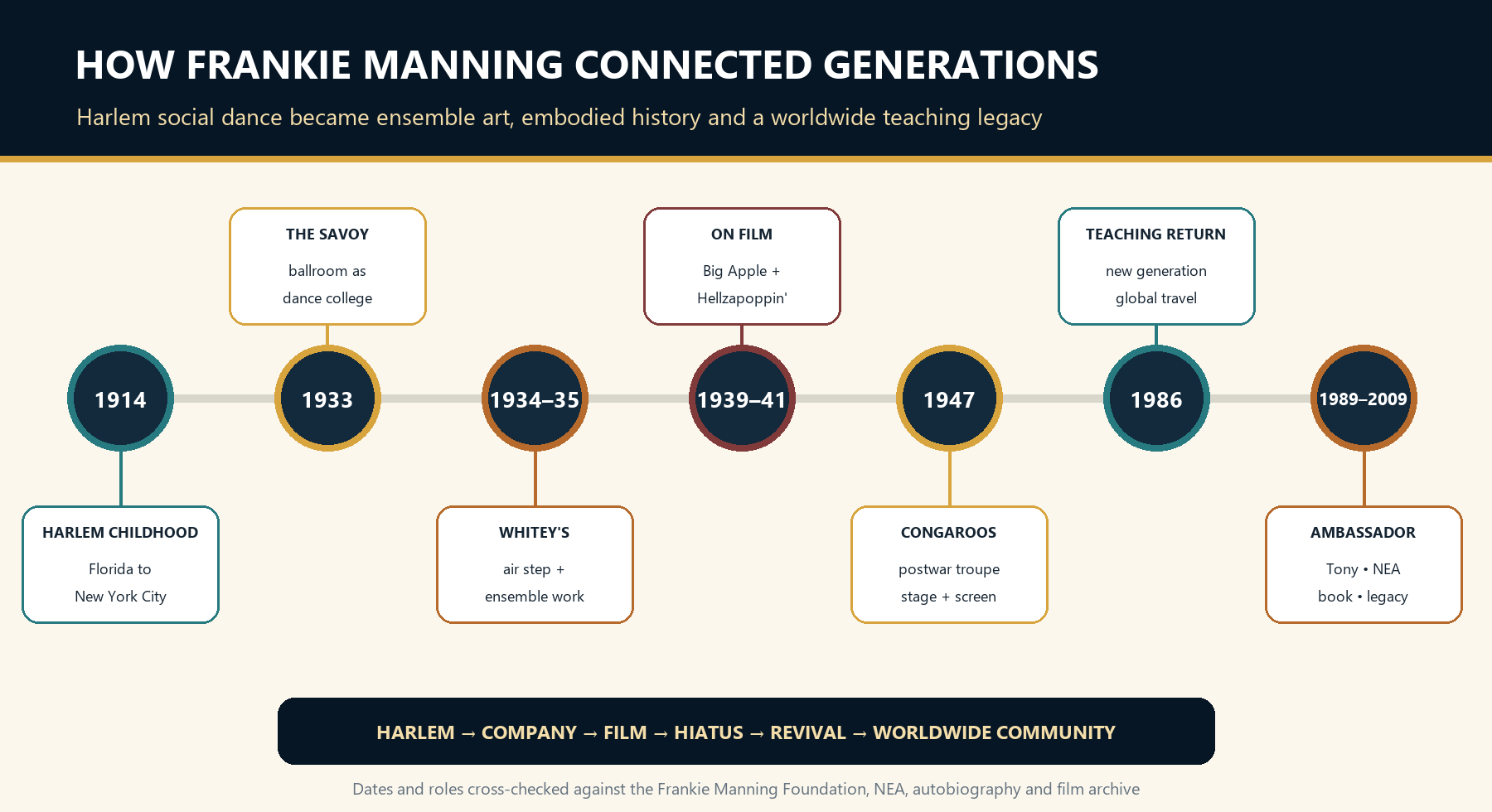
Manning was born in Jacksonville, Florida, and moved to Harlem with his mother when he was three. His official Foundation biography and the National Endowment for the Arts profile describe a progression through Harlem’s dance institutions: teenage afternoons at the Alhambra Ballroom, later nights at the Renaissance Ballroom, and finally the Savoy.
Manning compared that journey to moving from elementary school to high school and then college. The metaphor matters because it describes a community-based education. He did not receive a Lindy syllabus and graduate after a fixed number of lessons. He watched, tried, competed, borrowed, changed ideas and learned what the music and other dancers demanded.
The Savoy Ballroom, which opened in 1926 on Lenox Avenue, was integrated in an otherwise segregated city. Its long floor, great bands and highly competitive corner of elite dancers made it both social space and artistic laboratory. Manning arrived as a teenager eager enough to be tested and observant enough to grow.
There was never only one “Savoy style”
Modern dancers sometimes use “Savoy style” as if everyone at the ballroom shared a single posture, pulse and swingout. Manning’s own fame helped create that shortcut. His low, driving line and athletic momentum became a widely recognized image of Harlem Lindy Hop.
But the Savoy held generations of dancers with individual voices. Shorty George Snowden, Twistmouth George Ganaway, Norma Miller, Al Minns, Leon James, Willa Mae Ricker and many others did not move as interchangeable copies. A thoughtful 2003 Dance Forums discussion asked whether “Savoy style” meant Manning’s teaching or the many styles found at the Savoy. That is still the right question.
Manning is best understood as an extraordinary voice within a culture, not the culture’s sole author. His greatness becomes more interesting—not less—when placed beside the people who challenged and inspired him.
Whitey’s Lindy Hoppers
Herbert “Whitey” White, a Savoy bouncer and former boxer, organized elite dancers into performance groups. In 1934, he invited Manning into the circle that became known collectively as Whitey’s Lindy Hoppers.
Manning developed into a lead dancer, captain and chief choreographer. The work required more than winning a jam. Social improvisation had to be shaped for a stage, coordinated across several couples and made legible to an audience without draining away its rhythmic life.
The troupe’s names changed with engagements, and different dancers appeared in different units. That can make film histories confusing. It also warns against writing Manning’s career as a single permanent partnership. Frieda Washington was central to his famous account of an early over-the-back air step. Ann Johnson was his partner in the best-known Hellzapoppin’ routine. Other sequences joined him to different dancers, while the ensemble itself was the instrument he choreographed.
The Frankie Manning Foundation’s Archives of Early Lindy Hop is especially valuable because it connects surviving film to identified dancers rather than allowing the ensemble to become anonymous background spectacle.
The air step—and why “first” needs care
Manning is widely credited with introducing the first Lindy Hop air step in a 1935 Savoy contest. In the story preserved in his autobiography and official biographies, he and Frieda Washington developed an over-the-back move to answer the acrobatics of Shorty George Snowden’s team.
That event was unquestionably important. It helped establish an approach in which aerials could be composed into the phrase of the music and then developed into spectacular performance routines.
The absolute word “first,” however, should be handled carefully. Acrobatic partner dancing existed before 1935, and earlier Lindy generations used lifts and tricks. A more precise claim is that Manning and Washington’s contest air step became a defining innovation for the second generation of Savoy performance Lindy and helped push aerial choreography forward.
Manning also emphasized that air steps belonged in rehearsed performance, not on a crowded social floor. Dance Forums members reached the same practical conclusion in a long discussion about aerials and social-floor safety. The famous flips are fireworks; they are not permission to surprise a social partner.
Choreographing a company without losing the dance
Manning’s deeper contribution may be ensemble organization. He developed routines in which multiple couples performed synchronized phrases, separated into individual spotlights and returned to a shared structure. The result preserved the competitive personality of a Savoy jam while giving it theatrical form.
The Big Apple sequence in Keep Punching is one example. The dance itself emerged from Columbia, South Carolina, but Manning staged a version for Whitey’s troupe after receiving a description of it. Dance Forums’ early thread on the Big Apple and Manning’s choreography captures how a social craze could travel, be reconstructed and become film history.
The greatest surviving example is the 1941 Hellzapoppin’ number. William Downes and Frances “Mickey” Jones, Billy Ricker and Norma Miller, Al Minns and Willa Mae Ricker, and Manning and Ann Johnson enter as individual couples before the routine locks into ensemble precision. The Foundation’s film archive identifies the dancers and explains that Manning choreographed the sequence to different music before the studio replaced it.
Watch Whitey’s Lindy Hoppers in Hellzapoppin’
This is elite, rehearsed performance Lindy at extreme speed—not a picture of an ordinary night of social dancing. Manning and Ann Johnson are the fourth featured couple. Watch how the routine alternates comic character, individual invention, aerial spectacle and synchronized ensemble work.
Hellzapoppin’ (1941), Whitey’s Lindy Hoppers with the dancers identified. The embed is presented for historical study; Dance Forums does not claim ownership of the film.
The sequence is also a record of unequal Hollywood conditions. Black performers could deliver the most astonishing number in a film and still be isolated from the main narrative, often making the scene removable for segregated exhibition. Manning’s choreography traveled globally through cinema, but the dancers did not receive power or recognition equal to what their work generated.
War, the Congaroo Dancers and the end of a first career
World War II broke apart Whitey’s organization. Manning entered the Army and served overseas. After returning, he formed the Congaroo Dancers, a postwar troupe that combined Lindy Hop with other theatrical material and appeared on stage, television and in the 1948 film Killer Diller.
The group toured with major entertainers, but the market changed. Big-band touring contracted, bebop was not built around the same social-dance economy, and new popular music altered what venues wanted. By the mid-1950s, Manning disbanded the troupe and took a job with the United States Postal Service.
It is tempting to turn the next thirty years into a disappearance story. That is too simple. Manning left professional performance, but he raised a family and continued to dance socially. The public industry stopped paying attention; the knowledge did not vanish from his body.
“Rediscovery” was a meeting, not an archaeological dig
By the 1980s, dancers in New York, Sweden and Britain were studying surviving film and searching for people connected to the original dance. Al Minns and Leon James had already shared Savoy movement with researchers, filmmakers and students. After Minns died in 1985, young dancers including Erin Stevens and Steven Mitchell approached Manning.
Manning began teaching again in 1986. The usual word is “rediscovered,” but it can make a living person sound like a lost object. What happened was a meeting between generations: revival dancers brought hunger, organization and international networks; Manning brought embodied history, an inventive teacher’s mind and the ability to communicate more than steps.
He retired from the post office in 1987 and traveled increasingly widely. Workshops in Europe, North America, Asia and Australia made him a direct link to the Savoy generation for thousands of dancers. A 2005 Dance Forums thread marvels that, at 91, he was still traveling to teach workshops and dancing with unmistakable spirit.
This revival did not belong to one man. Norma Miller, Al Minns, Leon James, Mama Lu Parks, Pepsi Bethel, Sugar Sullivan and many other elders carried essential knowledge. Manning’s special role was his sustained reach: he remained visible long enough to teach several generations and generous enough to make history feel like an invitation.
A teacher of rhythm, partnership and joy
Students often remember Manning’s warmth before they remember a particular pattern. That does not mean his teaching lacked technique. He cared about pulse, weight, the elasticity of the swingout, musical breaks and the relationship between partners. But technique served the experience of dancing rather than replacing it.
His often-repeated language of “Lindy love” described a social ethic: dance with people, welcome them, listen to the band, and let personality appear. The Foundation that carries his name now defines its mission around preserving the history and supporting an inclusive global community.
That emphasis also explains why copying Manning’s silhouette is not the same as learning his lesson. A Dance Forums technical discussion notes how much individual possibility exists inside the basic swingout. Manning had a recognizable body line because he made choices through the music. The inheritance is permission to build an informed voice, not an order to impersonate him.
Watch Frankie Manning teach history from inside it
In this 2009 Lindyfest session, Manning watches and discusses archival dance film. The value is not only the facts he supplies. We see how a dancer remembers movement: who was present, what the music felt like, what a step meant and what the camera missed.
Frankie Manning’s Lindyfest Soul Session, Part I, recorded in Houston in March 2009.
For the social side of his legacy, this short dance with Dawn Hampton is a beautiful counterweight to Hellzapoppin’. There are no aerials and no movie spectacle—just two elders playing with rhythm, space and each other.
Frankie Manning and Dawn Hampton at Lindyfest. Additional films and interviews are collected by the Frankie Manning Foundation.
Broadway, film and national recognition
Manning’s second career was not limited to weekend workshops. In 1989, he won a Tony Award for choreography in the Broadway revue Black and Blue. He later served as a consultant and appeared in Spike Lee’s Malcolm X, connecting historical knowledge to a new cinematic reconstruction of the Savoy.
In 2000, the National Endowment for the Arts named him a National Heritage Fellow, the United States’ highest honor in folk and traditional arts. His autobiography, Frankie Manning: Ambassador of Lindy Hop, written with Cynthia R. Millman and published by Temple University Press, gave the dance world an unusually detailed first-person record.
These honors corrected part of a long imbalance. A Black social dance innovator whose film work was once left uncredited became an acknowledged choreographer, author and national tradition bearer. Recognition arrived late, but Manning used it to direct attention back toward the dance and its community.
Frankie Manning in the Dance Forums archive
Dance Forums preserves something different from an institutional biography: the moment when historical material becomes practical argument among dancers.
- The 2009 memorial thread records how immediately personal his loss felt.
- A 2003 discussion asks whether “Savoy style” can reasonably mean one dancer’s style.
- Members debate the invisible technique underneath Manning’s look in “Frankie Manning’s Secret”.
- The eight-count Lindy footage thread treats film as evidence rather than decoration.
- A discussion of which Lindy dancers mean when they say “Lindy” uses Manning’s memories to complicate fixed definitions.
- The Big Apple thread connects a South Carolina social dance to Manning’s staged version.
- The community’s aerial-safety discussion separates performance vocabulary from responsible social practice.
- A 2005 film discussion records the astonishment of seeing a 91-year-old Manning still traveling and teaching.
Forum posts are memories, opinions and ongoing research—not automatically settled facts. Their value is that they reveal how dancers test history against bodies, films, classes and social floors.
Why Frankie Manning still matters
Manning’s life breaks the familiar line between “original dancer” and “revival teacher.” He was both. He helped make performance Lindy Hop more theatrical in the 1930s and then, half a century later, helped a global community understand that the dance was more than a vintage costume or spectacular clip.
He also offers a model for how tradition can move. He did not preserve Lindy Hop by freezing one 1935 pattern. He preserved it by teaching rhythm, partnership, improvisation, history and joy strongly enough that new dancers could make living choices.
That is why “Ambassador of Lindy Hop” became more than publicity. An ambassador crosses boundaries without claiming to be the whole country. Manning represented a culture larger than himself, introduced people to it, and kept pointing them back toward the music, the Savoy generation and one another. The invitation remains open.
Media and research note
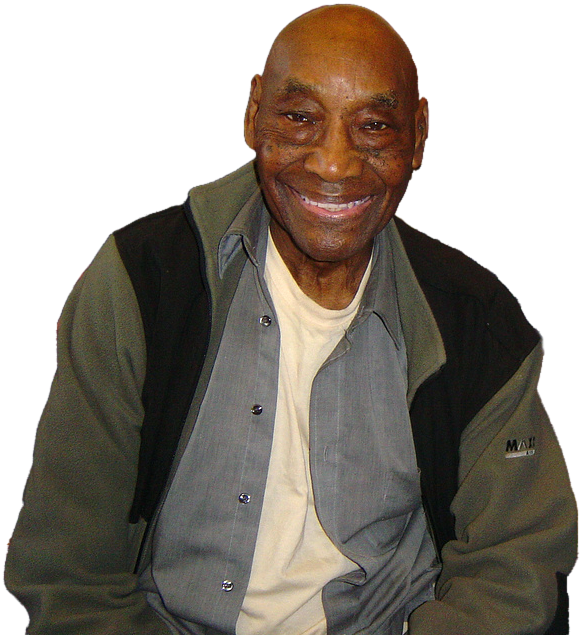
The featured image and timeline are original, portrait-free editorial graphics and do not present a synthetic face as Frankie Manning, Frieda Washington, Ann Johnson or any other historical dancer. The inline portrait is a real 2008 photograph by Rich Werden, published on Wikimedia Commons under CC BY-SA 2.0; its source and license are linked directly in the caption.
Biographical claims are cross-checked against Manning’s official Foundation biography and film archive, his autobiography as described by Temple University Press, the National Endowment for the Arts, scholarly dance history and contemporaneous film. Dance Forums links are treated as community testimony and historical discussion rather than sole proof of chronology.