

Sam Sodano: The Latin Pioneer Behind the Ohio Star Ball
From Pat Hogan and a groundbreaking Blackpool generation to Arthur Murray education, American Rhythm technique and ballroom’s most famous November tradition
One of the most revealing Sam Sodano stories in the Dance Forums archive is not about a trophy. A member recalled being tested many years ago by a “young Mr. Sam Sodano,” then watching him perform with his partner. They were the first real professional dancers that member had seen. The verdict, remembered decades later, was simply: “Wow.”
That memory captures something results alone cannot. Sam Sodano was a leading American Latin competitor during the generation that broke into the British establishment, but his influence became much larger than his own competitive career. He helped shape teachers, syllabi and ideas about American Rhythm; created the Ohio Star Ball and several competition series; and helped put high-level ballroom dancing on American public television for decades.
His story also completes a natural chapter in this series. Bob Medeiros carried the depth of American mambo onto the international floor. Vernon Brock brought theatrical scale and restless invention. Ron Montez and Elizabeth Curtis became one of the country’s defining championship partnerships. Sodano stood among them as a dancer—and then built institutions through which later generations would compete, teach and be seen.
At a glance
| Born | April 16, 1943, Fairview, New Jersey |
| Early competitive teacher and partner | Fran Rogers |
| Defining Latin partner | Pat Hogan |
| Later championship partner | Beverly Donahue |
| Major competitive record | U.S. Latin runner-up in 1971 and 1972 with Hogan; British Open breakthrough in 1972; North American Latin champion in 1975 with Donahue |
| Known for | Mambo-inflected cha-cha, partnership, coaching, Arthur Murray education, Hip Lift Technique and founding the Ohio Star Ball |
From New Jersey television to Arthur Murray
Sodano was born in Fairview, New Jersey, in 1943. His official Ohio Star Ball biography traces his first dance epiphany to age eight, when he watched The Arthur Murray Dance Party. By high school, dancing was no longer a distant television fantasy. He became a regular on the Clay Cole Dance Hour, broadcast from Palisades Amusement Park, and later remembered people asking for his autograph because they had seen him on television.
After graduating in 1960, Sodano entered an Arthur Murray studio in New Jersey as a student and soon became a Pro-Am teacher. In a long 2020 first-person interview, he describes being seventeen or eighteen, teaching as many as forty lessons a week and discovering that loving dance was not the same as understanding why each student had walked through the door.
That distinction became central to his teaching philosophy. A student might want technique, but might just as plausibly want friends, exercise, confidence or an enjoyable hour. Sodano came to believe that professional knowledge had to be delivered without losing the fun that drew people to dancing in the first place.
The franchise system gave him a formal structure. Teachers went through a training program and bronze certification; Sodano later completed professional examinations and owned several Arthur Murray schools. It also gave a young teacher travel opportunities. His first trip to Blackpool came in 1963 on an Arthur Murray trip—years before he returned as a competitor who would make the British ballroom world take notice.
Fran Rogers, Pat Hogan and Beverly Donahue
Sodano’s partnerships should not be collapsed into a single name.
His first important home teacher was Fran Rogers, with whom he also danced his early competitions. The partnership that defined his international Latin career, however, was with Pat Hogan. Barbara Ambroz’s published biographical account records Sodano and Hogan placing second in the U.S. national Latin championship in both 1971 and 1972. They represented the United States at major international events and were part of the first wave of American Latin couples to make a serious impression in England.
Sodano later competed with Beverly Donahue, already an important figure in this history through her partnership with Vernon Brock. Ambroz credits Sodano and Donahue with the 1975 North American Latin title. The partnership reinforces a recurring lesson of ballroom history: competitive couples are essential units, but dancers’ ideas and influence travel from one partnership to the next.
Pat Hogan and the American arrival in England
The story of Sodano and Hogan in England is vivid because it records not only results, but the culture shock surrounding them.
An excerpt from Sharon Savoy’s biography Sam Sodano: Passionate Journey, published by the Ohio Star Ball, describes their international debut at the United Kingdom International Championships shortly before Blackpool. Hogan could not afford the kind of ballroom gown worn by the established couples. She bought a tangerine swimsuit and added tangerine and purple fringe. Against a conservative field, it looked audacious.
Their dancing did too. They placed ninth in that first international appearance. In 1972, historical accounts credit them with reaching a British Open final and winning the cha-cha portion. The exact historical labeling of the division varies between later accounts, but the important point is consistent: the couple reached territory that had rarely been open to Americans.
The establishment noticed the character of their dancing. British technique authority Walter Laird praised Sodano as a partner who allowed the woman to dance without hindering her. In Dance News, Alex Moore captured the couple’s rhythmic impact in seven memorable words: “Sodano brought the mambo into the cha cha.”
That was not a complaint that Sodano lacked technique. He trained with Laird, Lorraine and Major Eric Hancox. It was recognition that he used established International Latin structure without erasing the musical instincts he had developed in American mambo and swing.
The breakthrough was shared. Hogan supplied half the partnership, including a visual boldness born partly from necessity. Medeiros and Sheryn Hawkins, Brock and Donahue, and other Americans brought different qualities to the same encounter. England did not receive a single “American style.” It encountered several strongly individual American couples at once.
Watch Sam Sodano dance
The following short film is identified by its uploader only as an early-1970s Latin competition featuring Sodano. The location is not documented on the video page, so it should not be casually relabeled as Blackpool. It nevertheless offers something no results list can provide: Sodano’s timing, body rhythm and competitive presence in the period when the American cohort was changing expectations.
Early-1970s Latin competition footage featuring Sam Sodano, uploaded by prrutherford.
Bonnie Diaz’s Ballroomology preservation project also presents competition footage highlighting Sodano and Pat Hogan. As with other Ballroomology reels, Vimeo’s privacy settings may require watching it on Vimeo rather than in an embedded player.
What about the Blackpool swing demonstration?
There is good reason dancers remember Sodano demonstrating swing at Blackpool. Ambroz, who attended, recalls his 1991 Blackpool Congress lecture as being about Mambo and Swing, and specifically remembers his body rhythm and smooth flow. That contemporary eyewitness description does not establish that the dance was West Coast Swing, however, and a reliably identified public upload of the 1991 lecture has not been located.
Sodano returned to the Blackpool Congress in 2017 for a different lecture, “Rhythm vs. Latin—What Makes the Difference?” That presentation opened with all five American Rhythm dances and then used Decho Kraev and Bree Watson to demonstrate his Hip Lift Technique. It is sometimes conflated with the earlier lecture, but it was not presented as a West Coast Swing demonstration.
This distinction is worth making because old ballroom video is often reposted with shortened titles and missing provenance. When firmer identification becomes available, this section can be updated without forcing an uncertain label onto the footage now.
His role in the Arthur Murray syllabus
Sodano’s connection to Arthur Murray was not merely that of a successful alumnus. The Columbus Arthur Murray studio identifies him as the head of the Arthur Murray International Dance Board as well as a professional coach and trainer. A former Arthur Murray instructor’s biography credits Sodano and Vicki Venka with creating the franchise’s bronze, silver and gold syllabus material.
The precise authorship of a large, evolving franchise syllabus is difficult to reduce to one line. Arthur Murray dance-board president Bob Long has explained that the board creates competition rules and oversees how new syllabus material is developed, tested and rolled out—a process that can take years. The evidence therefore supports a careful formulation: Sodano held a key leadership and creative role in Arthur Murray’s teaching system and syllabus development, not that he single-handedly invented every figure at every level.
That role fits the rest of his career. Sodano repeatedly tried to turn hard-earned individual knowledge into systems other teachers could use. Syllabus work organized social and competitive figures. His later American Rhythm work organized movement principles. The same mind that created competitions also created road maps.
From S.A.M. to Hip Lift Technique
By the early 2010s, American Rhythm had absorbed so much International Latin influence that dancers were debating what still made the two styles distinct. Sodano’s answer developed first under the name Structured Actional Movement—the S.A.M. or Sodano technique—and later as Hip Lift Technique.
A 2012 Dance Forums thread about S.A.M. shows competitors trying to describe the method while it was still new to much of the community. A later Hip Lift Technique discussion identifies the aim as both organizing American Rhythm and preserving a visible distinction from International Latin.
Sodano’s own explanation centers on delayed action. The foot is placed; actions through the knee and hip continue in sequence rather than arriving as one simultaneous event. The method is not simply “bent knees.” It is a way to clarify weight transfer, percussive Cuban action and the relationship between the standing foot and the moving body across the five Rhythm dances.
The 2017 Blackpool lecture gave that argument an international platform. Sodano said that if Rhythm borrowed so much from Latin that the events became indistinguishable, there would be little reason to retain both. His purpose was preservation through development: keep the identity, but give dancers a consistent technical language capable of standing up in modern competition.
Hip Lift Technique with Sam Sodano and Bill Sparks, from DanceSportExperts.
Dance Forums members remember the same balance of structure and accessibility in ordinary teaching. One member recalled a coaching-level Bolero class in which Sodano taught the basic with enough ease that the student only later understood how much nuance had been present.
Creating the Ohio Star Ball
Sodano did not simply purchase an established competition. He created and built the Ohio Star Ball.
In his 2020 interview, he dates its origin to about 1977 or 1978. He and another person organized a one-day event for the Ohio–Indiana–Michigan region at a time when the program consisted mainly of individually choreographed solo routines. The following year brought growth and freestyle competition. Sodano describes the original motivation as “party time,” not a calculation of how much money a major Pro-Am event might eventually earn.
The official event history similarly begins with a modest one-day showcase under Sodano’s direction. It grew gradually into a six-day festival including Pro-Am, professional, amateur, youth and collegiate dancing. That gradual expansion is an important part of the story. The Ohio Star Ball did not begin as a modern mega-event. Its operating model evolved in public, one added day and one new constituency at a time.
Forum members noticed the result. In a 2004 Ohio Star Ball discussion, one member wrote that no other competition was really comparable, pointing to both the main event and its collegiate component. Another member argued that Sodano made the event unusually accessible to a viewing public by concentrating leading dancers and showcases into an appealing Saturday-night program.
PBS, the red neon sign and a national audience
The Ohio Star Ball became something more than a large competition when public television arrived.
PBS chose the event as the setting for Championship Ballroom Dancing, later followed by America’s Ballroom Challenge. The partnership exposed television audiences to real competitive couples rather than a fictionalized ballroom story. Finalists gained a kind of national visibility that even a championship title did not automatically provide.
One detail has become part of Ohio Star Ball lore. In 1988, the event’s red neon sign lit up for the first time. Sodano later remembered running a victory lap around the ballroom, jacket swinging over his head. During PBS taping, however, the production sometimes had to hide the sign because the program being recorded was Championship Ballroom Dancing, not an advertisement for the event. The neon was reportedly broken and repaired more than once during those years.
For nearly three decades, the Ohio Star Ball television partnership placed ballroom dancing in American living rooms. Long before celebrity dance shows revived mass interest, viewers could see championship Smooth, Rhythm, Standard and Latin couples presented as the main attraction.
Building a larger Pro-Am economy
The Ohio Star Ball was only one of Sodano’s institutional projects. He also created the World Pro-Am DanceSport Series and the Best of the Best DanceSport Challenge, helped create the Fordney Foundation’s junior and youth series with Bill Sparks, and organized or co-organized other competitions.
The series model connected individual events across a season. Students and teachers accumulated points, followed standings and arrived at a culminating event with a narrative already underway. In a 2007 Dance Forums discussion of the DanceSport Series, a member encountered Sodano at another competition and interviewed him—an early example of the forum documenting the business architecture behind Pro-Am participation, not only the dancing.
There are legitimate debates about entry volume, costs and incentives in Pro-Am. Sodano himself has acknowledged that competitions are businesses. His distinctive contribution was to combine that business structure with event theater, personal recognition and continuity across the calendar. He was unusually good at remembering names, and he understood that an amateur competitor’s sense of belonging could be as important as a mark on a result sheet.
Sam Sodano in the Dance Forums archive
The forum record captures aspects of Sodano’s influence that official biographies miss:
- A member’s memory of meeting him as a young examiner and seeing a first professional performance shows the impression he made long before becoming an institution.
- The S.A.M. technique discussion records dancers encountering a developing system in real time.
- A detailed Hip Lift Technique thread preserves both enthusiasm and skepticism about codifying American Rhythm.
- A dancer’s Bolero coaching memory shows how his teaching could appear casual while carrying significant technical depth.
- Members discussing West Coast Swing in Nashville listed Sodano among the teachers at a broad dance camp—useful evidence that his range extended beyond a narrow competitive specialty.
- Forum recollections of the Ohio Star Ball document the participant experience that official entry counts cannot.
These posts are community memories and technical opinions, not formal championship records. Their value is cumulative. They show what dancers asked Sodano about, what they remembered years later and how often his name appeared when the subject shifted from steps to the structure of the ballroom world itself.
Recognition—and why it is not the whole story
Sodano was inducted into the U.S. Ballroom Dance Hall of Fame in November 2008. He later received humanitarian and lifetime-achievement recognition, and a biography based on three years of research and more than ninety interviews.
Those honors are deserved, but they do not explain the scale of his influence as clearly as the career itself. He competed in the American breakthrough generation, led education inside a major studio system, helped define a modern technical vocabulary for Rhythm, created a competition that became synonymous with American Pro-Am, and brought championship ballroom dancing to a national television audience.
Few ballroom figures have operated credibly in all those rooms.
Why Sam Sodano still matters
Sam Sodano’s career is a study in turning experience into infrastructure.
With Pat Hogan, he helped prove that American musical identity belonged on the international Latin floor. With Beverly Donahue, he extended that competitive story. Through Arthur Murray, he trained teachers and participated in the slow, collaborative work of organizing a syllabus. Through S.A.M. and Hip Lift Technique, he tried to preserve what makes American Rhythm recognizably itself. Through the Ohio Star Ball and connected series, he built stages on which other people could make their own history.
That final contribution may be the most enduring. Great dancers change what an audience sees for a few minutes. Great teachers change what students can do. A great organizer can change the conditions under which an entire field sees itself.
Sodano did all three.
Media and research note
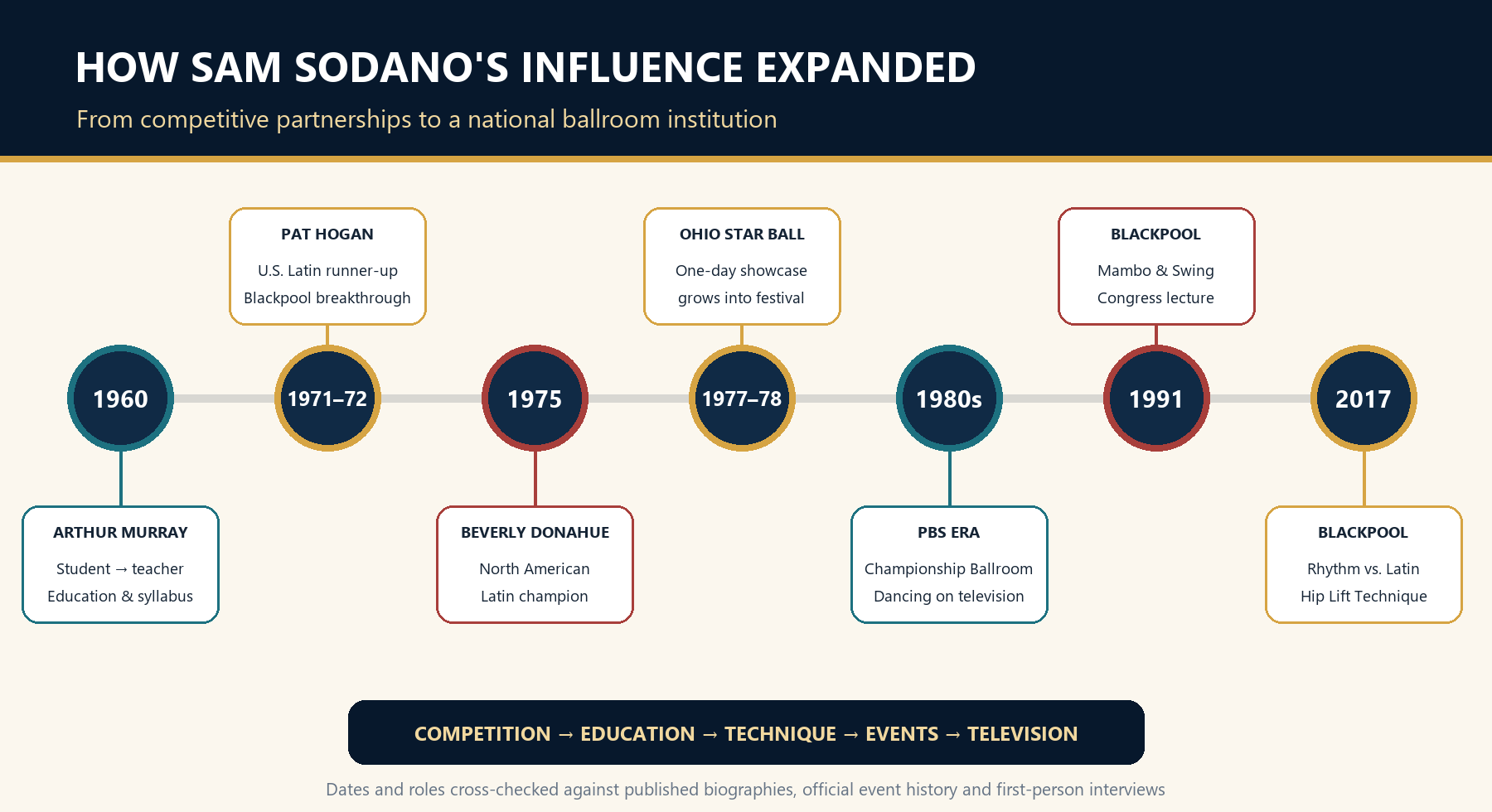
This profile uses original portrait-free graphics and does not present an AI-generated face as Sam Sodano, Pat Hogan, Fran Rogers or Beverly Donahue. The featured background is an original, people-free editorial illustration; the career graphic is an original data design.
The early-1970s YouTube film is labeled only as specifically as its uploader supports. The 1991 Blackpool Mambo-and-Swing lecture and the separate 2017 Blackpool American Rhythm lecture are distinguished rather than merged. Competition history is cross-checked against Barbara Ambroz’s biography, Sharon Savoy excerpts published by the Ohio Star Ball, Sodano’s first-person interview and formal championship records. Dance Forums links are identified as firsthand memories or community discussion rather than official documentation.