

Juan Carlos Copes: The Choreographer Who Took Argentine Tango to Broadway
How a Buenos Aires social dancer turned tango into theatrical architecture—and helped create an international profession without becoming its sole inventor
When Juan Carlos Copes died in January 2021, Dance Forums members remembered more than a celebrated dancer. In the forum’s memorial thread, they described a forceful performer, linked his 1962 American television appearance, and considered how much the modern tango profession owed to the stage world he helped build.
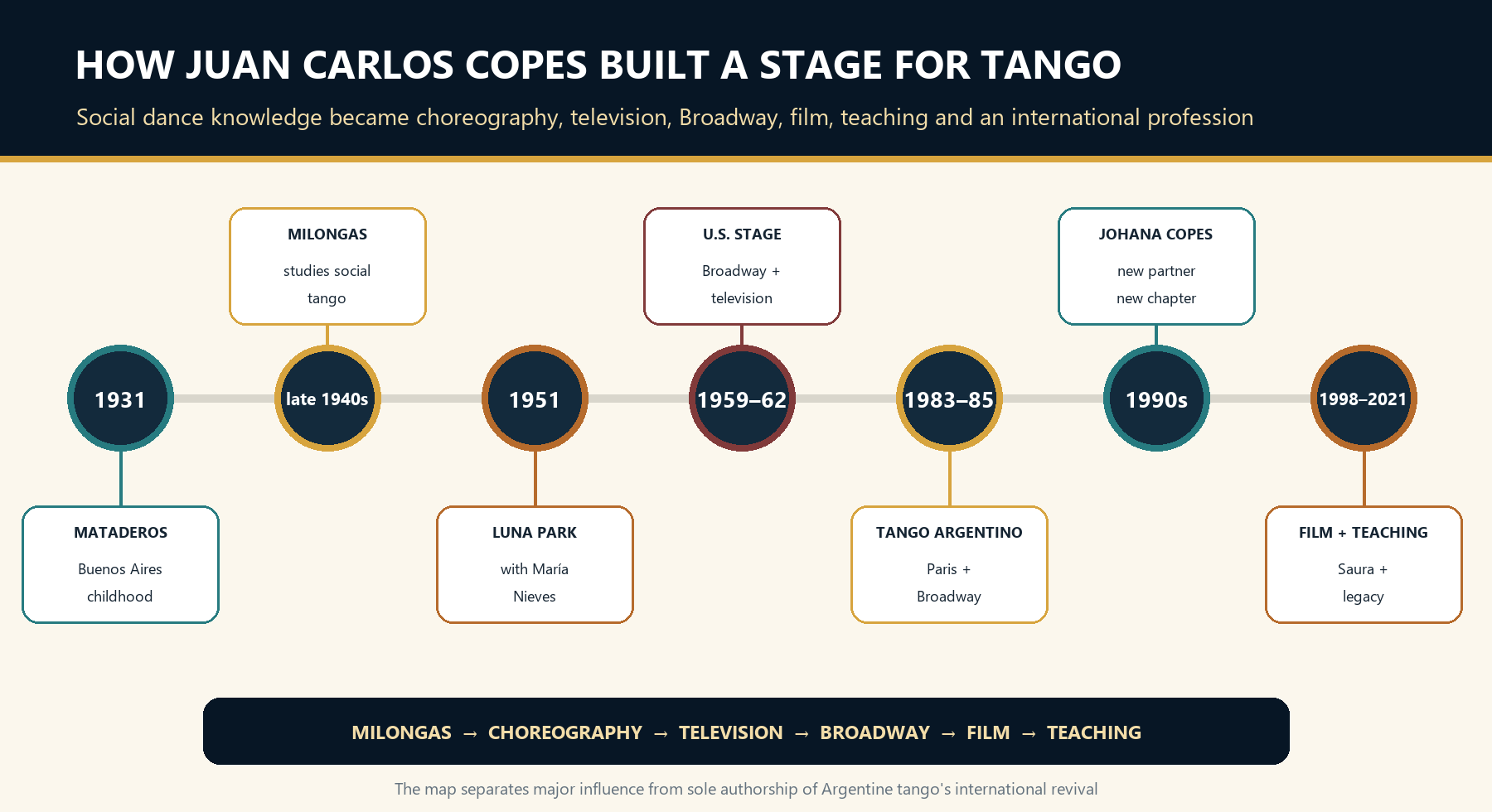
Copes’s life connects neighborhood milongas, touring cabarets, Broadway, television, film, teaching and choreography. He did not invent Argentine tango, nor did he single-handedly cause its worldwide revival. His distinctive achievement was to understand that social tango could be reorganized for an audience without surrendering its Argentine identity.
Dance Forums’ history of Argentine tango supplies the wider musical, social and political context. The companion profile of María Nieves examines the artist whose timing, personality and performance intelligence were indispensable to the partnership that made Copes internationally famous.
At a glance
| Born | May 31, 1931, Mataderos, Buenos Aires |
| Raised | Villa Pueyrredón, Buenos Aires |
| Died | January 15, 2021, age 89 |
| Formative dance world | Buenos Aires neighborhood clubs and milongas |
| Defining early partnership | María Nieves, beginning in their teens and continuing professionally for nearly fifty years |
| Later principal partner | His daughter Johana Copes |
| Broadway credits | New Faces of 1962; dancer and choreographer for Tango Argentino in 1985; guest artist in its 1999 revival |
| Film landmark | Actor and choreographer in Carlos Saura’s Tango (1998) |
| Signature legacy | Developing a theatrical language and professional infrastructure for staged Argentine tango |

From Mataderos to the milongas
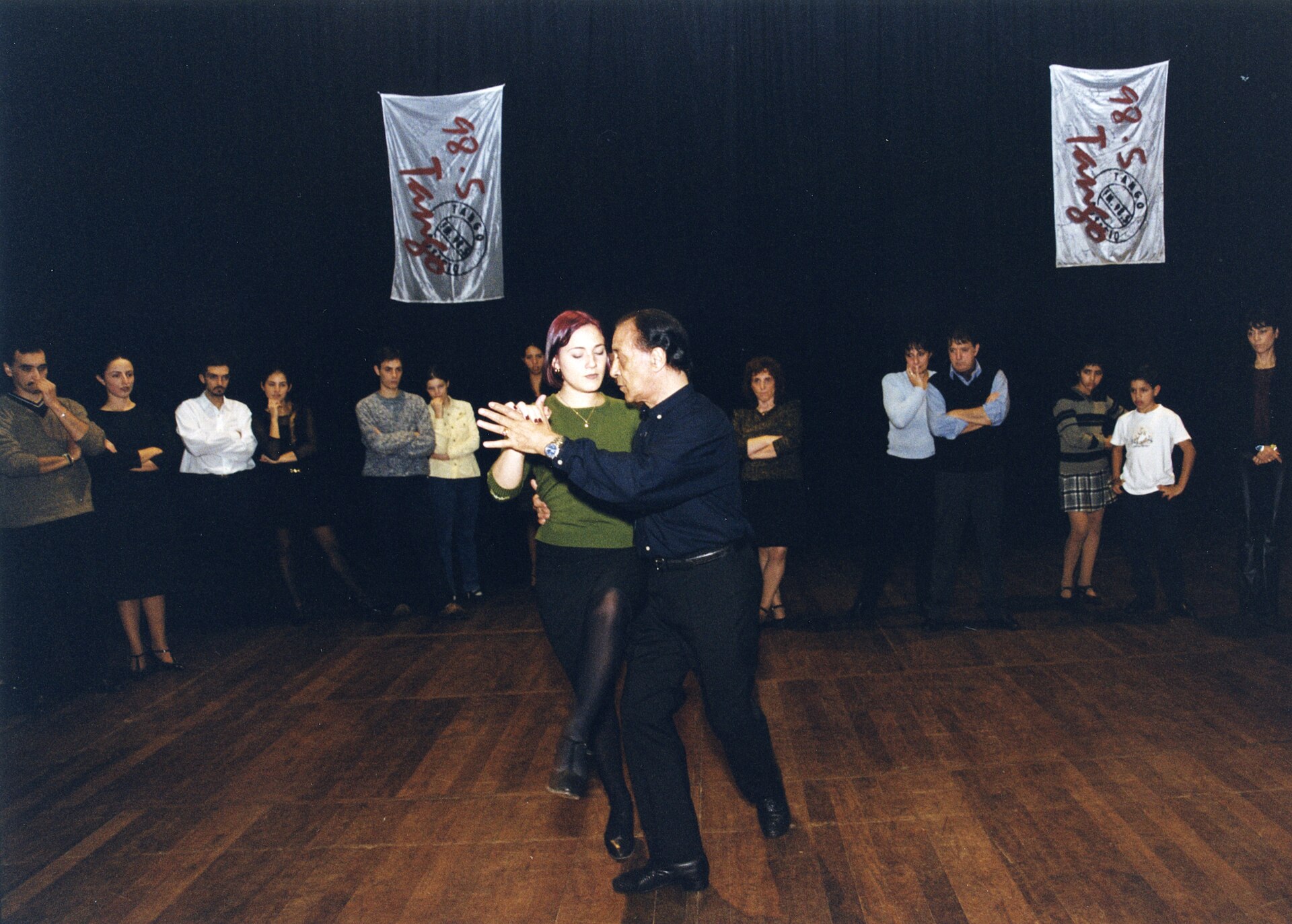
Copes was born in Mataderos and grew up in Villa Pueyrredón. His maternal grandfather played tango piano, but the boy initially studied to become an electrician. Like many dancers of his generation, he learned less through a formal academy than through repeated exposure to neighborhood social clubs.
The Buenos Aires tango world in the late 1940s was demanding. A young leader had to navigate the line of dance, protect a partner, understand crowded floors, recognize orchestras and earn invitations. Technique was inseparable from social credibility.
The New York Times obituary, reproduced and discussed in the Dance Forums memorial thread, describes Copes combining two broad tendencies he saw around him: one rich in steps and another smooth and elegant. Whether or not every dancer would recognize those categories, the description reveals his mind at work. He was already sorting movement, comparing effects and imagining synthesis.
That analytical habit became central to his career. Copes did not stop being a social dancer when he entered theater. He began asking how social knowledge could be made readable across a proscenium or through a television camera.
María Nieves and the creation of a partnership
Copes met María Nieves when he was about seventeen and she was about fifteen. They danced in neighborhood clubs, entered a large Luna Park competition in 1951 and won first place. Club and cabaret bookings followed, then a 1955 show at Teatro El Nacional.
Copes supplied ambition and an increasingly choreographic approach. Nieves supplied an instinctive musical command and a performance presence audiences could not ignore. Their style became known as estilo Copes-Nieves, but the hyphen matters: neither side explains the result alone.
Their movement could be fast, low and dynamically projected. It retained a walking logic while sharpening poses, kicks, rhythmic contrasts and directional changes for an audience. Copes understood that theater needed structure; Nieves kept the structure from looking mechanical.
The partnership was romantic as well as professional. They married in Las Vegas in 1964 and divorced in 1973, yet continued to work together into the 1990s. The artistic result was historic. The private history was painful, and it should not be turned into a sentimental claim that conflict automatically produces great tango.
Making social dance visible from the last row
Argentine tango began as social practice, not as a Broadway genre. A crowded milonga rewards economy, responsiveness and private connection. A theater must communicate to people who cannot feel the lead or see a tiny weight change.
Copes’s choreography enlarged selected elements without replacing tango with generic spectacle. He organized entrances, exits, phrases, pauses and spatial pathways. He used contrast so that a walk could become dramatic after rapid footwork—and rapid footwork could feel earned after stillness.
This translation always involves compromise. The last row needs clarity, while social dancers may distrust anything that looks performed. Dance Forums’ recurring debates over stage tango versus social tango show that the tension has never disappeared.
Copes matters precisely because he worked inside that tension for decades. His goal was not merely to add tricks. It was to create a theatrical grammar in which an audience could follow the changing relationship of two bodies and the music.
The first American breakthrough
By 1959, Copes and Nieves were touring internationally, including work connected with Astor Piazzolla. In the United States they entered the Broadway revue New Faces of 1962 and appeared on The Ed Sullivan Show.
The American television footage demonstrates how efficiently their tango could be packaged for a mass audience. The space is limited, the number is brief and every change must register immediately. It is stage tango adapted again—this time not for a deep theater but for the camera and living-room screen.
Dance Forums members returned to that clip when Copes died. Its survival lets modern viewers compare the historical pair with later tango aesthetics rather than relying on adjectives such as “dynamic” or “elegant.”
Watch Copes and Nieves on American television
Look at how Copes directs travel, changes level and creates space for Nieves’s action. Also watch what Nieves contributes: speed, balance, attack and the confidence to complete movement as a public statement.
Juan Carlos Copes and María Nieves on The Ed Sullivan Show in 1962. Embedded for historical study; Dance Forums does not claim ownership of the broadcast.
The clip is sometimes presented as a self-explanatory image of “authentic Argentine tango.” It is more specific than that. We are watching two particular professionals perform a tightly organized number for American television in 1962. Its authenticity lies in the artists and their history—not in being the only way tango was danced.
Before Tango Argentino
The global boom is often compressed into a single 1983 premiere, but Copes had already spent decades creating and touring tango shows. He worked in cabarets, revues and international productions, developing methods for presenting an evening of tango rather than one isolated dance.
His contribution was partly artistic and partly infrastructural. A sustained show requires rehearsals, casts, musical planning, theatrical pacing and a belief that tango can hold an audience beyond a specialty act. Those systems helped make a profession possible for dancers who came later.
That earlier history also explains why he was valuable to Claudio Segovia and Héctor Orezzoli when they developed Tango Argentino. Copes brought not only a recognizable partnership but decades of knowledge about how tango behaved under stage conditions.
Tango Argentino reaches Broadway
Tango Argentino premiered in Paris in 1983 and opened on Broadway in 1985. The official Internet Broadway Database production record credits Segovia and Orezzoli with conception and direction, Copes as choreographer, and an extraordinary company of dancers, singers and musicians.
That distribution of credit is important. Copes had a major choreographic role, but the dancers brought their own vocabularies and partnerships. The Tony nomination for Best Choreography named the company’s dancers rather than presenting all movement as the property of a single author.
The show ran for 199 Broadway performances, toured internationally and returned to Broadway in 1999. Its influence extended beyond ticket sales. People who had seen the production formed practice groups, sought teachers and built local milongas. Dance Forums members discussing how Argentine tango grew in Europe remember a culture of reconstruction from film and photographs after the stage shows passed through.
The production arrived at a politically significant moment, just as Argentina emerged from dictatorship. Dance Forums’ thread about the two international tango crazes distinguishes the early twentieth-century vogue from the late-century revival shaped by touring Argentine artists.
Copes did not produce that history alone. He was one of its architects.
Dancer, choreographer and teacher are different roles
It is tempting to measure Copes only by whether a modern viewer likes his dancing. Dance Forums members watching old footage have described his force, playfulness and energy; others find parts of the style dated. Both responses can be honest, but neither alone measures his historical importance.
A dancer makes choices inside one partnership and performance. A choreographer organizes movement over time and space for others. A teacher creates a method another body can use. Copes worked in all three roles, and the results were not always identical.
The distinction becomes especially useful in forum debates about the eight-count basic. In “8CB — history”, members consider claims that Copes created or standardized the sequence, then openly acknowledge gaps in the evidence. On the second page, the discussion becomes even more skeptical.
The safest conclusion is not that Copes invented the eight-count basic. It is that stage and teaching systems associated with his generation helped make standardized sequences internationally portable. Authorship remains contested, and the article should preserve that uncertainty.
Film turns Copes into a character
In 1998, Carlos Saura released Tango. Copes played the character Carlos Nebbia and served as one of the film’s choreographers. The official Sony Pictures Classics credits list him in both roles; the Cannes Film Festival record documents the film’s 1998 special screening.
The film is valuable because it shows Copes not only performing but explaining, counting and shaping theatrical tango within a story about making a tango production. Dance Forums members collected three Copes scenes from the film: a milonga, a class and the finale of the show within the show.
In the milonga scene, he vocalizes rhythmic subdivisions before moving. That moment appears in an older forum discussion of milonga timing, double time and traspié. A few seconds of film become teaching evidence because viewers can connect sound, intention and movement.
Juan Carlos Copes in the “Recuerdo” sequence from Carlos Saura’s Tango. The film’s official credits identify Copes as both actor and choreographer.
The scene should still be read as cinema, not documentary footage of an ordinary milonga. Lighting, editing, casting and narrative purpose shape what we see. Copes’s long career is useful precisely because it lets us compare how he adapted tango to different media.
Johana Copes and a later partnership
After his partnership with María Nieves ended, Copes increasingly performed with his daughter Johana. This was not simply a substitute pairing. Johana became a dancer, teacher and cultural organizer in her own right, and the partnership allowed Copes’s work to move into another generation.
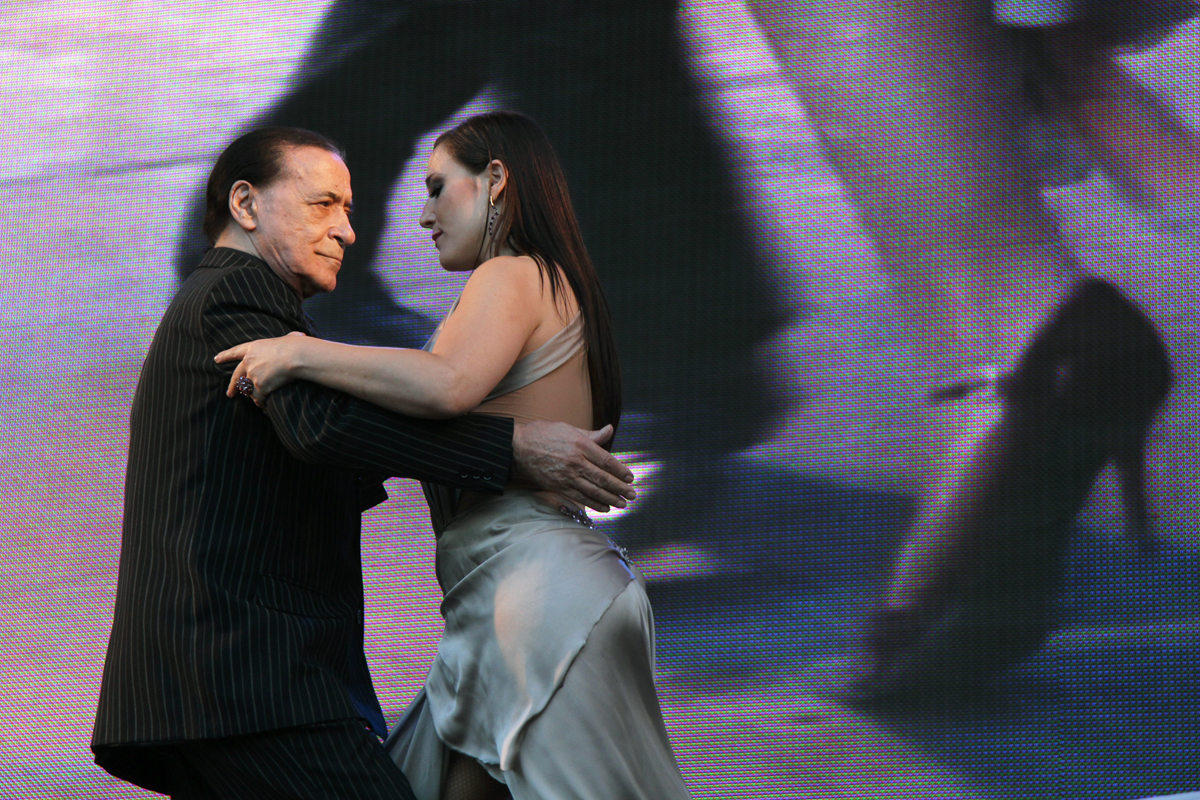
The licensed 2011 photograph below shows the pair at Buenos Aires’s Tango Day celebration. Copes is no longer the young man from the Ed Sullivan clip, but the movement still has theatrical clarity. The image also demonstrates why separate dancer profiles matter: one person’s career can contain several important partners, each creating a different artistic chapter.

Watch Juan Carlos and Johana Copes
This performance of “Recuerdo” offers a counterpoint to the 1962 footage. The emphasis is less on speed and more on phrasing, presence and continuity between generations.
Johana later described her father’s need to prepare, rehearse and dance as something she came to understand more deeply with time. The transmission was not merely a list of figures. It was a working discipline.
Our Last Tango complicates the monument
German Kral’s 2015 documentary Our Last Tango revisits the Copes-Nieves partnership through interviews, archive film and reenactments. The official U.S. trailer presents an extraordinary shared career alongside love, hatred and painful separation.
The film is essential but not final. It is constructed from memory, and memory has perspective. Copes explains ambition and artistic decisions; Nieves describes the cost of living inside the partnership. Neither voice cancels the other.
Dance Forums’ discussion of tango movies recommends the documentary as the story of the famous couple. A separate conversation remembers its combination of interviews, recreations and vintage film. Together those comments capture the film’s value: it turns the heroic public image back into two human biographies.
For Copes, that complication is healthy. Historical importance does not require sainthood. His ambition, control and theatrical intelligence created opportunities. They also operated inside relationships with unequal emotional consequences.
Juan Carlos Copes in the Dance Forums archive
The forum has discussed Copes across history, technique, teaching and performance—not only in obituary threads.
- The main Copes memorial preserves a detailed career account and the community’s immediate response.
- Members discussing the best milongas for followers pause to remember his force, energy and joy.
- “So You Think You Know Tango?” collects three Copes scenes from Saura’s film for comparative viewing.
- A technical thread on milonga rhythm analyzes the counted rhythm before one of those film scenes.
- The first page of the eight-count-basic history debate examines competing authorship claims.
- The second page of that debate corrects earlier assertions instead of hiding uncertainty.
- A conversation about teacher pedigrees lists study with Juan Carlos and Johana Copes while questioning what famous lineage actually proves.
- Members ranking favorite historic couples still describe Copes as a master, even while resisting the premise that tango can be reduced to a top-three list.
- A history thread distinguishes the early tango craze from the later stage-driven revival.
- The discussion of tango’s European growth links touring shows to local communities and practice groups.
The posts do not form one authorized verdict. Their strength lies in visible revision: members make claims, ask for evidence, compare film and sometimes change their minds.
Why Juan Carlos Copes still matters
Copes changed what a tango dancer could do for a living. He helped turn a club practice into sustained theater, made choreography legible to international audiences, taught performers and students, appeared in mass media and left a film record that dancers still analyze.
His legacy is strongest when stated precisely. He did not invent tango. He did not create Tango Argentino alone. He did not author every step later taught under the banner of Argentine tango. María Nieves, other couples, directors, musicians and communities were not supporting scenery in one man’s story.
What he did was recognize a possibility earlier and pursue it more relentlessly than most: tango could become an evening of theater, a television event, a film language and an international profession while remaining connected to Buenos Aires.
That architectural imagination is why his influence reaches far beyond his own steps. Copes built stages on which other tango dancers could be seen.
Media and research note
The featured image is an original, portrait-free editorial scene with anonymous silhouettes. It does not present a synthetic face as Juan Carlos Copes, María Nieves, Johana Copes or any other real dancer. The teaching photograph is a real image by CCPE Rosario under CC BY-SA 4.0. The photograph of Copes with Johana was made by Estrella Herrera for the Government of the City of Buenos Aires and is available under CC BY 2.0. Source and license links appear in the captions.
Biographical and production facts were cross-checked against the Internet Broadway Database, the New York Times obituary, official Sony Pictures Classics and Cannes film records, Todo Tango, and documentary festival and distributor materials. Dance Forums discussions are used as community testimony, reception history and research leads—not as automatic proof of disputed authorship claims.