

Dean Collins: The Dancer Who Brought Lindy Hop to Hollywood
How a Savoy-trained New Yorker, Jewel McGowan and the movie camera shaped Southern California swing
The dancer you were trying to remember is Dean Collins, whose career has been investigated in a long-running Dance Forums research thread. He is often described as the man who brought Lindy Hop from New York to Southern California, and that description is useful—provided we do not mistake it for the whole story.
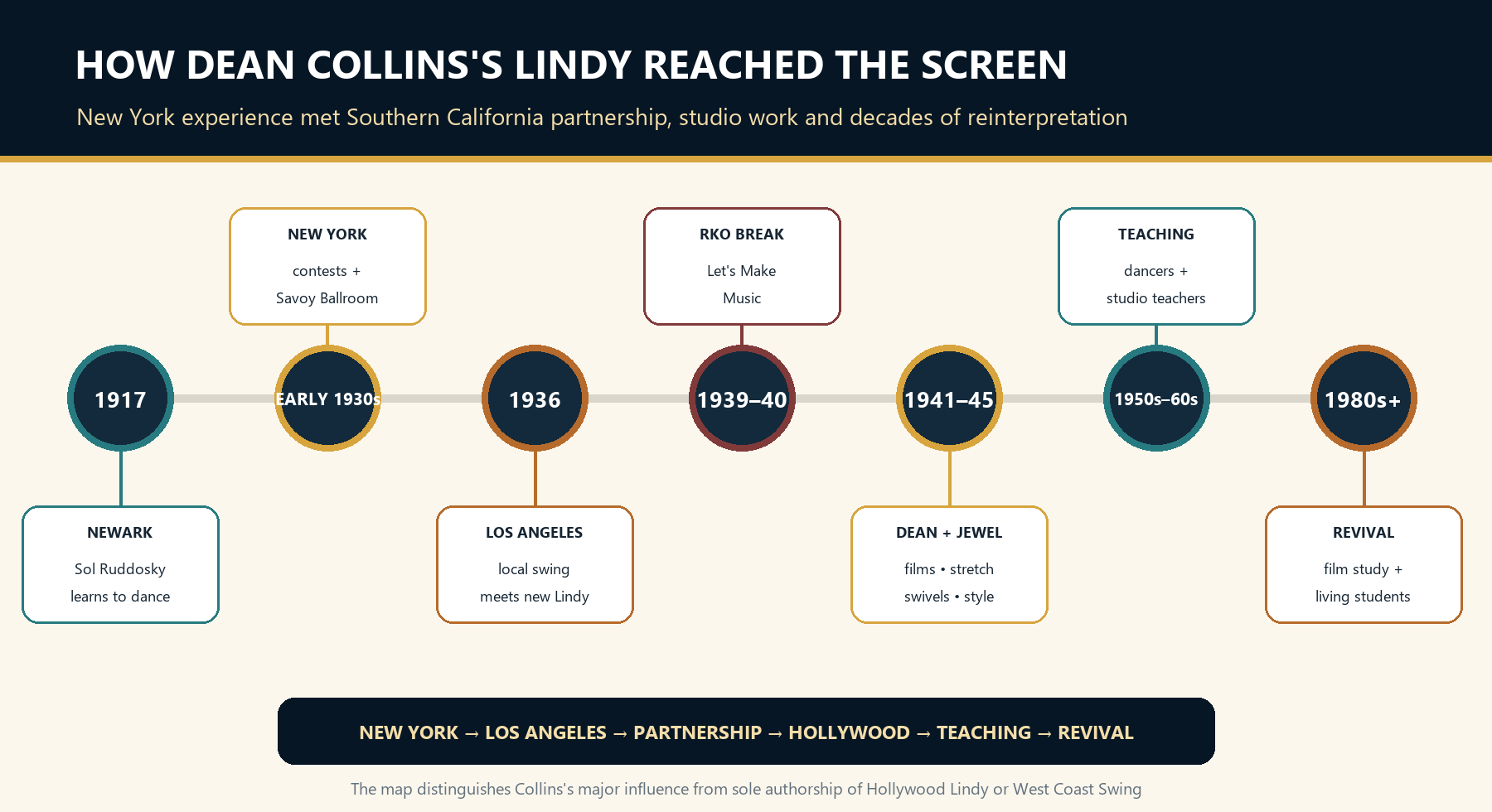
Collins arrived in Los Angeles during the 1930s with experience from the New York swing world. He won contests, taught dancers, entered the movie industry and formed an extraordinary partnership with Jewel McGowan. Their filmed dancing became a major source for the “Hollywood” or “smooth” Lindy vocabulary studied during the late-twentieth-century revival.
But Collins did not arrive in an empty dance landscape, did not invent every movement later called Hollywood style, and did not single-handedly create modern West Coast Swing. Dance Forums has been arguing about those distinctions since 2003. Its long Dean Collins thread has accumulated biographies, film sightings, corrections and first-hand claims across more than a decade—exactly the kind of living archive that makes this profile different from a standard résumé.
For the larger family tree, begin with Dance Forums’ history of Lindy Hop and the companion profile of Frankie Manning. Manning and Collins carried different experiences through different institutions, and film made both lineages visible in very different ways.
At a glance
| Born | May 29, 1917; born Sol Ruddosky |
| Raised | Newark, New Jersey |
| Early dance world | New Jersey contests and New York’s Savoy Ballroom |
| Moved west | Los Angeles, 1936 |
| Defining partner | Jewel McGowan, in an eleven-year dance partnership |
| Known for | Smooth, dynamically stretched Lindy Hop; teaching; choreography; extensive Hollywood film appearances |
| Legacy labels | Dean Collins style, smooth-style Lindy and a major influence on what revival dancers called Hollywood-style Lindy Hop |
| Died | June 1, 1984, Los Angeles area |
Sol Ruddosky becomes Dean Collins
Collins grew up in Newark and learned to dance as a young teenager, initially with help from his older sisters. He entered contests around New Jersey and traveled into New York, where the Savoy Ballroom offered access to an integrated, intensely competitive Lindy Hop culture.
The strongest institutional biography comes from the World Swing Dance Council Hall of Fame, which inducted Collins posthumously in 1989. It describes his New York development, move west and later film and teaching career. Dance Forums members have also examined newspaper directories, film credits and recollections in an effort to separate repeated legend from evidence.
Sol Ruddosky adopted the name Dean Collins before or during his Hollywood rise. Retellings often say he found the name in a wallet. That memorable story comes through community biography rather than a surviving official name-change record, so it is best presented as part of the Collins narrative rather than an independently verified fact.
What is clear is that the new name belonged to a dancer determined to make a career in California’s entertainment industry.
California already swung
Collins moved to Los Angeles in 1936, reportedly traveling through New Orleans. During the day he worked ordinary jobs; at night he entered the local ballroom world, including the Diana Ballroom and Casino Gardens.
Calling him “the man who brought Lindy to California” can accidentally erase what was already there. Southern California dancers had Balboa, collegiate and local swing practices, active contests, major ballrooms and their own ways of responding to bands. Collins brought a particular body of New York Lindy experience into that ecosystem. The result was interaction, not replacement.
His difference was visible enough to win attention. Hall of Fame accounts describe his contest success and rapid growth as a teacher. Dancers wanted to understand the movement arriving through him; Collins, meanwhile, adapted to partners, music, local mechanics and the demands of performance.
This is why a 2003 Dance Forums exchange about the swingout, whip and Collins’s changing styles is so revealing. Even people with direct links to mid-century Los Angeles disagreed about which period represented his “real” Lindy. The disagreement is evidence that his dancing changed.
Jewel McGowan was a co-creator, not a footnote
Dean Collins’s most important partnership was with Jewel McGowan. They danced together for approximately eleven years and appeared in numerous film sequences during the 1940s.
Older biographies often describe McGowan mainly as Collins’s partner, but surviving film makes that hierarchy impossible to defend. Her powerful swivels, rotational action, control and dramatic elasticity are central to what viewers recognize as the partnership’s style. Southern California peers repeatedly remembered her as one of the finest swing dancers they had seen.
The useful question is not simply what Dean taught Jewel. It is what they built together. Dance historian Bobby White’s study of Lindy’s arrival in Southern California argues that McGowan brought local swing mechanics into the partnership. Collins supplied a strong open-position stretch; McGowan answered with extraordinary counterbalance and rotation. Their shared solution made familiar Lindy structures look newly dramatic.
An Atomic Ballroom film guide collects appearances from 1940 through 1945 and is valuable precisely because it directs viewers to the seconds in which the pair can be identified. Film history requires that care. Uncredited dancers appear briefly, sometimes behind stars, and confident internet captions can be wrong.
Watch Dean Collins and Jewel McGowan in Buck Privates
The 1941 Andrews Sisters number “Bounce Me Brother with a Solid Four” is the most useful introduction to the partnership. Collins and McGowan are not the only dancers, and the camera does not build a modern showcase around them. Look for the intensity of their open stretch, the way McGowan’s swivels gather and redirect energy, and the quick transition from social texture to staged highlight.
Dean Collins and Jewel McGowan in the dance sequence from Buck Privates. The AFI Catalog documents the film’s 1941 release and production credits; the dancers themselves were not individually credited onscreen.
The clip is important for another reason: it shows that “Dean Collins style” is inseparable from a partner and a wider Southern California dance community. A biography centered only on the man misses what the camera preserved.
Hollywood turned movement into an archive
Collins’s first major film break came when RKO hired him to choreograph dance material for Let’s Make Music, produced around 1939–40. He went on to dance, stage or choreograph material in more than thirty films, shorts and television appearances. Hall of Fame accounts list titles including Dance Hall, Playmates, Buck Privates, Ride ’Em Cowboy, Springtime in the Rockies, The Talk of the Town, Always a Bridesmaid, Kid Dynamite, Junior Prom and Living It Up.
Not every circulated filmography agrees, and “appeared in,” “choreographed” and “influenced the dancers” are not interchangeable credits. The cautious way to write this history is to use studio or American Film Institute records where they identify credited production roles, then use specialist film guides to identify uncredited dancers onscreen.
The camera also changed the dance. Film favored movement that read instantly within a frame: clean lines, controlled travel, recognizable silhouettes, staged entrances and spectacular but repeatable highlights. That does not mean Hollywood invented a slotted dance in one decision. It means working dancers continually solved spatial and visual problems, and audiences later treated the surviving solutions as a style manual.
The Hellzapoppin’ complication
Both Frankie Manning and Dean Collins appear in Hellzapoppin’, but not in the same way.
Manning choreographed and danced in the isolated ensemble number performed by Whitey’s Lindy Hoppers. Collins appears earlier, dancing socially with comedian Martha Raye during “Watch the Birdie.” The contrast is historically revealing. White Harlem dancers deliver the film’s most astonishing sequence in a segregable production number; Collins, a white dancer, appears within the main comic action.
The Frankie Manning Foundation’s film archive identifies both appearances. Seeing them together helps explain why Hollywood visibility cannot be separated from race, credit and access.
Collins’s film career helped preserve remarkable Lindy movement, and it benefited from an industry that offered him forms of integration and continuity largely denied to the Black dancers whose culture shaped the dance he learned.
“Hollywood style” was named after the films
Modern dancers often imagine that Collins arrived in Los Angeles teaching a finished curriculum called Hollywood-style Lindy Hop. The label is much later and less stable.
During the 1990s revival, dancers including Erik Robison and Sylvia Skylar studied vintage Southern California film and organized what they saw into a recognizable contemporary approach. “Hollywood style,” “smooth style” and “Dean Collins style” became overlapping terms, but they never described exactly the same thing.
Dance Forums caught the naming argument while it was still hot. In “What is the Hollywood?”, members debate whether the term describes historical movement, modern reconstruction, branding or some mixture of all three. A later Savoy-versus-smooth discussion notes that many dancers had already grown tired of treating the styles as rival camps.
The films remain primary movement evidence, but they do not explain themselves. A 1941 screen performance shows what a specific couple did for a specific camera, partner, song and job. It does not prove that every Los Angeles social dancer moved that way—or that Collins danced identically across five decades.
Watch Chool Song
This 1942 Soundie puts Collins and McGowan more clearly in front of the viewer. Their phrasing is comic and relaxed, yet the connection is forceful. Watch how the partnership expands and contracts without losing the beat, and how McGowan’s swivels function as musical action rather than decoration.
Chool Song (1942), featuring Dean Collins and Jewel McGowan. The upload is embedded for dance-history study; Dance Forums does not claim ownership of the film.
More useful viewing is collected in the Atomic Ballroom Dean and Jewel guide, including Ride ’Em Cowboy, The Talk of the Town and The Powers Girl. A much later 1982 clip shows Collins still experimenting with swing movement to contemporary music, a reminder not to freeze him in 1941.
Did Dean Collins invent West Coast Swing?
No single person invented modern West Coast Swing, and Collins himself apparently resisted the claim.
He was enormously influential. He brought New York Lindy experience into Los Angeles, taught widely, worked with studio teachers and professionals, and helped establish movement habits that later California swing communities developed. That places him in the ancestry of West Coast Swing.
Ancestry is not sole authorship. West Coast Swing emerged over decades through changing music, nightclub practice, teaching studios, competition rules, regional forms, figures such as Skippy Blair and many dancers whose contributions were less documented. Collins died in 1984, before some of the modern dance’s present vocabulary and institutions took shape.
The World Swing Dance Council biography preserves Mary Collins’s answer when people asked whether her husband created West Coast Swing: Dean preferred to divide swing into good dancing and bad dancing, not proprietary styles. A Dance Forums post later located a similar recollection from Sylvia Sykes that Collins denied responsibility for West Coast Swing.
His legacy is substantial enough without giving him ownership of everyone who came after.
The teacher behind the screen image
In the 1950s and 1960s, Collins taught dancers and teachers across Los Angeles. Hall of Fame biographies connect him with performers including Shirley Temple, Joan Crawford, Cesar Romero and members of the Andrews Sisters, while swing dancers sought him for the material and feeling that movie credits rarely named.
Late in his life, Jonathan Bixby and Sylvia Sykes studied with him. Their work helped carry his approach into the modern revival. The Pacific Swing Dance Foundation’s oral-history project with Sykes is important because transmission does not occur through film alone. Students remember touch, timing, corrections, personality and what a teacher chose not to codify.
Collins also developed a version of the Shim Sham and continued responding to new music. These details complicate the image of a preservationist guarding a fixed 1940s style. He was a working dancer who changed while the culture and music changed.
Dean Collins in the Dance Forums archive
Dance Forums is unusually rich for this subject because several early members were intensely interested in Southern California swing history. Their claims sometimes conflict, but the archive shows research happening in public.
- The main Dean Collins thread combines a biographical sketch, film identifications and later newspaper research.
- “Swingout vs. Whip” records disagreement about how Collins’s style changed between the 1940s and 1950s.
- “What is the Hollywood?” captures the modern naming dispute rather than smoothing it away.
- “Savoy vs. Smooth Lindy” shows how the binary looked after dancers had lived with it for a decade.
- The Lindy Hop basic discussion asks whether the whip and smoother West Coast mechanics relate to Collins.
- “Original music West Coast Swing was danced to” tests chronology against changing music and terminology.
- “What is the Flying Lindy?” includes memories from dancers who encountered people taught by Collins.
- A later thread on recognizing different swing styles considers how Hollywood film preserved movement that later viewers interpreted through new labels.
- “Swing Historian’s Methodology” is a useful warning about first-person authority, documentary claims and the need to compare evidence.
These threads should be read critically. Some contributors had first-person contact with historical dancers; others repeated stories; even eyewitnesses disagreed. The archive’s strength is not unanimous certainty. It is traceable argument.
Why Dean Collins still matters
Dean Collins matters because he stood at several transmission points at once. He carried experience between New York and Los Angeles, between social floors and teaching, between partnership and choreography, and between live dancing and film.
His career also teaches caution. The name “Dean Collins style” can hide Jewel McGowan’s authorship. “Hollywood style” can make a late revival category sound like a fixed 1940s syllabus. “Father of West Coast Swing” can replace a long collective history with one marketable man.
The better story is richer. A Jewish dancer from Newark learned within an African American Harlem dance culture, entered an already active California swing scene, built a remarkable interracial history of influence, collaborated with one of the era’s greatest female swing dancers, and used Hollywood work to leave an unusually extensive visual record.
That record is why dancers can still disagree productively about him. We have enough film to see extraordinary choices, but never enough to reduce a living dance to one answer.
Media and research note
No clearly licensed, high-resolution portrait of Dean Collins was located for publication. The article therefore uses original portrait-free, people-free editorial graphics rather than an unlicensed publicity still, movie frame or synthetic face. Embedded historical clips are presented for study and remain the property of their respective rightsholders.
Biographical and film claims are cross-checked against the World Swing Dance Council Hall of Fame, American Film Institute records, specialist film identification, oral-history projects and scholarship on Southern California Lindy Hop. Dance Forums posts are treated as community testimony and research leads, not as automatic proof. Where sources disagree—especially about style names and West Coast Swing authorship—the disagreement is stated rather than silently resolved.