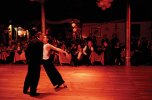
Close Embrace Tango Teachers

And their technique, your technique, did not evolve in 25 years?!
I don't know if the offenders' technique changed. People continually drop out of tango. Over the years, there were fewer and fewer chances of me encountering someone who hurts my back. While my technique has changed since I started, if you put weight on me, my back will hurt.
 
Now your partner relaxes and allows her upper body to "fall" towards you.
(This is best experiened without any contact with the arms.)
Like this from National Geographic December 2003. (Couldn't find it on their website so I can't give a link.)

gavito-dragone.jpg
Photograph by Pablo Corral Vega

TANGO
Lean Two

It's a signature move for Carlos Gavito: He stands casually, unmoving, hands at his sides. His dance partner, Mariana Dragone, leans into him, fully trusting, testing the limits of balance. "The simplicity of the style is the magic of it," says Dragone, who has been dancing with the popular Gavito—for pleasure, not professionally—since 1998. "There are moments of silence, of pauses, but the energy makes one feel reborn."
 
Perhaps at that early stage you were not sufficiently grounded
And floating in the air?

and their semi-apilado style was forcing you...
In those days everyone danced open. Some "advanced" dancers were told that Portenos touched their heads when dancing. These dancers then tilted their heads as far forward as possible to touch their partners' heads. Damn, I wish I had a picture of that.
 
Just going back to your question...
Does it matter? Why?
I wanted to learn a continuous left turn, something more interesting than what Homer Ladas (en.m.wikipedia[dot]org/wiki/Homer_Ladas) calls a paddle turn or what Rick McGarrey (www.tangoandchaos[dot]org) calls running backward. I was at a drop-in class at JournalInTime's old studio, and I asked the instructor for a continuous left turn in _close embrace_. He showed three turns in open. When I repeated, "in close embrace," he danced closer but still had an obvious gap between the torsos. I asked this forum for its definition in order to see if I was incorrect in my usage.
 
I wanted to learn a continuous left turn, something more interesting than what Homer Ladas (en.m.wikipedia[dot]org/wiki/Homer_Ladas) calls a paddle turn or what Rick McGarrey (www.tangoandchaos[dot]org) calls running backward. I was at a drop-in class at JournalInTime's old studio, and I asked the instructor for a continuous left turn in _close embrace_. He showed three turns in open. When I repeated, "in close embrace," he danced closer but still had an obvious gap between the torsos. I asked this forum for its definition in order to see if I was incorrect in my usage.
On that basic level I'll go with 'close embrace' is with torsos in contact, so 'closed' with no gap. All the rest is a stylistic implementation of dancing in 'close embrace'.

I didn't find that turn, assuming I've located the correct one, to be very elegant, although it gets you round. I can see why you were looking for something more interesting.
 
TANGO
Lean Two
That is a perfect illustration of how a larger body interacts with a smaller body...although she does not have her heels down, as far as I can see (I could be wrong.) They are in a(n functional) apilado position for sure.
(Although it's possible to be "grounded" ie your partner can feel where you are "in the floor," in general having heels down facilitates your partner's ability to feel where you are weighted.)
 
...instructor ..showed three turns in open. When I repeated, "in close embrace," he danced closer but still had an obvious gap.. I asked this forum for its definition in order to see if I was incorrect in my usage..
Hi Moustachio. First, did you learn it, and what sort of turn was it strictly speaking. Alone "turn" or giro is quite vague. Were you looking for the molinete-type, a pivot or an enrosque?

Second, you can do most tango figures to either side, but counter-clockwise is way more demanding. You need some degree of dissociation! So often that "gap" is owed to a lack of flexibility, instead of wanting.

Thirdly, I mean the term "close embrace" also is vague. "Close" is an embrace when you hold the follower at her left or right shoulder blade. So the gap depends on the "physique" of your partner and your arm length. In "open hold" you grab her at the rib cage or upper arm. More precise would be apilado hold (milonguero) or salón hold (villa urquiza style). With the former there should be no gap, with the latter there must be a gab on one side. Thus it is called "con luce". But both variants operate under the umbrella "close embrace".
 
Last edited:
I have attached a little vid of a counter clockwise swivel turn (pivot) in close embrace (milonguero style). It does not require that much dissociation.
 

Attachments

what sort of turn was it
I was looking for a continuous stationary (not traveling) turn to the left in a locked closed embrace where the girl does a grapevine step sequence (back, side, front, side, back, side, etc.). I can do the three turns (in open) that the instructor showed. I have not tried doing a paddle turn. In a paddle turn you put your weight on the foot you're going to pivot on and use your free foot like a paddle to turn your body around. I can do something similar to what Rick McGarrey calls running backward. I step only on the strong beat, so I guess Rick would call it walking backward.

I don't want to push the girl away (open up the embrace) in order to do a turn. If you're in a nice cuddly embrace, it's like being in a warm soft bed. Opening up is like being tossed out of bed.

I don't determine the embrace; the girls do.

In "open hold" you grab her at the rib cage
In public? :-)

or upper arm.
I've seen many cases where the girl has her hand on the boy's bicep, but I've never seen the reverse.

I have attached a little vid
I assume that was for me. Thank you.
 

Dance Ads

Advertise on Dance Forums Reach dancers, teachers, studios, event organizers, and dance-friendly brands. View ad options
Back
Top