Comp levels, divisions, categories, scholarship, rising star, multi-dance, etc.

It's not a bad idea to go to a competition and watch comps before you compete. It's just good to see how people dress, how the schedule goes, what's really involved in singles vs. multis and so on. Also, find out how much things are going to cost so you can make decisions you are comfortable with about number of entries. Depending on your personality, you might prefer to go to more comps a year, doing only rhythm at one and only smooth at another OR you might prefer to spend your budget on one and do both and so on.

Or of course, you might decide you don't want to compete, which is fine. That said, preparing for competition is motivating. Not sure if competition itself really helps if your main goal is not competition or show. But the preparing certainly does and its hard to prepare for competition if you don't compete!
 
I’m trying to figure out how to understand comp scoresheets. No doubt each comp does things slightly differently, but hopefully there’s enough consistency that y’all will be able to answer my questions about the redacted scores below.

1588807517759.jpeg
In the top row, I drew a blue rectangle around several numbers - I know those are the individual judge codes, because they’re identified elsewhere.

And in the far right column, I know those are the overall placements for that heat (1st thru 8th place).

But here are my questions.

1. In the middle of the top row, what is the significance of the number circled in red?

2. Below that, what do the two numbers inside the green rectangle mean, and why aren’t they sequential?

3. What are the numbers in the top row inside the red rectangle?

4. What is the meaning and importance of the numbers scattered randomly below those column headings? Why are so many boxes empty?

5. In the column headed “1-6” - what is the meaning of the 2 numbers circled in green?

Thanks in advance for your help!
 
I’m trying to figure out how to understand comp scoresheets. No doubt each comp does things slightly differently, but hopefully there’s enough consistency that y’all will be able to answer my questions about the redacted scores below.
All ballroom comps (excepting WDSF, I think) use the skating system.
1. In the middle of the top row, what is the significance of the number circled in red?
How many first place marks received by a couple
2. Below that, what do the two numbers inside the green rectangle mean, and why aren’t they sequential?
Couple 30 received 1 first place mark. Couple 34 received 4 first place marks.
3. What are the numbers in the top row inside the red rectangle?
How many 1st-through-nth place marks received by a couple. E.g., 1-6 means total number of 1st, 2nd, 3rd, 4th, 5th, and 6th place marks.
4. What is the meaning and importance of the numbers scattered randomly below those column headings? Why are so many boxes empty?
To win a particular place for the dance, a couple must receive placement from a majority of judges (3 out of 5 judges in this case).

Start with 1st place. Couple 34 has 4 first place marks, so they win 1st. Since their final placement has been determined, there's no need to fill in the remaining boxes in the row.

We move to 2nd place. Couple 30 has 5 1st-2nd place marks, so they win 2nd.

Now we count 1-3 marks. The remaining couples have only 1 or 2, which is less than the required majority of 3. So no couple has won 3rd place yet.

It's not till we count 1-4 marks that Couple 39 emerges with 3 (a 3rd, a 3rd, and a 4th place mark), so they win 3rd place.
5. In the column headed “1-6” - what is the meaning of the 2 numbers circled in green?
Counting 1-6 marks, both Couples 41 and 43 reach the majority of 3, each with 4 marks.

So counting 1-6 marks produces a tie. We break it by adding up the 1-6 marks.
Couple 41: 6 + 3 + 4 + 6 = 19
Couple 43: 5 + 6 + 3 + 6 = 20

Couple 41 has a lower sum, so the tiebreaker goes to them, they win 5th and Couple 43 wins 6th.
 
Last edited:
All ballroom comps (excepting WDSF, I think) use the skating system.
Also tyvm for this link. It answered all my other questions (about Recalls, quarter- and semi-final rounds, etc.). I found this example bizarre but strangely logical:

“RULE 8: WINNING WITHOUT A SINGLE 1ST PLACE
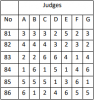
Let's go back to looking at 1st place. So far it's been easy because there has always been a majority, but what if there is no majority? Well, then it is determined who has the most 2nd or higher marks. If there is still no majority, we move down to 3rd or higher, and so on until some couple achieves a majority. In the chart below, no couple holds a majority of 1st places. In fact, no couple holds a majority of 2nd or higher, either, so we must move to 3rd or higher.

final_4.png

Couples 81 and 82 both hold a majority of 3rd places and up, and with couple 81 having more of them, that couple will win 1st place. It is interesting to note that not a single judge marked Couple 81 1st place, yet the Skating System will nevertheless result in that couple winning.”

Am I correct that the skating system would result in the following final placement order: 81, 82, 83, 84, 85, 86?

If so, it seems a tiny bit unfair, because if you add up the total points for each couple, the final placements would be 81, 82, 84, 83, 85, 86. It also seems more fair for 84 to place ahead of 83, since they got three 1st place marks and 83 only got one. And it also feels a little unfair that 84 got more 1st place marks than every other couple, but only wins 4th (or 3rd) place.

But I’m not going to question an established scoring system or propose any changes. I’m just thinking out loud. (Umm...typing out loud.)
 

Attachments

  • 1588847353233.png
    1588847353233.png
    11 KB · Views: 2
Am I correct that the skating system would result in the following final placement order: 81, 82, 83, 84, 85, 86?

If so, it seems a tiny bit unfair, because if you add up the total points for each couple, the final placements would be 81, 82, 84, 83, 85, 86. It also seems more fair for 84 to place ahead of 83, since they got three 1st place marks and 83 only got one. And it also feels a little unfair that 84 got more 1st place marks than every other couple, but only wins 4th (or 3rd) place.

But I’m not going to question an established scoring system or propose any changes. I’m just thinking out loud. (Umm...typing out loud.)
Yes, 83 will beat 84, and 84 will be 4th.

I understand why it looks unfair, but IMO on deeper analysis it actually makes a fair amount of sense--and it has a hidden benefit.

********

The reason it makes sense to me is that the skating system seeks to identify consensus. As an analogy, if this were a mathematical operation, it would be most similar to the mode as opposed to median or mean. Mode is the least-loved measure of central tendency in general, but it is useful when you're looking for an explicit pattern in a dataset where the number of unique values is relatively small.

Anyway, with respect to couple 84, the reason they do not win is that the judges can't agree on it. Three judges think they are the best, but the majority of judges find them to be fourth or worse.

By comparison, nobody thought that Couple 81 was best, but the majority felt that they were in the top 3--and it is only Couple 81 for whom they agreed on such a high placement. The next highest place they could agree on was couple 82, whom they unanimously agreed were in the top 4. Everybody else got polarized reviews that include two or more "bottom 2" marks.

*********

This is a system with plenty of apparent oddities, to be sure, but here's the hidden benefit: it degrades the impact of individual bias. In order for biased marks to be decisive, you need a majority of judges to be biased in the same way. Couple 84 is the perfect example. If we take away their first-place marks, the rest of the judging panel thought they should be fourth at best. Even with three judges giving a (potentially biased) "first place" mark, they couldn't place better than 4th. In order to win, they would have needed at least one other judge to agree that they were in the top 2, or two other judges placing them in the top 3.
 
This also demonstrates why it's nice to look at scores. If I was couple 84, and all I knew was I got 4th place, that would be one thing. But knowing 3 judges placed me 1st, and if I had swayed only one more judge to place me 1st or 2nd, I would have won, that makes it feel like just a near miss. But I also realize I'm either inconsistent and need to work on that, or there is something fundamental I do that some judges aren't happy with, so I have to figure that out. Similarly if I was couple 81, when I see the scores, I realize it's not a clear win at all, and next time when I get 3rd or 4th place, it will not be so surprising.

The skating system is just a resolution mechanic. It is no more or less fair than any other. It is essentially a popularity vote, how many judges placed you nth or higher, which is rather appropriate for dancing. When you look at a string of numbers, there are many stories those numbers tell. This story simply happens to be the one they chose to use for placements. You can derive the other stories yourself by looking at the numbers.
 
This also demonstrates why it's nice to look at scores.

To evaluate my performance, I tend to look at groupings. You might for example see two couples challenging for 1st and 2nd, three couples trading off / fighting for 3rd, 4th, 5th; and maybe 1 (or 2) couple(s) in 6th (or 7th place).

This kind of tells you who your competition is and how you compare against others. It could be one mark in one dance that determines whether one is 3rd or 5th in a multi-dance. Hence, when I look at scores I would not worry whether I was 3rd or 5th if I was clearly in that grouping . . . my thought goes to what I need do to get to that 3rd place by being closer to the couples competing for 1st and 2nd rather then worrying about the 1 judge who gave me a slightly lower mark that dropped me to 4th or 5th instead of 3rd. I'd rather lose to the 2nd place couple then squeak by the 4th place couple!
 

Dance Ads

Advertise on Dance Forums Reach dancers, teachers, studios, event organizers, and dance-friendly brands. View ad options
Back
Top