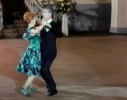
International Standard Waltz: CBM vs no CBM

On the first half of step 2, before the LF is planted, my mentors would often pivot on the RF to get more turn, plant the LF in CBMP as far inline to the RF as possible, toe turned in, and start resolving the CBM only when the RF closes to the LF. The hips resolve first followed by the shoulders.
Is the CBMP we're talking about here a continuation of the RF CBMP on 1 - that is, the left hip is moving forward of the right hip, so sort of a side lead with respect to the LF on step 2 - or is it a reversal to CBMP with respect to the LF on step 2, and the right hip is now moving forward faster than the left hip?
 
Interesting point.
I've always believed that after a certain point in training, we don't commit errors any more; rather we commit mistakes. The former is caused by a lack of understanding, while the latter is caused by variance in style or accuracy or both.
I'd say, rather: past a certain point, we don't commit errors, we have a personal style. I'm not talking syllabus dancers, obvs. Otherwise, why is there even a difference between, say, the Hiltons and Hilliers or Wood/Lewis, or Sinkinsons? Sometime, it stops being mistakes, and becomes style.
And no one was more accurate than the Hiltons. When they placed their feet, it never got reset nor caused them to be out of position.
It was hyper-accurate every time, placed with considerable forethought on its effect on the next two steps.
Clean as can be. The best videos I found for absolute precision, especially her. Her footwork knocks me out.
 
I'd say, rather: past a certain point, we don't commit errors, we have a personal style. I'm not talking syllabus dancers, obvs. Otherwise, why is there even a difference between, say, the Hiltons and Hilliers or Wood/Lewis, or Sinkinsons? Sometime, it stops being mistakes, and becomes style.
I agree with this... If it is done intentionally, with purpose and reason, exactly as the dancer means to do it, it is no longer an error or a mistake. I see an error as something we might do because we have a lack of knowledge in an area. I see a mistake as something we do because our body is not trained enough... Maybe in isolation we can do it correctly, we know the theory, but in the middle of a line, we fail to execute it. I make a lot of mistakes.

Most top professionals make minimal mistakes (they still make them, they just make them 1-2% of the time instead of 50% of the time). They rarely have a lack of knowledge, they have heard every angle, every view point. However, they do sometimes make controversial choices.

Regarding style, it should be noted, beware of someone who might say "Reverse turns are too hard so I decided it's not my style." That is not style, that is inexperience.
 
Regarding style, it should be noted, beware of someone who might say "Reverse turns are too hard so I decided it's not my style." That is not style, that is inexperience.
I remember one time I was trying to figure out some subtlety about outside partner, and I searched through that year's Blackpool video to find one of the top professional couples doing outside partner to try to figure it out. None showed up until most of the way through the foxtrot in the final. Then I realized the former top couples with whose dancing I was familiar also tended to avoid outside partner actions, preferring in line actions, such as preferring continuous waves to reverse wave back feather. When I finally found a video of the then World and British champions doing outside partner - in a demo, not in a competition - it actually didn't look very good, with the man's right hip pushing through and pushing the lady's hips out of the way.

So, I suspect outside partner actions are too hard for some top couples and they avoid doing them, or at least they did at the time. Inexperience, not style? Eggleton, with his desire for the man to move "sideways" in the feather step, might have called that right hip a "mistake", or even an "error".
 
Last edited:
I'd say, rather: past a certain point, we don't commit errors, we have a personal style. I'm not talking syllabus dancers, obvs. Otherwise, why is there even a difference between, say, the Hiltons and Hilliers or Wood/Lewis, or Sinkinsons? Sometime, it stops being mistakes, and becomes style.
Maybe different couples have different strengths. The Hilliers were closest to the same height, making it easier for them to maintain more perfectly parallel shoulder lines. John Wood was much taller than Anne Lewis, so she had to use amazing foot and ankle articulation to keep up with him, and once she had them, she could use them everywhere. The Hiltons always seemed to have a special rapport that gave their partnering a special quality. The Sinkinsons seem to have been expert at the technique of lead and follow, in ways that were transferable to and served them both well in later partnerships, and while still together the magical accuracy with which Loraine's feet followed Andrew's was spooky.

Maybe the different couples were making different mistakes. Maybe different judges and coaches disagree on what the correct action is, and what is "style" to one is "error" to another. Certainly if one followed the "How the Judges Saw It" column in "Dance News" at the time, it wasn't hard to tell from the marks which couples were from which schools.

Sometimes, maybe John Wood would seem to squeeze a fourth beat out of the end of each bar of waltz, and most of the audience might marvel at the musicality and style - but maybe some of the judges would consider it to have overstepped the bounds of "style" and become merely "off time".
Clean as can be. The best videos I found for absolute precision, especially her. Her footwork knocks me out.
I love Karen Hilton's footwork too, but one local coach apparently disliked it. Unfortunately I never heard what specifically he disliked. Then again, every couple I knew said he was their worst judge, so maybe he disliked everything!
 
There has definitely been a change in the way CBM is interpreted and used. First one has to consider that a step commences with the feet together, weight on one foot, and ends with the feet together, weight on the other foot. One has CBM on step 1 of most progressive turns (e.g. Natural and Reverse Turns in the waltz, foxtrot, quickstep). The Technique does not prescribe an alignment for the body, but in classical interpretations, when turning right, the body is ahead of the standing foot by the end of the step. This means that the torso is almost facing the wall by the time step 1 of the Natural Turn in waltz ends. In contrast, the foot only "commences to turn", which suggests at most a negligible amount of turn out when moving forward.

Reverse turns have CBM technically described in the same way, but in practice far less CBM is visible, because it is not needed (the dancers "change places" later in a reverse action). Notice however that most dancers seem to use more foot turnout when stepping forward into a reverse turn.

Classical principles made dancing easy, but that was not enough for contemporary competitors who wanted to increase their visual "impact" so things started to change around 20 years ago. People today commence the waltz Natural Turn leaning to the L and with the body turned to the L of the feet; this allows them to show that swayed "body line" longer, and more dramatically reverse it during the Natural, artificially increasing the amount of body activity. The body is a best "square" (feet and body aligned) by the end of step 1. This can still be considered CBM to the extent that the body has turned faster than the foot (which has not turned). This also happens in the Feather Step; people are now square at e/o step 1 and therefore must continue to turn their bodies on step 2 if they are to create an outside partner position. This ruins the beautiful ease displayed by older generations in this figure, but it is now the norm.
 
Eggelton has a different take on this. He stated that CBM should be kept to an absolute minimum.
But are you sure this is the way he actually danced? Below is a still of Peter and Brenda at the end of step 1 of the Natural in waltz. Not only he has turned his RF out somewhat relative to the previous alignment (the "commencement of turn"), but his body is almost facing the wall as I described above. His execution seems very compatible with classic CBM. Also look at the lady's body.

Screenshot from 2021-09-05 18-13-39.png
 
Sorry if I ask a provocative question, tyner: Does it matter whether with or without CBM? It's only important that you master both variants, right?
 

Dance Ads

Advertise on Dance Forums Reach dancers, teachers, studios, event organizers, and dance-friendly brands. View ad options
Back
Top