Standard Geekery

What's speed got to do with it?
Directly? Nothing at all. I left out detail in that thread because I didn't think it was the place for it. I spoke in terms of velocity as a way of emphasizing the difference in momentum usage between AT and ballroom, despite the fact that both are traveling dances and so theoretically can "move the same distance."

But consider what we mean when we say that someone has good body flight. We mean that their movement is especially smooth and continuous, and especially large and dramatic. Better continuity is the principal element, but given the same degree of continuity, larger is better.

But in most cases, dancers with good flight aren't achieving that size by taking more steps and doing lots of subdivision. They do it by moving further in individual steps. And if they are moving further with the same number of steps taken over the same period of time, then they are moving faster.

In other words, if we want a big-moving natural turn, that is equivalent to saying we want a fast-moving natural turn (measured by peak velocity).

Now, one could counter that bigger movement is not or should not be a goal in ballroom. In that case, I would agree that we live in different worlds, from an artistic sense, and my definition of flight is over-defined.
 
one could counter that bigger movement is not or should not be a goal in ballroom
Is this maybe a personal preference, or dependent on how one was trained? My teacher wants bigger movement, longer steps, more powerful strides, more distance traveled across the floor, etc. He also wants bigger shapes both in and out of hold…everything stretching up and out and forward and back and towards the floor and toward the ceiling (all at the same time of course). But idk if all teachers want that, or if all judges look for that.
 
Is this maybe a personal preference, or dependent on how one was trained?
In my experience, the modern culture of ballroom has been pretty universal on this point.

However, there are many learning approaches that do not pursue size & distance directly (or even frown upon explicitly reaching for it), because there are many more wrong ways to do it than right ones. Plus, you naturally gain the ability to move bigger as you polish your baseline skills. But I would say that, all other aesthetics and technique being equal, bigger movement is consistently preferred today. I have found this to be true in social environments as well as competitive ones.

I don't think that has always been true historically, which is why I leave the door open for dissent.
 
But consider what we mean when we say that someone has good body flight. We mean that their movement is especially smooth and continuous, and especially large and dramatic. Better continuity is the principal element, but given the same degree of continuity, larger is better.
I would agree that "smooth and continuous" are positives and are connected to the concept of "body flight". I disagree that it has anything to do with "large" or, especially, "dramatic" - if anything, good body flight is connected with subtlety and understatement, less drama rather than more. I question your use of "we" here; it brings to my mind one of ADM Rickover's favorite quips when he caught someone using the word ("the only people entitled to use "we" are the Queen of England and a pregnant woman; which are you?" This was before Elizabeth R died, of course.)

A counterexample would be the viennese cross turns in Standard tango: they are supposed to move rapidly across the floor, but they are absolutely not supposed to be flighted.
Is this maybe a personal preference, or dependent on how one was trained? My teacher wants bigger movement, longer steps, more powerful strides, more distance traveled across the floor, etc. He also wants bigger shapes both in and out of hold…everything stretching up and out and forward and back and towards the floor and toward the ceiling (all at the same time of course). But idk if all teachers want that, or if all judges look for that.
Your teacher is European - as in Continental - trained; the general belief there is that "bigger is better", because it's believed to make one more visible to the judges. This is even generally correct for Continental European judges, and has some validity in preliminary rounds up to the quarterfinal in most competitions.

In England you will hear more about the "quality of dance", which is not thought to correlate with the size of, especially, shapes.

It's absolutely dependent on how one is trained. 14 year old gets positive remarks on his amount of movement from time to time, but he has not, in general, been trained to attempt to get large amounts of movement; rather, he has been taught that movement occurs as a result of accurate technique, and improving his technique is how he achieves more movement.
 
But idk if all teachers want that, or if all judges look for that.
My teacher agrees with your on the "big" thing. My understanding is that at least for smooth current judges are heavily swayed by this-- whether or not they specifically state it's an objective metric. Of course, big/fast not the only thing. Dance is not the 100 m dash. But 'big in volume' taken up by arm and body motions and 'big in distance' traveled over a specified number of beats is admired right now.

All this "big" has to be achieved with a mostly continuous smooth look. This is not to say the smooth can't be interrupted by some intentional dramatic direction changes and so on. But you don't want a hurkey-jerky start-stop looking motion. I think to some extent, "body flight" is to some extent achieving this fast, continuous smooth motion in a way that doesn't look like "step-stop-step-stop-step-stop-step" that is extremely apparent in beginners and which takes a great deal of practice to entirely eliminate, because, after all, your feet do take steps. But you don't want that to be apparent in the motion of the body.
because there are many more wrong ways to do it than right ones.
Like possibly "reaching" with your legs, landing the foot and then 'pulling' your body? Or "pushing" like you are on a weight machine doing leg presses? I'm sure I've explored all the wrong ways to move. Though perhaps with effort I may be able to discover more.

[...] I would say that, all other aesthetics and technique being equal, bigger movement is consistently preferred today. I have found this to be true in social environments as well as competitive ones.
Me too. On dance floors, audience eyes are drawn to couples who are moving.
I don't think that has always been true historically, which is why I leave the door open for dissent.

There are entire classes of dancing where translational motion, speed,volume are not valued. But I suspect when there is motion, lack of "hurkey-jerky" is always valued. Like for example, Irish dance.
In all dance categories, which sort of 'dance' features are more valued are going to change.
 
As about competitions, no matter European or not, I suppose that between two couples at similar technical level, the one covering more distance will gain more attention by both public and judges

But as hobby/social dancer, I have no judges and don't care is somebody actually watching me. However, speed of movement is important to me. Above some point, I feel that inertia and dynamic balance start playing big enough role in my movement. What I want is to still have experience of high smoothness despite the speed, like being on rails curving smoothly along the room, definitively no drama. It's what I liked immediately when I danced waltz for the first time with my teacher

Below certain speed, that sensation is gone. Maybe body flight is actually not the right term for this, not sure. We didn't use that term in my long gone competitive days, I heard it maybe 10 years ago for the first time and I know it is used only for "swing" BR dances, so BR tango excluded ...
 
Is this maybe a personal preference, or dependent on how one was trained? My teacher wants bigger movement, longer steps, more powerful strides, more distance traveled across the floor, etc. He also wants bigger shapes both in and out of hold…everything stretching up and out and forward and back and towards the floor and toward the ceiling (all at the same time of course). But idk if all teachers want that, or if all judges look for that.
You are at a stage in your dance learning where your movement and shaping can be bigger, and he'll ask for it. That's not the same as body flight. Not.
 
But consider what we mean when we say that someone has good body flight. We mean that their movement is especially smooth and continuous, and especially large and dramatic. Better continuity is the principal element, but given the same degree of continuity, larger is better.
Larger is larger. Poorly produced larger is still larger, and still poorly produced.
But in most cases, dancers with good flight aren't achieving that size by taking more steps and doing lots of subdivision.
What is "subdivision"?

They do it by moving further in individual steps. And if they are moving further with the same number of steps taken over the same period of time, then they are moving faster.
What do you mean by "moving further?" Taking a bigger, wider stride? What does that have to do with moving faster? I can stand still and swing the non-standing leg a long way, push a lot from the standing leg, and still be on time; to me, moving faster implies something other than being on time.

In other words, if we want a big-moving natural turn, that is equivalent to saying we want a fast-moving natural turn (measured by peak velocity).
Beg to differ. If I want a big moving natural turn, I need to swing bigger. Not faster.

I get the feeling I don't understand your language, but we may be talking about the same thing, with totally different concepts behind it.
 
Last edited:
What is "subdivision"?
I suspect what he means is that unlike runners or walkers who can do more steps per minute, dancers can only go faster by moving further in the number of steps they take.

This would be "subdividing the beat", if say, you suddenly switched from foot steps on 1,2,3 and instead managed to manically step 1&2&3&.
What do you mean by "moving further?" Taking a bigger, wider stride? What does that have to do with moving faster?
To have the simplest discussion of "fast", I'll stick to discussing translation in a straight line, if a beat takes 1 second and you move your center of gravity 3" forward you are moving 1/4 fps. If the beat takes 1 second and you move your center of gravity a foot, you move 1 fps. Since we do use our feet, the later generally involves taking a longer stride.

(Edit for the metric onlies: there are 12" in a foot. And fps is feet per second. oy! :) )

So this is the way in dancing. If you were, instead, running the 100 yard dash, different people can plant their feet a larger number of strides per minute.
I get the feeling I don't understand your language, but we' may be talking about the same thing, with totally different concepts behind it.
I suspect you are taking for granted the fact that in dancing, the beats are determined by the music. So you are going to take so many footsteps per minute.

Average linear Speed = (Distance traveled in a foot step)* (number of footsteps)/(amount of time).

In non-dance life a runner or walker can vary this part: (number of footsteps)/(amount of time).

You know that the dance and music dictates this part: (number of footsteps)/(amount of time). So if the music and choreo are predetermined, the dancers increase speed by moving further-- they increase (Distance traveled in a foot step.)

One can think of the end result as "increasing speed" or a dancer can think "all I'm doing is moving more in each foot step".

There is also rotational speed, but I'm not going to discuss it beyond saying it's this:

Average rotational Speed = (Angle turned per step)* (number of steps) / (amount of time).
 
backing away slowly
Instead, to help us understand the term, could you post a video of what you mean by body flight? Or two videos of the same step/sequence, one done with only a little body flight and one done with lots?

I thought I understood the term but after the back and forth above I'm not sure anymore.

As a side note (directed to no one in particular) I always thought it was odd to talk about moving the spine across the floor in ballroom. Unless someone is very, very seriously injured (and unlikely to be dancing in that state), it's impossible to move the spine anywhere without taking the rest of you along for the ride. I understand from the dancer's perspective, that you may need to feel like you're moving your spine somewhere to create the right movement quality, and so that's how some teachers may describe it and how a dancer may think of it. But to then describe it like that to a potential spectator seems a bit odd.
 
Ok, no need to complicate that much. "Moving with higher speed" in this case means just doing larger steps
 
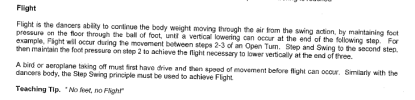
Found one definition of the term in Geoffrey Hearn book that comes together with Gozzoli's videos Advanced standard ballroom technique. Probably not the best one possible, but ...

It is shortly demoed in chapter 8 of the first DVD

013313.png
 
Larger is larger. Poorly produced larger is still larger, and still poorly produced.
Yes, completely! And your raising of this point is a perfect example of how good teachers are careful to warn us that bigger is not automatically better. Quality first, always.

But that's why I include the caveat of all else equal. Because I think it would be pretty widely agreed that If you consider two couples with perfectly identical movement quality, whichever one is making bigger movements will be judged better. It isn't that size is the most important feature--far from it--but ballroom is a style that is always reaching out for as much distance and volume as the dancer can produce with quality.

Which is actually a pretty unusual characteristic for a dance style! It does not hold true in Latin or Rhythm, for example, even in the traveling dances underneath those umbrellas. In fact, in those styles, big steps are sometimes interpreted as indicative of a fundamental flaw, even if the movement quality is otherwise good.
 

Dance Ads

Advertise on Dance Forums Reach dancers, teachers, studios, event organizers, and dance-friendly brands. View ad options
Back
Top