itwillhappen
Forum Master
Do you as a male Northern Germany DJ have chances? And how often do you mail organizers?And of course mail our organizers, a nordic DJane will have her chances!
Last edited:

Ask questions, meet dancers, and be part of the conversation.
Do you as a male Northern Germany DJ have chances? And how often do you mail organizers?And of course mail our organizers, a nordic DJane will have her chances!
There are many, many more, but a journey has to start somewhere.If you leave the simplicity and limitations of a streaming service, there are many new freedoms, but also many new tasks, in the medium term.
You could at least have plans for how to:
1) Organize your music files?
2) Organize your metadata?
3) Check the structure of your playlists and tandas?
4) Prelisten over headphones?
5) Adjust the sound?
6) Insert breaks between songs?
7) Make backups?
8) Mirror to backup devices (smartphone, tablet)?
9) Maybe also visualize information?
...

This is the one I wish more DJs would do! One or two DJs project the specific songs playing, which can save some Shazamming when I discover a new one I like, but the single most useful thing is to know the orchestra for the next tanda.9) Maybe also visualize information?
This is the one I wish more DJs would do! One or two DJs project the specific songs playing, which can save some Shazamming when I discover a new one I like, but the single most useful thing is to know the orchestra for the next tanda.
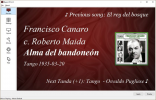
 www.beam-project.com
Where I will use the software next are half of the invites during the cortina, however.I am not sure whether projecting this information about the next tanda is a good idea. It encourages people to invite during the cortinas or start thinking about their next partner while they're still dancing with their current one.
It works well. At least you don't have people standing around blocking the floor. And it gives a time for a sensible cabeceo.I am not sure whether projecting this information about the next tanda is a good idea. It encourages people to invite during the cortinas or start thinking about their next partner while they're still dancing with their current one.
In Germany this is more of a legal than a moral issue as there is no agreement with Argentina regarding copyright fees so these go into a pool for local musicans. Well, it distorts competition with other organizers.I could add legality - both copyright and public performance (and that depends on your locale and your own moral approach).
It also depends who owns the copyright, which can be complex. It's not necessarily in Argentina and Amazon bought up a whole load - and that may have extended them. Of course, if you use modern recordings by contemporary bands, that's another matter.In Germany this is more of a legal than a moral issue as there is no agreement with Argentina regarding copyright fees so these go into a pool for local musicans. Well, it distorts competition with other organizers.

The big labels already consider the digitization and filtering of GA pieces as a new production, which resets the expiration date to zero. The protection of copyrights is handled differently in each country. In Germany, the traveling DJs are not so much in focus, but rather the dance studios and commercial organizers. I asked the organization that collects royalties in Germany about the downloads. They replied that the fees are collected immediately with every physical or streamed download...many GA era recordings are out of copyright and nobody is going to bother about a small event in a village hall, which may or may not be true depending how many tracks have been downloaded.

Depends. Many of those CDs being issued are copyrighted by the labels that produce them. I don't think you can assume that they are out of copyright across the board. In the US, commercial venues that play music at events have to pay an annual licensing fee for that music. Not all of venues demand it but many do. It can amount to several hundred dollars a year for a small space.and generally the feeling is that many GA era recordings are out of copyright and nobody is going to bother about a small event in a village hall, which may or may not be true depending how many tracks have been downloaded.
What is unified tagging? The year of publication for a GA song is in most cases seen as the date of digitalization, not the release of the original shellac...song with unified tagging..