Tango plateau - been there? how handled it?

I was told early on by my very traditionalist teachers that everybody is terrible for 3 years and that I wouldn't be dancing in crowded milongas before then.
I think one of the luckiest things to happen to me in tango was going to BsAs as my present to myself for making it a year into tango. I had absolutely no idea what a brave/foolish idea that was, so when I found myself in crazy crowded milongas where everyone had to dance small, it was a sink-or-swim moment.

Fortunately, I had very good teachers, both here and there, so I very quickly learned how to swim.

It also showed me what tango could be like, with the right people, in the right place, and I think that more than anything saw me through other tough times ahead.
 
I tell all the newcomers I accompany and teach to think of tango in years. Saves them a lot of time and money if they quit right then.

Unfortunate, but necessary. I just wish there were an easy, reproducible way to show newcomers just what tango could be like, to give them a taste of what it feels like as an experienced dancer when dancing with another compatible dancer. It's a catch-22: most won't stay unless they experience that feeling, but most won't experience that feeling if they won't stay. Unfortunately, that elusive state of flow is less easily achieved in tango compared to many other social dances.
 
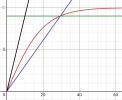
I'd call that a technical difference . . . They're aiming too high for the time they've allotted. I'm not going to create another graph because the last one was distractingly colored, but if you're aiming 45° above the horizonal and real progress slopes at closer to 30°, then whether you're aiming at a target 1 second or 10 seconds away for your projectile, you'll be aiming too high.

Allow me to illustrate it! Consider a sigmoid function for a non-negative domain, starting at 0 years/experience and converging to some upper bound which marks the highest level of ability/skill/level/whatever one is able to physically achieve.

1000126024.png

Red curved line: average "level" of a person over time

(Arbitrary values) Say a person's absolute highest level is 10, which takes about 60 years to get appreciably close to. Their goal is a 9, which is denoted by the green horizontal line.

They think that they can get to 9 in 10 years, which is illustrated by the leftmost black diagonal straight line. But in reality, the trajectory [?] would be closer to the rightmost blue diagonal straight line - about 29.5 years.

Hope this helps ;)
 
Stagnating… that’s the feeling that should maybe trigger the decision to invest some money in some private lessons and/or some travels to new scenes/events? I’ve been there. I wondered if the reason I was no longer growing was me or the limited partners I had access to in my small scene. It turned out it was both. What I needed most was more experience with better partners and to build my confidence that my basis was solid.
I grew tremendously once I was in a new scene. People I danced with in my new scene thought I was much more experienced than I was, thanks to those extra privates where my maestro would make sure my fundamentals were solid. So it became an upward spiral. Gaining confidence gaining experience.

Now, one of my main partners is having stagnation issues. My observation is that it has mostly to do with attitude and priorities. Because he has danced for over 3 decades, he thinks he doesn’t have to work on basic stuff. Yet he has tremendous bad habits. He complains others are not continuing to evolve. He complains that his partners don’t have a good level. He complains certain dancers no longer will dance with him. And never questions if his issues stem from himself. He thinks he is continually evolving but in fact he is perceived as stagnating from his partners. His experience
Is stagnating. So, a different kind of stagnation than the classic learning-a-new-skill perceived plateauing.
 
I think people experience that not because their goals are too high, but because they have little idea of how much time, effort and patience it takes to reach something approximating their goals. They cannot take a long-term view of things, and so they expect to reach their goals fast. Or at least fast enough that they're inevitably disappointed over and over again.
Good points. I think you need to have reasonable expectations of what you can achieve within a given amount of time given your own limitations. Those can include, age, weight, height, flexibility, agility, athleticism, physical training, etc. If you start dancing at the age of 18 and keep going, you have a lifetime to develop your dance. Start at 50 or 60, well, not so much, you work with what you have. The playing field is not even. Many contemporary professionals have dance backgrounds, some others have lots of physical ed in their backgrounds or are physical trainers themselves. But most of us aren't working toward performance as a goal. But we do need to be serious and work at it all the same.
 
Now, one of my main partners is having stagnation issues. My observation is that it has mostly to do with attitude and priorities. Because he has danced for over 3 decades, he thinks he doesn’t have to work on basic stuff. Yet he has tremendous bad habits. He complains others are not continuing to evolve. He complains that his partners don’t have a good level. He complains certain dancers no longer will dance with him. And never questions if his issues stem from himself. He thinks he is continually evolving but in fact he is perceived as stagnating from his partners. His experience
Is stagnating. So, a different kind of stagnation than the classic learning-a-new-skill perceived plateauing.

I think that's just him refusing to do any form of self-reflection. Maybe more partners should stop dancing with him and shock him out of his self-induced self-absorption.
 
..danced for over 3 decades... complains others are not continuing to evolve... complains that his partners don’t have a good level... complains... He thinks he is continually evolving but in fact he is..
..more partners should stop dancing with him and shock him out of his self-induced self-absorption.

I would like to defend him a little.
I see clear signs of the Red Queen Principle !

As you get older, it becomes more and more difficult to maintain your previous standards. Even experienced dancers have to practice more, work harder, and analyze more than advanced beginners. The Red Queen Effect can manifest itself in a plateau, but it actually is a falling back, losing, declining.
Added to this are micro-alienations with the currently predominant dance style. How often have I changed my foot technique in my 24 years of tango? Heel-first, toes-first, heel-first again, ball-first, etc. As I wrote in the Jorissen thread, people danced very differently 30 years ago.

RedQueen.jpg
 
Last edited:
more partners should stop dancing with him and shock him out of his self-induced self-absorption


He’s not a lost cause. Otherwise I wouldn’t consider him one of my main partners.

If one is unhappy you have two choices: change your circumstances or change your attitude.

But if you don’t know how to change things like focusing on fixing the technique that’s making others not want to dance with you… Or being so sure the problem lies with everyone else…

It brings up the issue of having learned a long time ago when tango instruction wasn’t much more than some good dancers showing a move and leaving it up to the students to figure out how to do it.
I would like to defend him a little.
 
As you get older, it becomes more and more difficult to maintain your previous standards. Even experienced dancers have to practice more, work harder, and analyze more than advanced beginners. The Red Queen Effect can manifest itself in a plateau, but it actually is a falling back, losing, declining.
Added to this are micro-alienations with the currently predominant dance style. How often have I changed my foot technique in my 24 years of tango? Heel-first, toes-first, heel-first again, ball-first, etc. As I wrote in the Jorissen thread, people danced very differently 30 years ago.

But if you don’t know how to change things like focusing on fixing the technique that’s making others not want to dance with you… Or being so sure the problem lies with everyone else…

Whether or not he has the tools to improve, it is his attitude that irks me so. The I can do no wrong attitude is simply wrong in any and all cases. Such ego and arrogance has no place.
 
Whether or not he has the tools to improve, it is his attitude that irks me so. The I can do no wrong attitude is simply wrong in any and all cases. Such ego and arrogance has no place.
Whilst I agree about someone who isn't a maestro, maybe I'd expect that from someone who is/was recognised as such - and has kept up.
 
Whilst I agree about someone who isn't a maestro, maybe I'd expect that from someone who is/was recognised as such - and has kept up.

I've spoken with plenty of prominent, globally-recognised maestr@s — all of them never gave me a hint of that attitude. Granted, I've also heard things about other dancers on that level. It's usually more (relatively) minor ones that have plenty of ego.
 
Stagnating… that’s the feeling that should maybe trigger the decision to invest some money in some private lessons and/or some travels to new scenes/events?
Taking lessons and traveling, or traveling to be able to take better lessons, seems to me to be a good strategy. That is, if you like learning and like traveling.

Now, one of my main partners is having stagnation issues. My observation is that it has mostly to do with attitude and priorities. Because he has danced for over 3 decades, he thinks he doesn’t have to work on basic stuff. Yet he has tremendous bad habits. He complains others are not continuing to evolve. He complains that his partners don’t have a good level. He complains certain dancers no longer will dance with him. And never questions if his issues stem from himself. He thinks he is continually evolving but in fact he is perceived as stagnating from his partners. His experience
Is stagnating. So, a different kind of stagnation than the classic learning-a-new-skill perceived plateauing.

But here the case is completely different, it's more about secondary goals, more about "just getting something". That might work, but it would require feedback and a more accurate model of the situation. For feedback, again I think traveling together, i.e. car and accomodation pooling, going out to eat (and drinking alcohol) is quite helpful.

But to be honest, it will be easier if he writes off the "lost followers" for a foreseeable future.
 
Unfortunate, but necessary. I just wish there were an easy, reproducible way to show newcomers just what tango could be like, to give them a taste of what it feels like as an experienced dancer when dancing with another compatible dancer. It's a catch-22: most won't stay unless they experience that feeling, but most won't experience that feeling if they won't stay. Unfortunately, that elusive state of flow is less easily achieved in tango compared to many other social dances.
There is a way:
  • 2nd (or higher) level class occurs 1st (or a practica)
  • Beginners class occurs 2nd
  • Have 5 to 10 minutes of informal practice before the beginners class
  • Encourage the advanced dancers to practice with the beginners. Better yet, offer that advanced dancers can take the beginners class for free.
  • Bonus: That I have seen, male leaders are more likely to repeat a beginners class than female followers, so it helps gender and role balance, too.
This was a factor when I was beginning. I remember my first Tango class. On top of my Tango Distance Dystopia, I was having the usual beginner leader beginner follower, blind leading the blind challenges. When I had a turn with an experienced follower, I had a glimpse of the magic. Amazing! This lady is effortlessly and perfectly following my lead! It was encouraging, plus made it clear my dear wife and I were doing it wrong.

To flip it the other way, I still do beginners classes sometimes (and still learn from them!). Followers will say things like "I can tell what you want" or "It's so easy to do with you!" and have huge smiles. I tell them it's just some experience and the other gentlemen will get there.

I have done beginners classes on my travels. Instructors have run up to me afterwards and invited me to come back -- that's smart. Leaders, particularly experienced ones, are in short supply in beginners classes.
 

Dance Ads

Advertise on Dance Forums Reach dancers, teachers, studios, event organizers, and dance-friendly brands. View ad options
Back
Top