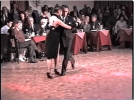
The Booty Misconception

Imagine that you are standing straight and tall. Now look down at your belt buckle (or cell phone!). Rather than being in line above your feet, pelvis and shoulders, you let your head go forward.
Women sometimes "drape" themselves over their partner because they not only have their arm over the man's shoulder and behind the head, but allow more than a minimum of weight to be on that arm and their partner.

"There is a certain amount of butt visible on both sides."

The "forward lean" can/should come from the ankles and/or the knees. If it comes from the pelvis, the booty can be more noticeable.

This style comes from the center of Buenos Aires where milongas were crowded. Cacho Dante went their to dance because in the other parts of the city in his day mothers accompanied their daughters to milongas to keep an eye on them. With limited space and respect for other couples big flashy moves were not welcome.
"Clean lines" and how things looked to observers was unimportant.
What is important is the connection between the partners.
Dennis and Tyree aren't doing much with the music. Maybe I'll just leave it at that.
Thanks for explaining re the head movement, and the origins of this style.It's interesting how function can lead to form.

Look at how much they do with the music while using limited space.
Also note that the other couples probably aren't thinking gotta stay away from them so we don't get kicked.

PS I hope you take the time to read the text that goes along with ArbeeNYC's post to understand why some of us prefer this style. But, yeah, for me it was like learning a new dance after a year of that other stuff (with tongue in cheek!)

Can I infer from your message here that you came back and learned milonguero style? I'm therefore intrigued about what kind of style you were dancing before, and why you changed (perhaps for practical reasons re space on a limited dancefloor?).
 
..this is a rough idea of the spirit and form of the dance..
This is certainly not a specific style. However, such couples are not that rare. My analysis:

-The leader performs a vertical bobbing motion before each step. His intention is directed upwards, instead of into the ground. He doesn't project his steps either, but rather pushes physically his partner forward. Somehow very predictably he regularly switches to the cross system, only to quickly return to dancing in parallel after sone ochos again.
-The follower shows too little leg extension.
 
when I went to a different tango school, I was confused by them asking me to step in-line, rather than slightly outside the follower. Just thinking out loud here.
I would suppose that someone consciously stepping slightly outside the follower's line is a relative beginner who is afraid of stepping on her feet.
 
Last edited:
..someone consciously stepping slightly outside the follower's line is a relative beginner..
It sounds like it's taught in that studio. I also remember my first group lessons, and they taught tracks. Everyone had to learn to walk two-tracked, then in three tracks with one foot outside on the left and the same on the right. Four-tracked was also covered.
..who is afraid of stepping on her feet.
I refer to beginner-I which was taught in practice hold. So feet were far enough apart.
 
This is certainly not a specific style. However, such couples are not that rare. My analysis:

-The leader performs a vertical bobbing motion before each step. His intention is directed upwards, instead of into the ground. He doesn't project his steps either, but rather pushes physically his partner forward. Somehow very predictably he regularly switches to the cross system, only to quickly return to dancing in parallel after sone ochos again.
-The follower shows too little leg extension.
Can you explain what it means to project your steps?
 
Of course, there can be all sorts of reasons to step outside the follower's line - for instance, to better prepare for the next step.

But I was referring to the parallel system; here, he is moving in the crossed system, where there is usually no other way to do it.
Good point, thank you
 
Can you explain what it means to project your steps?
(sorry for using him and her, projection works for any gender)
I would say projection is the most ellegant lead-follow technique, enrosskay. And besides, you avoid ever stepping on your partner's toes again. The leader shows the follower the step direction and step length in advance by changing his hip position. This prompts the follower to extend her leg backward without shifting her weight. This type of lead-follow works through communication, instead of physically pushing the follower in the desired direction.

How it works in a close embrace: The couple stands parallel in front of each other, closed at sternum height. The desired direction is now indicated by a pelvic torsion. The leader presses his supporting leg into the ground and lifts the hip slightly on the side of his free leg. The spine transmits the hip action to the sternum. Based on the degree of torsion, the follower knows how long her step will be before the leader even begins to move.

Javier in the vid TT has shared uses step projection, while Dennis in your first vid does not. You can clearly see that Stella moves her leg before Javier moves his torso. In your vid its the other way round, Tyree only extends her legs after Dennis already had begun to move.
 
Last edited:
But is the walk 'supposed' to be in-line or outside the follower? I guess it depends on the step. But imagine from the embrace the leader just goes straight ahead

You are in-line with the follower. (Of course, there are things you can do in cross system as well, but we're talking about the basic caminata here.)
Until Steve pointed it out, the nuances here did escape me.

The leader here is clearly a very accomplished dancer. My musicality improved just by watching him there.

These guys were very familiar with the music.
To me, the milonguero style looks like a dance which would feel very nice to dance, and I enjoy watching it when executed so well like that. It still doesn't give me the rush of emotion that I would get watching Osvaldo Zotto and Lorena Ermocida – I prefer more 'active' leaders and more dramatic moments. It's a taste thing I guess. But then I also don't like tango escenario, or the work of Zotto's brother Miguel, which I find too showy — there is no suspension before the denouement.

Zotto is very accomplished. But performance is performance and not social tango. Don't confuse the two. Personally, I've never been drawn to that style of dancing.
 

Dance Ads

Advertise on Dance Forums Reach dancers, teachers, studios, event organizers, and dance-friendly brands. View ad options
Back
Top