What really happens in leading and following?

Warren J. Dew

Forum Master
I know the lesson lucia is talking about. This is similar to the corporate "make a decision once you have 70% of the information", rather than sitting on your hands waiting until you are 100% sure.
I can sort of understand this in the context of beginners who are leading or following one figure at a time, but I'm having trouble making sense of it in the context of realistic lead and follow between experienced dancers.

Let's suppose I'm finishing 123 of a reverse turn in foxtrot. As I lower onto my left foot, I can lead the follower to step forward, lowered, in line.

However, that's not enough to tell what figure I'm leading. Maybe it's a feather finish. Maybe it's a curved feather finish. Maybe it's a reverse wave. Maybe it's a check. Maybe I haven't decided yet. Maybe I'm planning to let the lady decide.

But, the lady is not getting more information until after she takes, or at least commits to, the step forward, because it's only then that I can lead the next movement, which will start differentiating between some of those figures.

What is 70% of the information in this context? What is 100%?

Not meaning to pick on you, IndyLady - just responding to you since you seem to know what the ladies are talking about here.
 
Oh Warren, you picked my worst and least favorite dance, foxtrot, especially if that is the international version which I think it is and was the bane of my Standard training (see how bad I am)... can you reframe this in cha cha (American)? :rofl:

(Seriously, the above is an exercise for j_alexandra).

I honestly am not sure how to answer this in the context of a specific sequence. Do you ever feel like it took forever (relatively speaking, in milliseconds) for a follow to actually follow? That's often the consequence of waiting to be 100% or 150% sure. Most of us start like that, and we may struggle with it for a while, not just as beginners. And then there are the ones that seem to take off without you, or before you felt like you completely finished the lead, like when someone walks away before you have finished your sentence? That's the other end of the spectrum, and I am currently struggling with that - e.g. for certain people I know after 25% of the information and I just go and sort of leave them in the dust (relatively speaking, in milliseconds).

And at the risk of anchoring on 70% (which I knew would happen - this is why I'm so reluctant to throw out numbers that aren't fully vetted and buried in context) - I would say it varies depending on the figure, the sequence, etc.
 
I can sort of understand this in the context of beginners who are leading or following one figure at a time, but I'm having trouble making sense of it in the context of realistic lead and follow between experienced dancers.
The context where this matters is dancers at the intermediate and up level. It's not all that important for beginning leads becuase they are just doing "step, stop, step, stop, step stop". A follow has all the time in the world to move.
Let's suppose I'm finishing 123 of a reverse turn in foxtrot. As I lower onto my left foot, I can lead the follower to step forward, lowered, in line.
Yes. And the follow should then feel confident enough to step forward. Not wait for more information to confirm you really want her to step forward. But there are leads who can manage to lower onto their left foot, give the follow the sense of step forward, in line and then suddenly halt and move back.
However, that's not enough to tell what figure I'm leading.
Correct. And I actually never identify the name of a figure that is being lead nor even think in terms of figures. (This results in me s*ck*ng at learning choreography.)
But, the lady is not getting more information until after she takes, or at least commits to, the step forward, because it's only then that I can lead the next movement, which will start differentiating between some of those figures.
She does get more information. Because you don't lower and then come to a dead stop waiting for her to step forward. After you lower and give an indication "move forward" if you really want to move forward, you start (or continue) to move forward. As opposed to suddenly stopping yourself, giving the lady a pull and moving backward. You starting to move forward confirms you meant what you lead.

But if the lady hasn't stepped to move forward, you've now got a heavy follow in front of you. She may follow but you'll feel she's somewhat in the way.
What is 70% of the information in this context? What is 100%?
You lowering with some indication of moving forward is 70% (or more correctly "enough" ) . You having given yourself (or replenished) your forward momentum, but having neglible displacement is 100%. If she waits until this go step and start initiating her own momentum, she will feel "heavy".

You actually bumping into her because you actually moved and she did not is 200% of the information. By that point, she definitely knows you meant step forward. :) But what she did is recognizably not following.
 
Thanks, Lucia, that's very helpful.

She does get more information. Because you don't lower and then come to a dead stop waiting for her to step forward. After you lower and give an indication "move forward" if you really want to move forward, you start (or continue) to move forward. As opposed to suddenly stopping yourself, giving the lady a pull and moving backward. You starting to move forward confirms you meant what you lead.
If I were dancing with an advanced lady, I actually would come to a dead stop at the end of the lowering, because at that time I would think I had given her enough indication to move forward, including starting to move my own body back, so if she's not moving, there's a problem I'm unaware of. My other alternative is to continue the step back, dragging her forward with my frame since my hand is on her back, and if she stopped, presumably she has a reason, so dragging her doesn't seem like a good solution.

With a beginner, I wouldn't be doing International foxtrot. In smooth, I suppose I might follow through by using my frame to physically move her body, since the movements have more of a sideways component that would allow me to move her in a more controlled way, rather than just pull her over.

You lowering with some indication of moving forward is 70% (or more correctly "enough" ) . You having given yourself (or replenished) your forward momentum, but having neglible displacement is 100%. If she waits until this go step and start initiating her own momentum, she will feel "heavy".
Now I'm confused again. I sort of think initiating my backward momentum - forward for her - but with negligible displacement is exactly how I give her an indication to move forward.

Of course, making it more confusing is that in this particular step, we both already have some momentum - not full momentum, but in the correct direction. But if we look at the previous step - okay, I guess my shape gives an indication she'll be moving forward in closed position rather than in promenade, say, or rather than backward after a closed telemark, before I actually initiate movement.

You actually bumping into her because you actually moved and she did not is 200% of the information. By that point, she definitely knows you meant step forward. :) But what she did is recognizably not following.
Or pulling, rather than bumping, since I'm moving backward when she's moving forward. But sure. And as mentioned, I'm stopping at 100% unless I'm expecting to physically have to move her around.
 
Thanks, Lucia, that's very helpful.


If I were dancing with an advanced lady, I actually would come to a dead stop at the end of the lowering, because at that time I would think I had given her enough indication to move forward, including starting to move my own body back, so if she's not moving, there's a problem I'm unaware of.
Ok. But that's because you think something has gone wrong. You don't know what-- but othewise, she should move. And, as you stated, you do this with an advanced lady. An advanced lady is someone who has learned to move as the instant she "knows".

But the fact is-- and you know this physically-- if you are moving, you can't stop your center of mass instantly. That would require ∞ force on your part. Information about what the lead is commuincated quickly.
Now I'm confused again. I sort of think initiating my backward momentum - forward for her - but with negligible displacement is exactly how I give her an indication to move forward.
I usually feel changes in connection pressure on my back too-- often first. In fact, if you move back relative to you and I move forward, I will almost always feel at least some slight pressure on my back before you've got any considerable momentum. This is possibly even more true of beginner leads. :)

I also often see/sense other changes in anticipation. Turns will often involve arm motions which I can see and feel. There can be changes in how the hand is held (as required to keep from yanking our arms out of their sockets.)

I can also feel a lead lowering which definitely gives an indication of timing. And the way he lowers (which can involve a very slight change in pitch- or shifting of center of gravity relative to feet-- dancers are often not aware of) often indicates direction.

A lot of motion can be sensed by the follow. One difficulty is distinguishing between intentional and unintentional signals. Another is that the lead might sometimes actually change his mind (which is jerky no matter what the follow does. But it still happens.)

FWIW: I'm not sure when you think you've started the "official" lead. But if a lead is more accomplished a follow senses what the lead might consider pre-lead. If the lead is good, that "pre" behavior does eliminate some options of what might come next.
 
I usually feel changes in connection pressure on my back too-- often first. In fact, if you move back relative to you and I move forward, I will almost always feel at least some slight pressure on my back before you've got any considerable momentum. This is possibly even more true of beginner leads. :)
I was taught that my hands belong to the lady and should stay with her, so ideally you won't feel any difference in pressure on your back - though I won't claim my lead is ideal. However, I have overheard partners being told to sense the reduction in pressure at the contact point, which I hope would be more obvious.

I can also feel a lead lowering which definitely gives an indication of timing. And the way he lowers (which can involve a very slight change in pitch- or shifting of center of gravity relative to feet-- dancers are often not aware of) often indicates direction.
Absolutely. In this case I would be lowering into my toes and I hope leading the lady to lower into her heel, which should give a clear indication of what direction she will be rolling through her foot.

FWIW: I'm not sure when you think you've started the "official" lead. But if a lead is more accomplished a follow senses what the lead might consider pre-lead. If the lead is good, that "pre" behavior does eliminate some options of what might come next.
I'd certainly consider the above to be within the first 70%.
 
Warren,
I was taught that my hands belong to the lady and should stay with her, so ideally you won't feel any difference in pressure on your back - though I won't claim my lead is ideal. However, I have overheard partners being told to sense the reduction in pressure at the contact point, which I hope would be more obvious.
I probably should have said 'hands/arms'.

If the lead is providing connection on my back, I feel some changes in pressure from arms/hands while we are dancing. The relevant changes are generally from the mans right hand which is on my left. With good dancers I don't feel a yank or pull of shove. That connection gives me information, and there are at least some changes in pressure.

Also, I don't dance standard, I dance Smooth, Rhythm, Club and country dances. WCS definitely uses changes in hand pressure and in fact changes in the direction of the connection to communicate. Even a move like the lead just rotating his hand will change the pressure or distribution of pressure. If a lead and follow are connected, the lead beginning to rotate his frame will change the pressure pattern from his arms and hand. The pressure pattern from all the connection points changes.

Maybe there is significantly less information in arm/hand connections in standard.

I think in any endeavor involving something physical, there are some "lies-to-children" type instructions. Leads are likely often told that the are not to lead by pushing or pulling with their arms/hands because all beginners want to do everything with their arms/hands. As you progress, they want still want leads to focus on other things-- like not breaking their frame while they start to rotate rather than think of pushing or pulling with arms and hand.

But I'm pretty sure on the receiving end follows still sense changes in pressure patterns at every connection point including arms and hands. It all provides information and in a continuous stream. Analog-- not digital.
 
Warren,

I probably should have said 'hands/arms'.

If the lead is providing connection on my back, I feel some changes in pressure from arms/hands while we are dancing. The relevant changes are generally from the mans right hand which is on my left. With good dancers I don't feel a yank or pull of shove. That connection gives me information, and there are at least some changes in pressure.

Also, I don't dance standard, I dance Smooth, Rhythm, Club and country dances. WCS definitely uses changes in hand pressure and in fact changes in the direction of the connection to communicate. Even a move like the lead just rotating his hand will change the pressure or distribution of pressure. If a lead and follow are connected, the lead beginning to rotate his frame will change the pressure pattern from his arms and hand. The pressure pattern from all the connection points changes.

Maybe there is significantly less information in arm/hand connections in standard.
My comment was with regard to the specific outlined example: leading the lady to step forward exiting the 123 of a reverse turn in, yes, Standard, foxtrot. There are times when the lady might feel pressure from that hand, such as centripetal force maintaining her rotation in a standing spin - but in that case, the pressure would actually provide support, and not just a lead.

Smooth doesn't have this exact movement, and the traveling movements are more likely to be at an angle such as outside partner; I think in those cases I might be providing an indication at the wrist, though still not through pressure in the palm of the hand. I agree Latin, Rhythm, WCS have very different ideas about how to use the hands and arms.

I think in any endeavor involving something physical, there are some "lies-to-children" type instructions. Leads are likely often told that the are not to lead by pushing or pulling with their arms/hands because all beginners want to do everything with their arms/hands. As you progress, they want still want leads to focus on other things-- like not breaking their frame while they start to rotate rather than think of pushing or pulling with arms and hand.
The common "lie to children" here is that the leader should always maintain a constant, and even rigid, frame. The "hands belong to the lady" concept is a step toward more sophisticated use of the "frame" by allowing it to "breathe" - but within limits, without returning to wholesale pushing or pulling with arms and hands.

But I'm pretty sure on the receiving end follows still sense changes in pressure patterns at every connection point including arms and hands. It all provides information and in a continuous stream. Analog-- not digital.
Sure. As j_alexandra says, from the toes to the scalp.
 
Warren,


My comment was with regard to the specific outlined example: leading the lady to step forward exiting the 123 of a reverse turn in, yes, Standard, foxtrot.
As I said in the previous comment: I don't dance standard.
Having said that, as far as I've seen in any dance, if something provides enough pressure or tension to create any tension or pressure, the tension or pressure pattern will vary at least somewhat. Maybe there is some exception in standard, but I find it difficult to believe based, partly, on physics.
There are times when the lady might feel pressure from that hand, such as centripetal force maintaining her rotation in a standing spin - but in that case, the pressure would actually provide support, and not just a lead.
In some moves I do feel the force required to provide centripetal acceleration. Of course this provides "support" -- anyone moving in a circle needs the inward pull. But at initiation and ending this force also changes largely because we are changing speed. But the continuous nature of lead follow will also generally mean the lead will generally have some aspect of the connection changing especially near the end when he wants to initiate something new. At that point, I will feel pressure in a different place, or directed slightly differently. It's not just a dimminishing of the centripetal force that results from moving at a lower speed.
Smooth doesn't have this exact movement, and the traveling movements are more likely to be at an angle such as outside partner; I think in those cases I might be providing an indication at the wrist, though still not through pressure in the palm of the hand.
Depending, in traveling moves I'd generally have arm/body/hand has contact in varying degrees. Other than some turns, I rarely get the sensation of having contact with a wrist on my back. But who knows? If it's out of my line of sight, I only know that I feel some amount of pressure in some spots. In shadow position, I often feel contact by a palm on either the rib cage or hippular area. (I need to assist that contact.) I also might feel a whole arm. In some turns, I do briefly feel hand on back, with some accompanying arm motions.
The common "lie to children" here is that the leader should always maintain a constant, and even rigid, frame. The "hands belong to the lady" concept is a step toward more sophisticated use of the "frame" by allowing it to "breathe" - but within limits, without returning to wholesale pushing or pulling with arms and hands.
Honestly, taken literally, I don't know what the phrase "hands belong to the lady" actually says. Obviously, the lady doesn't actually take over your hands and move them arbitrarily wherever she wishes. So there must be quite a bit of context or an additional paragraph elaborating that to leads.

The only thing I can respond to is this
"I was taught that my hands belong to the lady and should stay with her, so ideally you won't feel any difference in pressure on your back -"

I do feel differences in pressure on my back in any dance and any move where there is enough pressure to create a connection. Maybe standard is different from all other dances, but I dont' dance standard.

The only time I can't feel variations in pressure in my back is when I feel no pressure at all! So either there is no connection in the pattern (there isn't in some), or the lead doesn't provide connection or I screw up and don't settle into the connection.

Anywhere there is connection, I can sense changes in pressure tension, distribution and so on. I may not respond. I may be confused. I may get mixed signals. But I don't think there is ever a connection that has an absolutely constant pressure.

The thing is: there is a lot of information communicated by the leads state of motion and connection. It might not all be information he thinks is "the lead", but it does tell the follow something. (Some of the information can be misinformation, especially with an inexperiencee lead.)
 
Honestly, taken literally, I don't know what the phrase "hands belong to the lady" actually says. Obviously, the lady doesn't actually take over your hands and move them arbitrarily wherever she wishes. So there must be quite a bit of context or an additional paragraph elaborating that to leads.
It means the hands stay with the lady; for example, the right hand stays on the lady's back, and move with her body, not with the gent's body.

I do feel differences in pressure on my back in any dance and any move where there is enough pressure to create a connection. Maybe standard is different from all other dances, but I dont' dance standard.
Correct. The right hand on the lady's back is not a connection point. The closest connection point is the top of the gent's right wrist under the lady's upper arm. Again, this is in Standard and Smooth, not necessarily Latin etc.
 
It means the hands stay with the lady; for example, the right hand stays on the lady's back, and move with her body, not with the gent's body.
Then that phrase that tells us nothing about whether pressure from the hand exists or changes. And if it's "on" her back, it's almost impossible for there to be no pressure.
Correct. The right hand on the lady's back is not a connection point. The closest connection point is the top of the gent's right wrist under the lady's upper arm. Again, this is in Standard and Smooth, not necessarily Latin etc.
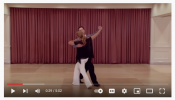
Ok, here are Michael Mead and Toni Redpath in a DVida video. His hand is clearly on his back. I know when I'm in that sort of position, I can feel pressure from the hand.

I have always considered the connection to include any and all points of contact that permits physical non-verbal communication was part of "the connection". That would include Michael Mead's hand to Toni Redpath's back as part of "the connection". But maybe there is some other more subtle definition of connection that makes that not a connection.

Whatever the distinction between what you consider to be the difference between "the connection point" and "a point of physical contact that can be used to communicate information" , that hand on that back in that position can communicate information to the follow. (It can do so and does even if, perhaps, leads are taught to concentrate on thinking about the wrist under the upper arm!)

So getting back to how a lead might sense information about what the lead wants her to do: Among other things, he might feel a change in the pressure in the hand. (Of course this could be in addition to tons of other things.) The fact is: She feels pressure through a range of "contact areas" (not points), that pressure continually changes and from those she gathers information in an analog form of time (not discrete points in time.)


ClosedHold.png
 
Then that phrase that tells us nothing about whether pressure from the hand exists or changes. And if it's "on" her back, it's almost impossible for there to be no pressure
Sure. And if I'm keeping the hand with her, rather than with me, the pressure will say nothing about where my body is going, and thus nothing about what I'm leading. Most likely it will just be constant pressure.

Ok, here are Michael Mead and Toni Redpath in a nURL='https://youtu.be/MYiC_TiETgw']DVida[/URL] video. His hand is clearly on his back. I know when I'm in that sort of position, I can feel pressure from the hand.

I have always considered the connection to include any and all points of contact that permits physical non-verbal communication was part of "the connection". That would include Michael Mead's hand to Toni Redpath's back as part of "the connection". But maybe there is some other more subtle definition of connection that makes that not a connection.
I could go on about the differences between connection and contact, but for now, I'll just say my definition of "connection" includes communications channels actually used to communicate, and doesn't include channels that could theoretically be used to communicate but are not actually used for that.

This isn't to say that Michael Mead does or doesn't use the palm of his hand against Toni Redpath's back to communicate, but I personally would not, at least in closed hold.

(It can do so and does even if, perhaps, leads are taught to concentrate on thinking about the wrist under the upper arm!)
Just to be clear, I'm not saying anything about leads in general. I was just describing how I would lead it, in response to the phrase "if you move back relative to". Perhaps the "you" was intended to address all leads, not just me, but different people lead in different ways, and dance in different ways, so I just answered for me. I would personally also aim for a slightly different promenade position than at 0:39 into your video, at least if I were dancing with j_alexandra, but that doesn't mean all leads would or should do so. (And I do have to say about the video in general, Toni does a terrific job of talking the viewer through both parts while dancing through the group.)
 
Last edited:
Warren
Sure. And if I'm keeping the hand with her, rather than with me, the pressure will say nothing about where my body is going, and thus nothing about what I'm leading. Most likely it will just be constant pressure.
Wrong. You may not intend to communicate that way, but it doesn't mean the follow doesn't get information.
I could go on about the differences between connection and contact, but for now, I'll just say my definition of "connection" includes communications channels actually used to communicate, and doesn't include channels that could theoretically be used to communicate but are not actually used for that.
And as I have told you several times-- the pressure in the hand does change and does give informaiton. That information is used by the follow. So by your definition, that hand would be included in "the connection".
Just to be clear, I'm not saying anything about leads in general. I was just describing how I would lead it, in response to the phrase "if you move back relative to".
Yes. But earlier, you did not ask how a lead would lead. You asked how the follow would acquire information during a certain period. And I gave as an example (without intending it to be exclusive) pressure from the hand. The follow does get information that way even if a lead thinks he doesn't convey any that way. The follow gets that info even if the lead doesn't think it's "part of the lead" and even if the lead isn't intentionally using that body part to convey information.

Similarly, when people communicate in life, those speaking may not want to provide information from body language, but those listening and interpreting do acquire some that way. It is an information channel.

Perhaps the "you" was intended to address all leads, not just me, but different people lead in different ways, and dance in different ways, so I just answered for me.
Well, obviously, if you ask how a follow can know what a lead is leading on a internet forum populated by follows you've never danced with, the answer isn't going to be how do follows know what Warren J Dew leads. The question will be interpreted to mean generally with most leads.

I'm open to the possibility that you have managed not provide important information a follow can use to follow, which nearly all other leads do provide! But in general, I can feel pressure changes in any and every contact point and that change in pressure does convey information if I'm sensitive to it. The hand on the back is a contact point.
 
Similarly, when people communicate in life, those speaking may not want to provide information from body language, but those listening and interpreting do acquire some that way.
Depends on how good their poker face is.

You asked how the follow would acquire information during a certain period.
Actually I asked about what information was acquired when, not how the information was acquired, but now I understand better how we got off on this tangent.

I'm open to the possibility that you have managed not provide important information a follow can use to follow, which nearly all other leads do provide!
Thanks. I was wondering how you thought you knew exactly how I led when we'd never danced together.

At the risk of sounding self-serving, can youse guys move this fascinating (to me) discussion about leading and following to the Follower's POV thread?
Generally men have been made to feel unwelcome in that thread, so I try not to post there if there's an alternative.
 

Dance Ads

Advertise on Dance Forums Reach dancers, teachers, studios, event organizers, and dance-friendly brands. View ad options
Back
Top