Bad habits?

Language evolves. Milonguero no longer has its earlier meaning(s) (perhaps a good thing).
There's also the question of "What language?"

Certain tango aficionados love to snob it up with, "Spanish, of course. That's the only correct language for tango!" We have a few of those here . . . they hang out at the same tables together, because I live in Québec, where you go French or go home. I learned "huits" and "croisements," not "ochos" and "cruzadas," and the teachers just assumed everybody would get French ballet terms (battement, chaîné, chassé, rond de jambe, etc.) because the meanings are fairly clear from ordinary use of the words in French. English is used when French isn't, and it's always a bizarre anglicization of Spanish terms – and, because it is Québec, French ones.

Hours of fun!

So, I've learned to do and show, not say. That's generally best for a led-and-followed dance anyway.
It's becoming necessary to put some of these terms into a context.
That's a good rule in general for technical vocabularies that haven't entered common use. We've had so many threads here about "How to bring more people to tango?" I think we could certainly start with, "Try not to speak in code."

I mean, I know the code some, and I'm still not sure whether when an 84-year-old Argentine woman told me, "Tu es un vrai milonguero!" (yes, in French, not Spanish) , she meant "You're a devoted tango dancer," "You're a bum who dances and ogles girls instead of working," or some other thing.
 
Yeah I wish people would just drop the whole milonguero/salon/nuevo classification, it's just confusing these days when people do "milonguero" close embrace with boleos and ganchos, and "salon" can be more or less anything.
I like the classifications, but someone's personal style might draw from more than one category (or element). Some also dance different styles, depending on how the music moves them, as well as who they're dancing with, and how everyone else is dancing.
 
I like the classifications
To some degree, the classifications are about dancing styles in a particular time frame. About the style where people learned to dance, where they lived, and where they went for their nights out.

someone's personal style might draw from more than one category (or element).
Whilst some teachers may teach a particular style because that's what they know, some may also teach a perception of a style (e.g. milonguero as 'dancing within a tight space in a close hold').

Many start out just wanting to dance AT, with no idea of these distinctions; and maybe there was little awareness of styles amongst the younger dancers in BsAs in that era (although that seems to come with experience). Yes, it's interesting to some to know the evolution, but maybe it would be better to accept that styles merge.

In a crowded milonga space I used some of what I'd been taught as 'milonguero'. I couldn't even guarantee it was that style, but I was aiming to be compact. With more space I led some boleos and high sacadas. Does it matter? We had fun and nobody got injured.
 
In what sense?
Simplistically, as @JournalInTime said:

I mean, I know the code some, and I'm still not sure whether when an 84-year-old Argentine woman told me, "Tu es un vrai milonguero!" (yes, in French, not Spanish) , she meant "You're a devoted tango dancer," "You're a bum who dances and ogles girls instead of working," or some other thing.

or, in some more detail, here

And, perhaps today, as a perjorative term for the affectation some apply to their dress code and attitude to dancing AT in their perception of the 'one true way', as they hold it was once done in BsAs and ought to be continued forevermore.

Or maybe, outside Argentina, as someone (male or female), who got the AT bug, learnt, and goes to some place for an evening event called a 'milonga' instead of drinking and partying with their mates.

Yes, the old meanings exist in historical reference, but in language new meanings evolve, particularly with loan words, and become common (?) usage.
 
And, perhaps today, as a perjorative term for the affectation some apply to their dress code and attitude to dancing AT in their perception of the 'one true way', as they hold it was once done in BsAs and ought to be continued forevermore.

Or maybe, outside Argentina, as someone (male or female), who got the AT bug, learnt, and goes to some place for an evening event called a 'milonga' instead of drinking and partying with their mates.

Yes, the old meanings exist in historical reference, but in language new meanings evolve, particularly with loan words, and become common (?) usage.
Exactly. For the specific term "milonguero":

I've been called this more than once in the past few years. Not in my first 5-6 years of tango, but several times in the last 4-5 years. There's no specific group of people who've called me this; I just singled out a specific, older Argentine woman for effect.

I'm at a loss to understand because:
  • I go out to dance only 3-4 times per week – not every night and twice on Sundays.
  • When I go out, it isn't to drink and smoke with the guys, and to ogle girls, but strictly to dance.
  • I don't wear a suit, hat, aftershave, etc. in an attempt to look old-timey elegant; I dress young (I think).
  • I don't care much for Golden Age music; I prefer late-era D'Arienzo and Pugliese, and Salamanca and Varela.
  • My dance incorporates less-than-traditional movements and Interpretations.
  • I don't speak a word of Spanish.
  • Most important, I'm not macho . . . I'm happy to have women invite me and to lead 50/50 rather than 100/0, and I don't affect a "chivalrous with the ladies" vibe, but rather a "polite with the humans" one.
So, I'm not sure what I'm doing to rate the label, yet there it is. In my mind, that label goes on a guy in a suit and fedora, redolent of aftershave and cigars, who uses the milonga as a daily social club where he hangs out with a gang of fellow machos who yack about football and girls in Spanish, and who invites women to dance his way, at his pleasure, with old-timey musical preferences and dance moves. But of course that, too, is just a silly stereotype.
 
..Didn’t Gustavo Naveira invent ocho cortado?
I doubt it. But at least he analyzed the ocho milonguero and made it known as ocho cortado. Basically it is an interruption of an initiated molinete (a front ocho would follow after the sidestep).
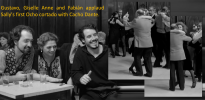
I photoschopped the scene "El Flete" from the Tango Lesson again (1:05). In a way, it was also Gustavo's nod to Chaco, who had only recently converted to the milonguero style. I think it's a masterfully edited scene, by the way. Omar Vega's space-saving steps or Copello's tracking shot with the cadencia. Simply class.

Flete.png
 
Last edited:
I am really wondering what kind of tango movements/techniques are considered inherently nuevo.
The years 2000-10 we roughly divided the existing styles to salong and nuevo. Back then the workshop descriptions were like - *You will dance elegant after this course* - but the students needed to at least roughly know what the content will be. Mostly these labels were enough.

I checked a content list for my participation on Tango Camp 2008 - a big festival for hundreds of participants from Europe, US and other countries. That year we could choose 12 hour package of Nuevo or of Classic tango. There were several levels of them both.

I remember coming across volgadas, golgadas, linear boleos and piernazos quite early and I felt them to be part of the nuevo moves.

I fully agree that today we cannot separate the variations in AT by content as we did in history - the volgadas and other stuff can be done in most of them comfortably.
 
...Naveira was also very clear in his interviews that "nuevo" is not actually a dance style, but rather a method to generate more possibilities in the dance..
And he also claimed to revive the old "black" tango heritage like soltadas, sacadas, colgadas, volcadas that had disappeared from the dance halls in the 20th century.
 
But I mean, we've discussed this before, right?
Yes. My point, however, was about nuevo and what it now referred to. Milonguero and its multitude of meanings in different times and contexts was just an illustration of how terminology changes and is re-applied. I wasn't dancing AT at that time, but have an inkling of what was meant then (and also never a great fan of much of Piazzolla's music); I hear people applying nuevo nowadays to AT danced to alternative music (and I'm certainly in favour of good, danceable, AT music).

To some extent, so what? My only 'bad habit' complaint is that many seem to lack awareness, or what might be described as 'floorcraft'. It's the triumph of showy steps over improvisation technique. I can only say that, in at least a couple of instances, these dancers have matured from the dark side to develop an understanding of more traditional AT.
 
I doubt it. But at least he analyzed the ocho milonguero and made it known as ocho cortado. Basically it is an interruption of an initiated molinete (a front ocho would follow after the sidestep).
I photoschopped the scene "El Flete" from the Tango Lesson again (1:05). In a way, it was also Gustavo's nod to Chaco, who had only recently converted to the milonguero style. I think it's a masterfully edited scene, by the way. Omar Vega's space-saving steps or Copello's tracking shot with the cadencia. Simply class.

View attachment 5130
Some of my teachers were his students and they said he invented the cross system vs parallel system vocab, which I think is pretty wild since everyone uses that terminology today.
 

Dance Ads

Advertise on Dance Forums Reach dancers, teachers, studios, event organizers, and dance-friendly brands. View ad options
Back
Top