Covid-19 NON DANCE debate

Here's a paper that summarizes the results of modelling various options. https://www.imperial.ac.uk/media/im...-College-COVID19-NPI-modelling-16-03-2020.pdf

This paper seems to have influenced a lot of governmental responses both in the UK and the US. Is it perfect? I rather doubt it. Are your opinions better than those of this paper? I highly doubt that. But if you have better data and a better model, please share it.
The analysis in that paper on the effectiveness of various measures is quite good. Their model is detailed enough that it should address the critiques in this thread about the Washington Post "simulation". One could quibble with some of their assumptions, but none are obviously unreasonable. Their division of general strategies into "mitigation" - trying to get to herd immunity with minimal stresses on the health care system - and "suppression" - attempting to suppress all outbreaks - is a good framework for analysis.

Let's look at some key findings:

- Mitigation alone will cause health care limits to be exceeded. Their most effective mitigation strategy, voluntary isolation of known cases, voluntary quarantine of household members of known cases, and voluntary social distancing of those over 70 - will still result in exceeding the limits of the health care system in the case of the UK. This backs up the discussion upthread on the UK mitigation strategies, which pointed out that they would likely result in age related triage with the NHS denying treatment to the very old.

- Suppression is possible without extreme measures. For example, School closure, case isolation, and voluntary general social distancing effectively suppresses the epidemic until the interventions are removed. Given this example did not even include household quarantine, there are likely other combinations that would be effective; for example, social distancing could likely be eased or eliminated if households of known cases were voluntarily quarantined. Lockdowns are not required. The very large difference between the school closure and no school closure cases suggests that school closure is necessary, though. All of this is exactly consistent with the positions I've taken in the thread.

- Suppression requires years. Suppression measures need to be maintained until an effective vaccine has widespread availability, which is likely to be at least a year or two. I've made this observation myself upthread.

- Intervention measures can have "enormous" social, economic, and health costs. "We do not consider the ethical or economic implications of either strategy here, except to note that there is no easy policy decision to be made. Suppression, while successful to date in China and South Korea, carries with it enormous social and economic costs which may themselves have significant impact on health and well-being in the short and longer-term." This is exactly the point I made in the post you are responding to.

- Bans are not useful. From the paper, "Stopping mass gatherings is predicted to have relatively little impact". This is exactly what I started out arguing: there's little public health value, for example, in shutting down dance competitions.

So basically the paper is backing up every point I've made.

The paper does have a couple of weaknesses. First, they don't do any sensitivity analysis on fatality rates. This is fine in the context of a paper that isn't trying to balance the costs of intervention against the costs of not intervening, but is an issue in discussions that do address such balancing, since reasonable estimates of the fatality rate vary across orders of magnitude. Second, they conclude that suppression is superior to mitigation, a conclusion that isn't reasonably possible to make without addressing the costs of intervention measures, which they "do not consider".

Still, the model seems quite reasonable and the analytical - as opposed to policy - conclusions seem sound.
 
Last edited:
And everybody washes their hands, a lot.
I've always washed my hands a lot, but recently I've started being more structured about it. In addition to extending my hand washings to the recommended 20 seconds, I've tried to do it before and after each trip out of the house, and had the kids do it before and after each ballroom lessons or practice. That may help maximize the value of the hand washings.
 
"groups of college kids partying and tweeting with hashtag #BoomerRemover"

What does this phrase mean?
First, there is substantial resentment against "boomers" - the baby boom generation - in some segments of the millenial population. Their view is that boomers' selfishness has caused the economic conditions of the last decade or two that have been difficult for millenials.

In this part of the population, Covid-19 is sometimes referred to as the "boomer remover", because it has a significant fatality rate for older people - that is baby boomers and older generations.

Apparently college closures and bans on bars have caused purposeful flouting of the rules among part of the college population, on the theory that (1) if college closures are going to end their partying college lives for now, they want one last bash, and (2) why not, since Covid-19 doesn't tend to cause serious symptoms for young people, and who cares about boomers.

There was an article in the WSJ about this, though primarily about flouting of the rules in Germany and other parts of Europe. However, Governor Baker of Massachusetts also cited bar hopping and partying in his order closing restaurants and bars to eat in patrons.

I don't see it as a big deal.
 
What I've heard about Vitamin D is that it can reduce the respiratory symptoms. See the following YouTube video, also papers can be found with a Google search.
That's what I read. It doesn't necessarily keep you from getting. The paper that influenced my decision to take multivitamines was done pre-covid-19 and on children. It was a meta-analysis. The general result is: 1) Small daily does helped reduce kids reporting colds during cold season. There was an overall reduction for those who took vitamine D, but the real help was the sub-population of vitamin D deficient children. 2) Mega does did not help and might hurt.
Another paper I read said it seems to somehow help with issues associated with mucus sticking to lungs. Another: Vitamin D helps pigs with corona viruses (that affect pigs. NOt Covid 19. That's obviously untested.) Another: Chinese results on autopsies suggest one of the mechanisms for killing people is mucus ends up adhering to lungs and reducing lung efficacy.

I did not collect the articles, and probably haven't said these in the proper terminology. However, I know I am not out in the sun much. My husband is definitely vitamin D deficient. (Diagnosed.) I figure it's prudent to take the Vitamin D which is cheap, and... well... I already had unused multivitamines in the cabinet. Note that the paper also convinced me NOT to self medicate with "mega-doses", which sadly IS a recommendation on some faux-health pages on the web. But the meta-data paper specifically said bolus doses don't appear to work and may make things worse.

So I"m getting about 150% the RDA from those every day. It might be useless, but it's also harmless and essentially cost free. I'm doing a few other possibly useless but likely harmless things. (I do have a private lesson today. I went OUTSIDE to brush my shoes in advance. I am wearing only freshly laundered clothes just in case I did rub my nose on my face... yada, yada....) I'm doing this in addition to recommended things like wash hands. I always do that before I start a lesson. I did it even before Covid-19. (I open door handles with paper towels and toss those in the trash outside the bathroom. I mentioned this to my pro, and he said he is worse. He dries his hands with one towel, toss that, The uses a 2nd towel to open the door. )
 
Part of the problem is that there is a lag between any efforts to control the disease and the reduction or increase in new infection cases. That is due to the incubation period of around 5 days and then additional delay in getting new cases recognized and reported. I expect that there will be tweaks to the governmental response but they should be applied in stages to see what happens.
Agreed. In Massachusetts at least, the effect has been that the government starts out with reasonable measures, then when results aren't immediate, rapidly escalates to unnecessarly extreme measures. In order to "see what happens", things need to be left alone for a week or two.
 
First, there is substantial resentment against "boomers" - the baby boom generation - in some segments of the millenial population. Their view is that boomers' selfishness has caused the economic conditions of the last decade or two that have been difficult for millenials.

In this part of the population, Covid-19 is sometimes referred to as the "boomer remover", because it has a significant fatality rate for older people - that is baby boomers and older generations.

<snip>

I don't see it as a big deal.

Thanks for the clarification.
 
As far as ventilation, multiple windows open can create a cross draft which can be good or bad depending on the direction.
Yes. That's why I had some caveats about it being warm enough.

Hospitals typically use very high air refresh rates (possibly 100%). The systems are designed for it so outside air is brought through the HVAC system and warmed or cooled prior to release into the building. Homes typically rely on infiltration through gaps in windows, doors opening and closing and so on.

If you wanted to increase the air refresh rate in a home you could likely avoid the problem of drafts by using bathroom exhaust vents. This would probably avoid drafts. You probably don't want those on 100% of the time though-- to big a heating bill. Estimating the "best" way to use the bathroom vents would require a calculation... which would be case specific to a house. Also, "best" will depend on whether having a sick person in your house does increase the suspended aerosol load, how much it does, and how much that matters for cotagion.
 
Agreed. In Massachusetts at least, the effect has been that the government starts out with reasonable measures, then when results aren't immediate, rapidly escalates to unnecessarly extreme measures. In order to "see what happens", things need to be left alone for a week or two.
Perhaps they recognized a problem and initially applied a control that they thought would be sufficient, but later on after reading the analysis in the paper I linked earlier decided that a stronger response is needed. I do hope that they'll review the status and make adjustments at least every 2-3 weeks.
 
Perhaps they recognized a problem and initially applied a control that they thought would be sufficient, but later on after reading the analysis in the paper I linked earlier decided that a stronger response is needed. I do hope that they'll review the status and make adjustments at least every 2-3 weeks.
If they'd read the paper, they would have reduced the controls, not increased them.
 
If you look in the paper's appendix figure A1, it shows that the following measures are needed to avoid overloading the health system:
1. School and university closure
2. General social distancing
3. Case isolation
Not being familiar with Massachusetts, what measure are they imposing that you view as excessive? Other than shutting down the competitions you mentioned before -- that would fall under social distancing.
 
If you look in the paper's appendix figure A1, it shows that the following measures are needed to avoid overloading the health system:
1. School and university closure
2. General social distancing
3. Case isolation
Not being familiar with Massachusetts, what measure are they imposing that you view as excessive? Other than shutting down the competitions you mentioned before -- that would fall under social distancing.
In addition to those measures, our city, and I believe all of Massachusetts, are also quarantining families of cases. The analysis in the paper suggests that this quarantining is quite effective and could replace general social distancing. However, those were the initial measures which I considered conservative but reasonable.

If you actually read the paper, you'll see that event closures do not fall under social distancing; as I mentioned before, the paper says they analyzed event closures separately and concluded they were immaterial. Thus, the event bans, especially after the limit was reduced to 25, are excessive, according to the paper.

In addition, the restaurant and pub closures fall under business closures, which the paper considered too draconian even to analyze, sot those are clearly overkill as well.

You seem to be interpreting "social distancing" as "social isolation". That's clearly not the paper's definition, if you read their definitions of the various measures they list. They envision a reduction, but not elimination, of contacts.
 
I open door handles with paper towels and toss those in the trash outside the bathroom
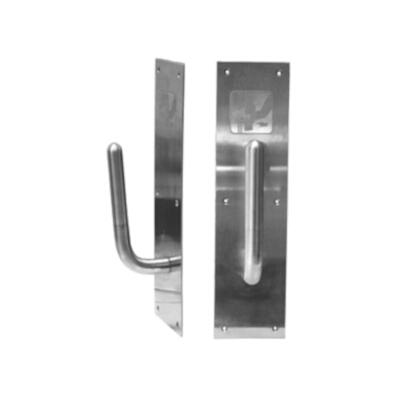
Ditto, given how many people I see leaving without washing their hands. The restroom one floor above my office (but oddly none of the others in the building) has a neat little gadget that should be mandatory for restroom doors - a 4x4-inch ledge with upward-facing cleats that lets you pull open the door with your foot.
 
I like this, but have only seen it at one restaurant.

CHSG101.jpg
 
Their model is detailed enough that it should address the critiques in this thread about the Washington Post "simulation".
Certainly; my critique was very specific to the WaPo article, not to the various restrictions, etc, that have been put into place (aside from the fact that I don't think they've acted with enough urgency).

In addition to those measures, our city, and I believe all of Massachusetts, are also quarantining families of cases. The analysis in the paper suggests that this quarantining is quite effective and could replace general social distancing. However, those were the initial measures which I considered conservative but reasonable.

If you actually read the paper, you'll see that event closures do not fall under social distancing; as I mentioned before, the paper says they analyzed event closures separately and concluded they were immaterial. Thus, the event bans, especially after the limit was reduced to 25, are excessive, according to the paper.

In addition, the restaurant and pub closures fall under business closures, which the paper considered too draconian even to analyze, sot those are clearly overkill as well.

You seem to be interpreting "social distancing" as "social isolation". That's clearly not the paper's definition, if you read their definitions of the various measures they list. They envision a reduction, but not elimination, of contacts.

The paper writes:
Stopping mass gatherings is predicted to have relatively little impact (results not shown) because the
contact-time at such events is relatively small compared to the time spent at home, in schools or
workplaces and in other community locations such as bars and restaurants.


It's not obvious to me that these assumptions would hold in the case of dance events or, say, group lessons. Are they talking about concerts, or conventions?
 
Last edited:

Dance Ads

Advertise on Dance Forums Reach dancers, teachers, studios, event organizers, and dance-friendly brands. View ad options
Back
Top