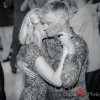
Maybe in a small scene with one instructor, but even then the students can go online where they'll encounter some material that contradicts whatever their instructor was saying.
For sure!
I've never met this hypothetical tango dancer who's unaware that there are approaches, styles, and opinions other than those their instructors proffer. Anybody can turn on the idiot box and see tango escenario on well-known dance shows, or go to YouTube to witness every conceivable approach to the dance. When I return to my smallish hometown which has one tango school, two teachers, a single monthly práctica, and a lone milonga on the months when somebody remembers to organize it, a
defining feature of "I dance tango!" is that you travel to one of Canada's larger cities a few times a year for lessons and milongas,
even if you don't otherwise travel, for tango or otherwise.
But personally speaking if early 2010s style conservative tango was the only option available, I'd have quit long ago.
I do think people could use more training in how to deal with crowded floors but what's viewed as "milonguero" style is considered too restrictive.
Exclusivity of style is bad, full stop.
I can and do dance big, dynamic movements when there are just 5 other couples on a floor big enough for 60 rather than 6 couples. It's great fun!
I can and do dance tiny, almost in-place steps that move us 3 metres down the floor over the course of 4 tangos when there are 80 couples stuffed in there. It's more fun than no tango that night.
I'm not sure I'd
quit if I could do only one, the other, or some specific thing in between, but I admit I'd be disappointed . . . I don't think "all small, conservative stuff, all the time" is optimal for keeping tango alive and evolving. I realize that some traditionalists believe that moving away from that means tango is dying, but I'm not with them on that.
If one day I can't dance as I would like anymore, then I will probably shift mostly to the music side.
I know in my heart that even if I have to be held up because I have no knees left and back-led because I'm blind, I'll want to dance.
I think it's a habit developed from dancing often with beginners at milongas - I try to make them feel great, which includes making them feel like a good dancer. It's more of minimising their perception of any 'mistakes' with little adjustments. But for the most part, I do mean things like catching their falls. Obviously, if I had to strain myself to compensate, then I'd rather not dance with them.
Understood. I spent four years accompanying unpartnered followers in four sessions a year, each session with 3-6 of the 6 levels the school offered. I once added it up and it came to around 60 partners . . . not hundreds, but not "a few," either. Eventually, the school closed, so I couldn't do that any more.
Anyway, my coach needed about 5 years after that to break me of the bad habits that set in when one dances for less-capable partners. These habits have several negative effects, notably:
- Even if you think you're not sacrificing your posture, using too much strength, and so on, you are. You're harming your body.
- Even if you think you're not limiting your musicality and vocabulary, you are. You're harming your dance skills.
- Always being in "protect and serve" mode physically means you're subconsciously restraining some of your partner's freedom of movement. You're harming their expression, and possibly their body.
- Always being in "protect and serve" mode mentally means you're subconsciously taking away some of your partner's creative autonomy. You're harming their dance, and possibly your tango partnerships.
There comes a point where you have to let people make and own their mistakes. The only errors that are yours to deal with are the dangerous ones, like collisions and falls.
D'Arienzo with Echagüe and/or Biagi on the piano is probably peak D'Arienzo for me.
When it comes to tangos cantados, my view is "Go Echagüe or go home."

To see me be less conservative and maybe even wild, play "El Nene del Abasto" (1951) or "El Tigre Millán" (1952).
I've been experimenting with different configurations.
I'd agree, on the whole. It's possible to dance without using that arm/hand hold.
Two nights ago, a tanguera of long acquaintance pulled my left/her right hand
inside the embrace so we were compact, flat, and not open in the slightest. The milonga was not crowded . . . this wasn't for safety. She said, "This way, we feel the most like one four-legged body!" It was a fun way to dance. In particular, it made rapid turning even faster and pauses more delicious. But it also garnered evil stares from some seated dancers, so I don't know . . .