Growing Old in Tango

..how the instructors instruct, that's how the students will learn. Beginners are completely unaware of stylistic differences or traditions. Of course, if you study with someone who only does escenario or tango nuevo, well, that's likely to be what you'll be taught...
But can't you also understand that there is enormous economic pressure and a lot of competition among dance teachers, at least in our cities. Every school needs a unique selling proposition.
You can't make money from social dancing and milinguerostyle. You don't need any lessons for this. Look at me, before my first tango lesson i danced at milongas for two years. And I got good feedback.
 
but even then the students can go online where they'll encounter some material that contradicts whatever their instructor was saying.
That's an interesting comment in the context of 'ageing'. I've been involved with computers and technology throughout my working life, but many of my generation still don't use 'online' information. Or, or they do, then it's specifics like FB or Zoom.

where they'll encounter some material that contradicts whatever their instructor was saying.
There's no 'standard' in social AT, nor standard of teacher. We've had several teachers with differing perspectives, and some we consider simply wrong on a specific aspect. It's more about having a broader perspective and being open to that view.
 
P.S. It is less about different configurations. The left arm of the leader (right of the follower) doesn’t contribute a lot to the feeling of a good embrace.

I agree, but nowadays more presence is being added back to that arm too, just to add to the pile of contradictory teachings and concepts! Some followers want more and some less, and it is actually a bit annoying that I can't just set it to zero and forget it.
 
Tonight, I was surprised when I realised my left hand looked a lot like Gavito's. I'd honestly be satisfied if I could feel the Argentine embrace for myself, and if a teacher can explain the rationale/technical aspects, I'd deem the money worth spending.
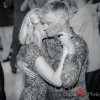
I don't expect there to be a common opinion about an "Argentinian embrace". After a few years of self-optimization, it would also come too late for me. Here I got photographed in "full contact mode", and that embrace felt pretty good:

embrace-01a.jpg
 
I don't expect there to be a common opinion about an "Argentinian embrace".

Women who lead have raved to me of the embrace of the older women in BsAs. We don’t realize that an embrace reveals a lot about the feelings, very much like a hug does. If I ever get as eloquent as JiT, I might try to describe what a good embrace feels like. Sometimes you feel it when friend or some gives you a hug too. We have a few local followers that have really good embrace. You can feel it when you watch them dancing with someone else too.
So was I right all along, in that beyond the physical, it is all about the feelings one puts into and tries to convey through the embrace? Or is the Argentinian embrace akin to what I've heard about Turkish leaders and Russian followers having the best embraces/dances outside of BsAs — i.e. grains of truth, some exaggeration, some generalisation? I can only say that in my experience, the vast majority of Russian women I've danced with have had lovely embraces; in that they gave themselves to me. And my friends seem to enjoy dancing with the few Turkish leaders I've met.
 
P.S. It is less about different configurations. The left arm of the leader (right of the follower) doesn’t contribute a lot to the feeling of a good embrace.

It can make for a poor, even painful, embrace.

I'd agree, on the whole. It's possible to dance without using that arm/hand hold.
Oh, no, I didn't mean to imply all that, just that I was surprised that through experimentation, my hold evolved over time into something like that for that particular follower. I'd always thought that it seemed uncomfortable for the follower, since their wrists were bent that much in that kind of hold. But the lady with whom I was dancing loved our tanda together.
 
I don't expect there to be a common opinion about an "Argentinian embrace". After a few years of self-optimization, it would also come too late for me. Here I got photographed in "full contact mode", and that embrace felt pretty good:

View attachment 5471
It's never too late to embrace. There is a lot to like in this photo but an Argentine embrace isn't "full contact" - think more of the two partners both in an Argentine "man hug". It is disappearing even in Buenos Aires.
 
Maybe in a small scene with one instructor, but even then the students can go online where they'll encounter some material that contradicts whatever their instructor was saying.
For sure!

I've never met this hypothetical tango dancer who's unaware that there are approaches, styles, and opinions other than those their instructors proffer. Anybody can turn on the idiot box and see tango escenario on well-known dance shows, or go to YouTube to witness every conceivable approach to the dance. When I return to my smallish hometown which has one tango school, two teachers, a single monthly práctica, and a lone milonga on the months when somebody remembers to organize it, a defining feature of "I dance tango!" is that you travel to one of Canada's larger cities a few times a year for lessons and milongas, even if you don't otherwise travel, for tango or otherwise.
But personally speaking if early 2010s style conservative tango was the only option available, I'd have quit long ago.

I do think people could use more training in how to deal with crowded floors but what's viewed as "milonguero" style is considered too restrictive.
Exclusivity of style is bad, full stop.

I can and do dance big, dynamic movements when there are just 5 other couples on a floor big enough for 60 rather than 6 couples. It's great fun!

I can and do dance tiny, almost in-place steps that move us 3 metres down the floor over the course of 4 tangos when there are 80 couples stuffed in there. It's more fun than no tango that night.

I'm not sure I'd quit if I could do only one, the other, or some specific thing in between, but I admit I'd be disappointed . . . I don't think "all small, conservative stuff, all the time" is optimal for keeping tango alive and evolving. I realize that some traditionalists believe that moving away from that means tango is dying, but I'm not with them on that.
If one day I can't dance as I would like anymore, then I will probably shift mostly to the music side.
I know in my heart that even if I have to be held up because I have no knees left and back-led because I'm blind, I'll want to dance.
I think it's a habit developed from dancing often with beginners at milongas - I try to make them feel great, which includes making them feel like a good dancer. It's more of minimising their perception of any 'mistakes' with little adjustments. But for the most part, I do mean things like catching their falls. Obviously, if I had to strain myself to compensate, then I'd rather not dance with them.
Understood. I spent four years accompanying unpartnered followers in four sessions a year, each session with 3-6 of the 6 levels the school offered. I once added it up and it came to around 60 partners . . . not hundreds, but not "a few," either. Eventually, the school closed, so I couldn't do that any more.

Anyway, my coach needed about 5 years after that to break me of the bad habits that set in when one dances for less-capable partners. These habits have several negative effects, notably:
  • Even if you think you're not sacrificing your posture, using too much strength, and so on, you are. You're harming your body.
  • Even if you think you're not limiting your musicality and vocabulary, you are. You're harming your dance skills.
  • Always being in "protect and serve" mode physically means you're subconsciously restraining some of your partner's freedom of movement. You're harming their expression, and possibly their body.
  • Always being in "protect and serve" mode mentally means you're subconsciously taking away some of your partner's creative autonomy. You're harming their dance, and possibly your tango partnerships.
There comes a point where you have to let people make and own their mistakes. The only errors that are yours to deal with are the dangerous ones, like collisions and falls.
D'Arienzo with Echagüe and/or Biagi on the piano is probably peak D'Arienzo for me.
When it comes to tangos cantados, my view is "Go Echagüe or go home." ;) To see me be less conservative and maybe even wild, play "El Nene del Abasto" (1951) or "El Tigre Millán" (1952).
I've been experimenting with different configurations.
I'd agree, on the whole. It's possible to dance without using that arm/hand hold.
Two nights ago, a tanguera of long acquaintance pulled my left/her right hand inside the embrace so we were compact, flat, and not open in the slightest. The milonga was not crowded . . . this wasn't for safety. She said, "This way, we feel the most like one four-legged body!" It was a fun way to dance. In particular, it made rapid turning even faster and pauses more delicious. But it also garnered evil stares from some seated dancers, so I don't know . . .
 
Or is the Argentinian embrace akin to what I've heard about Turkish leaders and Russian followers having the best embraces/dances outside of BsAs — i.e. grains of truth, some exaggeration, some generalisation?

For followers I would say it's not just Russia but Eastern Europe on average, could be a cultural thing. I've certainly danced with women from all over the world with great embraces though.
 
nowadays more presence is being added back to that arm too, just to add to the pile of contradictory teachings and concepts! Some followers want more and some less, and it is actually a bit annoying that I can't just set it to zero and forget it.
I’ve been struggling for years finding the right amount of strength to use, till I took a lesson last year with an Argentinian instructor of excellent credentials (mundial finalist). I was told to match the intensity of the leader. If his hand is shifting between firm or relaxed that I should respond instead of setting it to some point on a virtual scale. This way the shifts in intensity is part of the communication. Showing that now something different is about to happen etc.

Angle and tilt and width and height are other important elements. We discussed this not so long ago, I think. I mentioned that it can be painful when the hand is angled inwards, too close to the body, depending on anatomy of the individual. If traffic conditions get tight, it’s fine to relax the open side hand and move closer to the body, but then the angle has to relax too.

I find the hands are an important part of the embrace. Both with respect to communication and comfort.
 
For followers I would say it's not just Russia but Eastern Europe on average, could be a cultural thing. I've certainly danced with women from all over the world with great embraces though.
I do tend to enjoy dances with Slavic and Balkan followers more, for some weird reason, so that does make some sense. Not that dancers of other origins aren't great, of course.
 
I do tend to enjoy dances with Slavic and Balkan followers more, for some weird reason, so that does make some sense. Not that dancers of other origins aren't great, of course.
I'll add that while there's variation in any ethnic group, people of certain origins tend to be taller or shorter, broader or narrower, heavier or lighter, etc. than the global average. For instance, Canadian women are on average 163 cm tall, our many immigrants from Eastern Europe are in the 164-172 cm range (call it 168 cm), and our even more numerous immigrants from East Asia are in the 152-158 cm range (call it 155 cm). I find shorter easier, so while at 179 cm (about 1 cm taller than average for Canadian men) I can dance with most of them, many of my preferred partners are of East Asian origin.
 

Dance Ads

Advertise on Dance Forums Reach dancers, teachers, studios, event organizers, and dance-friendly brands. View ad options
Back
Top