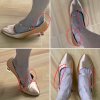
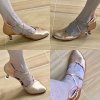
So I went to my appointment at Showtime, and the research data I obtained was well worth the travel! Carrie wasn’t there so I worked with Brandy, who was extremely knowledgeable and helpful and patient. They definitely know their stuff.
Bottom line: I lucked out with my original online purchases from International Dance Shoes. That brand by FAR works better for me than Ray Rose, Supadance, or Dance Club, in standard, smooth, Latin, and practice shoes. (Still would like to try Paoul and Aida someday.)
Tidbits I learned that might help others:
Int’l’s Georgia model is custom made specifically for Showtime to be almost identical to the Mia, but wider, and has a channel back strap. It does not come in a narrow width.
the “channel back” heel cup where the long arch strap actually runs through the top of the heel cup. This way when you pull the strap tight and buckle it, it will hold the heel cup to your heel and will prevent your heel from slipping.
This is a great concept! Several other shoe brands offer this style in certain models, too. Unfortunately for me, the location of the strap channel around the back of my heel is right where my ankle curves in, so tightening the strap didn’t actually have any practical effect on how the heel cup fits my foot.
Int’l’s Flavia model is a narrow style, and worked surprisingly well for me. I had anticipated that my pinky toes would have problems with sticking through all those extra straps around the toes, but so far it hasn’t been an issue. (I bought a pair in size 6 UK to replace my stretched-out size 6.5 UK Mias. Have only danced in them for an hour so far, but I’m cautiously optimistic.)
Int’l’s American Flex smooth shoes were absolutely the best smooth shoes I tried on. Exactly what I own already, but I need a size 6 UK instead of the 6.5 I have now.
When they say “order your ballroom dance shoes in a size smaller than your street shoes,” they mean it. In fact, maybe 1.5 sizes smaller than your street shoes. When new, the shoes should fit so snugly that you think they’re too small - without being actually painful. The ones I ordered online without trying on first - with the exception of my very first pair of Mia sandals - have all been a half size larger than I should have bought.
For practice shoes, the split sole style (like the Int’l Heather split sole mesh that I bought recently) has its downside. The absence of a full shank makes them very flexible, but too many times I’ve tripped myself because the heel folded under toward the middle of the shoe. The Heather full shank style felt much more stable to me, and was just as comfortable.
To evaluate the fit of a dance shoe, a technique that often works is this: sitting down, rest your foot on its heel, toes pointing straight up at the ceiling. The big toe should be touching the end of the shoe but not pressing against it, and the width should be comfortable. This indicates that the length of the shoe is correct. However, when you stand up, if your foot slides forward causing your toes to get squashed (despite the shoes being the correct length), this indicates that the shoes are too wide. A narrower shoe in the same size should, ideally, hold your feet securely in place so that they don’t slide forward.
(This is exactly how it worked for me, when I tried the Int’l Heather practice shoes in the same size I own, 6.5 UK, but in narrow width. Perfect. No squashed toes.)
Some shoes (including the Heathers mentioned above) have very, very scratchy inside linings around the mouth of the shoe. This could be from where the stitching knots are located or from excess glue. Simple solution is to use an emery board or nail file to gently smooth down the scratchy bits. I was thrilled at how well this worked! (And disappointed that it never occurred to me before to try it.) I wonder if this might cause problems down the road (e.g., if you file down a knot, could that eventually lead to the stitching unraveling completely? The way a sweater unravels if you pull on a loose yarn end?), but I suspect that the shoe’s limited life span means it will be worn out before something like that can happen. Another unexpected solution is to use “puffy paint” - the kind you buy at craft stores to decorate t-shirts or whatever - to create a sort of cushioned buffer between the scratchy edges and your foot. Neat!
The Ray Rose kalahari model, which is one of the most popular shoes out there, apparently runs large. I had to go all the way down to size 5.5 UK in those. The straps around the toes are very snug, but feel almost elasticized so they’re not uncomfortable. Unfortunately for me, the Ray Rose brand is known for having the biggest heel cup. If you hear a farting noise from your shoe on every step you take, it indicates that there is extra space in the heel cup, so you need either a different size or a different style. (Personal conclusion: due to the big heel cups, Ray Roses will never work for me unless my feet get significantly wider.)
Narrow, straight heels - usually called elite or stiletto depending on the brand - are TOTALLY different from the flared version!!! I was shocked at what a difference that made. Flared heels don’t LOOK that much fatter than straight ones, but OMG I could barely even stand up in the narrow heels, and certainly couldn’t dance (or even walk) in them. I know your weight is supposed to stay on the balls of your feet most of the time, so perhaps more experienced dancers would be able to wear stilettos; or perhaps it’s just a personal preference; but I can’t see myself EVER wearing narrow heels. Hats off to dancers whose balance is good enough to manage those.
The Supadance brand is apparently known for having good arch support. Also, many of their sandals have much shorter-than-usual toe boxes, which some dancers prefer, because they like having the ends of their toes extend way past the ends of the shoes at all times. (I don’t mind my toes going past the ends of the shoes during certain moves, but it’s uncomfortable for me to feel them constantly dragging on the floor [after all, my toes aren’t suede-soled].) YMMV.
I took lots of detailed notes, so I’ll be better informed whenever I make my next online shoe purchases. Hopefully some of the info in this post will be helpful for other dancers too.