Some stories to share

Dear Tango Friends,


Like many of you, I love tango deeply. For a period of my life, I went to a milonga almost every day, and along the way I began writing short stories to process the moments, emotions, and scenes I witnessed across different cities. These stories are not reality — they’re reflections, imaginations, and creative echoes of the atmosphere we all share.


I write as an amateur. My profession is completely different, and creating stories and simple videos is just a hobby that brings me joy. If there is anything you find meaningful or enjoyable in them, I would be very grateful to know.


Please be kind — I’m not a professional writer or filmmaker. I am simply someone who loves tango and hopes to get better with time.


With appreciation and abrazos,
Futbol Y Tango
1) The story of Toro con el Reloj
2) The tango competition
 
Dear Tango Friends,


Like many of you, I love tango deeply. For a period of my life, I went to a milonga almost every day, and along the way I began writing short stories to process the moments, emotions, and scenes I witnessed across different cities. These stories are not reality — they’re reflections, imaginations, and creative echoes of the atmosphere we all share.


I write as an amateur. My profession is completely different, and creating stories and simple videos is just a hobby that brings me joy. If there is anything you find meaningful or enjoyable in them, I would be very grateful to know.


Please be kind — I’m not a professional writer or filmmaker. I am simply someone who loves tango and hopes to get better with time.


With appreciation and abrazos,
Futbol Y Tango
1) The story of Toro con el Reloj
2) The tango competition
Haven't watched the second one yet, but what I've seen is pretty impressive. Especially like the spoken story. You should be pleased. I'm sure a lot of work went into these.
 
Haven't watched the second one yet, but what I've seen is pretty impressive. Especially like the spoken story. You should be pleased. I'm sure a lot of work went into these.
Thank you. This is just a hobbie. It helps me to process the intense emotions and experiences that Milongas have brought in me.
 
1764500353525.png


The Woman I Once Saw in Milonga Media Luz (Part I)
© 2025 Luis Eduardo Azmitia. All rights reserved. No part of this work may be reproduced without the author’s permission.
Part I
I don’t know if anyone will believe me, but the events I am about to recount took place the year I began dancing Argentine tango in Vancouver. For those unfamiliar with this port city at the far edge of the Pacific, winter is not a season but a temperament—clouded, sodden, and weighted with fog so dense it seems to swallow sound. Weeks can pass without a glimpse of the sun. The nights are colder still, all rain-slick streets and restless wind. There were evenings when the fog thickened in a way that felt older than the city itself, as if it had drifted inland from another century.

In a place like this, loneliness does not visit so much as it settles. You can drift through an entire day without a single meaningful conversation, untouched by another human being, moving through the city like one more shadow dissolving in the rain. Looking back, I sometimes wonder whether it was loneliness that led me toward what happened, or whether something else—something quieter, older—was waiting for me to step into its half-light.

After a few weeks of tango classes, that loneliness finally pushed me to call the organizers of what everyone said was the most popular milonga in the city. A woman answered—her British accent precise, her tone warmly old-fashioned, as though it had drifted forward from another era. She gave me the address and mentioned that the event was held in the Polish Hall, only a few blocks from Mountain View Cemetery, Vancouver’s only burial ground, founded in 1886. The way she said cemetery lingered a heartbeat longer than the rest of her sentence, soft yet deliberate, as if the word carried a meaning I had not yet earned.

When I told her I lived nearby, she paused—just long enough to be felt—and then gently suggested I walk instead of drive. Parking could be difficult on those nights, she added, though something in her voice made the advice sound like a warning disguised as courtesy. As she spoke, I became aware of a faint, dry floral scent—lavender or something like it—though I could not say whether it came from her, the phone, or the thought of her.

I could hardly wait for Tuesday to arrive. I had never been to a large milonga before, and even its name intrigued me—Milonga Media Luz. The night began with me standing too long in front of the mirror, choosing a suit and tie as though fabric could steady my nerves. Before stepping out, I looked for the moon, hoping for even a sliver of light, but the sky was empty; it was a moonless night, the kind that makes the city feel older than it is.
The cold struck the moment I opened the door. I walked briskly for a few blocks to warm my body, and soon found myself facing the entrance to the cemetery. I could have taken the long way around, but that felt like delaying something I already sensed I needed to face. So I stepped toward Mountain View—and regretted it almost instantly, though not enough to turn back.

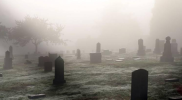
Fog drifted low across the ground, pooling between gravestones as though the earth itself were exhaling. The trees shifted in the wind, letting out a hollow, restless sound that pressed my coat against my back. My breath clouded faintly before me, a pale bloom dissolving into the fog. I quickened my pace, aware of the silence deepening behind me, and then—footsteps. Soft. Unhurried. Too close. I turned. Nothing. Only the shifting fog. My heartbeat quickened, pushing my walk into something closer to flight than stride. When the glow of Fraser Street finally appeared ahead, it looked like a narrow ribbon of safety cut through the dark.

When I reached the Polish Hall, its windows glowed with that unmistakable half-light—amber, muted, neither bright nor dim, as if the room were illuminated by memory itself. The sound of bandoneón, piano, and violins pulsed through the walls, low and melancholic, vibrating faintly beneath my feet. I stood at the entrance for a moment, catching my breath, trying to quiet the echoes the cemetery had left in me, and letting the warmth of the music settle my nerves. The door was heavy, and I had to push with both hands to open it. Warm air spilled out in a soft exhale fragrant with perfume, polished wood, and the faint sweetness of rum.

Inside, silhouettes moved in slow circles, bodies gliding in the half-light as though guided by something older than music. I stepped forward—only a single step—and something in me shifted. The outside world fell away. The cold, the fog, the footsteps behind me… all dissolved at the threshold.
What remained was the half-light and the strange certainty that I had just entered a place I was meant to find, though I could not yet understand why.

A woman at a small table near the door was checking people in. She was elegant in a way rarely seen now—black dress, dark hair pinned neatly, a brooch catching the light like a drop of frozen flame. Her accent was European, but not from any place I could name; it seemed stretched across centuries, its vowels softened by time. As she handed me a small ticket, I noticed something unusual: even in the warmth of the room, no breath escaped her lips.

“Welcome,” she said. “Your entrance, please.”

I paid, and she gave me the ticket with a faint, unreadable smile. As she did, she leaned in the smallest amount and lowered her voice.

“Be mindful of whom you choose to dance with.”
Before I could respond, she turned to the next couple, her expression giving no sign of whether her comment had been a jest, a courtesy—or something else entirely.

I moved quietly to a corner chair and changed into my dance shoes, my attention drawn again and again to the dancers on the floor. Their steps were precise, their embraces intimate, and their movement so unhurried it seemed as if time itself slowed to keep pace with them. I had intended to dance, but instead I found myself watching—entranced by the quiet grace with which they moved.

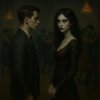
At some point, I became aware of someone watching me. I turned and saw a woman seated alone near the far wall. Her dress was deep red and black, catching the half-light like embers smoldering beneath ash. Her skin held the cool sheen of porcelain—faintly luminous, as though lit from within by something the room did not provide. She sat perfectly still, yet her presence felt impossibly vivid, as though the air tightened around her. Our eyes met. The moment was brief—her gaze intimate and distant at once, a look that seemed to regard not only me but something beyond me, or behind me, as though testing whether I belonged in that room at all.

Then a dancing couple passed between us, and when they moved on, she was simply gone. Not hidden—gone, erased, as though she had stepped out of the half-light itself.
A flicker of red and black caught my attention—the hem of a dress disappearing behind a partially closed door near the back of the hall. I stood, moving through the crowd, but when I reached the door the hallway beyond was empty. Only the faint echo of light, quick, almost weightless footsteps drifted down the stairs toward the building’s basement.

Curiosity—unsettling, insistent—pulled me forward. I descended a few steps into the dim passage, where the sound of my own breathing felt too loud in the stillness. Then a man appeared at the bottom of the staircase, blocking the way. His suit was dark, his face expressionless, and for a moment I realized, with a sudden chill, that I couldn’t hear him breathing either.
“The milonga is upstairs,” he said. “There is nothing for you down here.”
“I thought I saw a friend,” I replied, though the words felt thin in the cold air.
“There is no one here,” he said again, gently but firmly, as though reciting a rule. “You must be mistaken.”
There was nothing to do but turn back. When I reached the main hall, the dancing continued as though I had never left, the music steady, the lights unchanged, the dancers moving in patient circles through the half-light.

I did not dance that night.

In the weeks that followed, I returned to Milonga Media Luz again and again, certain I would see her—the woman in red and black who vanished as though the shadows themselves had claimed her. With each visit, the nights grew more enchanting, the music more intoxicating, and I felt myself drawn deeper into a place where the city’s ordinary rules no longer seemed to apply. Sometimes, standing at the edge of the dance floor, I would catch myself searching the half-lit corners, listening for the soft trace of breath that wasn’t mine.

But she never appeared again.

Not then.

And yet I left each night with the unmistakable feeling that someone had been watching me from just beyond the glow of the half-light.
(To be continued)
 
Miradamiranda, is there an AI tool to remove AI cliches?

TangoyFutbol: Thanks for posting, I like the old black and white detective story feel. I presume you used some AI tools? Which parts are AI and which tools? I have played around with some, it is fun.
 
Miradamiranda, is there an AI tool to remove AI cliches?

TangoyFutbol: Thanks for posting, I like the old black and white detective story feel. I presume you used some AI tools? Which parts are AI and which tools? I have played around with some, it is fun.
Hello everyone,


Thank you for your comments. For the images, I use Runway AI and ChatGPT. Film and writing are not my professions—though I always wished I had studied film, videomaking, or creative writing. Life required me to pay the bills, so these became passions I explore on the side.


Tango is a powerful experience for me. After milongas, I often find myself sketching stories or imagining short films based on the moments I observe on the dance floor. I usually write in Spanish, which comes more naturally, and then translate and refine the text in English.


I don’t want to overwhelm the group by posting continuous stories here, but if anyone is interested, you’re welcome to email me and I can share my Facebook account, where I post some of them. I tend to write about love, heartbreak, loneliness, class, race, magical realism, the passage of time, and the emotional undercurrents that emerge in tango. Sometimes I write about politics with Tango interpretations but I usually keep these to myself. Writing helps me process the feelings that stay with me after dancing—otherwise they linger and return until I put them into words.


Once again, thank you for your interest and kindness.
 
The Woman I Once Saw in Milonga Media Luz (Part Ii AND III)
© 2025 Luis Eduardo Azmitia. All rights reserved. No part of this work may be reproduced without the author’s permission.
Part II
I returned to Milonga Media Luz for the next three Tuesdays in a row.
Each week I told myself I would dance more, speak more, perhaps stay later.
Yet the moment I stepped into that amber half-light, something inside me folded inward.
I hovered at the margins, watching instead of participating.
From my usual seat near the far wall, I observed the dancers with an intensity that felt almost intrusive.
Their bodies moved as if they shared a single breath—
the subtle tilt of the chest, the quiet advance of a step,
the gentle gathering of an embrace.
It was a private language spoken through skin, bone, and intention,
and I felt like an exile learning it by watching shadows on a wall.
The hall often held three hundred people, yet it carried a strange anonymity.
At each tanda announcement the air shifted—
the lights dimmed, the music reoriented itself,
and the room dissolved into a single tide of moving bodies.
The ritual felt ancient, almost sacred, as though the dancers enacted a ceremony
older than the Polish Hall, older than the city itself.
I danced only a few tandas during those weeks—two, perhaps three.
Still new, still cautious, I chose partners carefully.
To my surprise, the women who agreed most often were Eastern European—
from the Baltics to the Balkans.
Their embraces had a steadiness that felt like old-world warmth:
hands that guided without force,
perfume that carried faint hints of jasmine, dark tea, or winter fruit,
movements shaped by histories I could feel but not name.
Dancing with them steadied my breath,
and for brief moments, something inside me felt less alone.
And yet, even in the comfort of those embraces, my eyes drifted toward the entrance.
Toward the dimmest corners of the hall.
Toward any place where a shadow might gather into the form of a woman
wearing black and red.
But she never appeared.
Or perhaps she did—
hidden in the periphery,
dissolved into the half-light,
folded into the music like a secret refrain.
Once, I thought I saw her reflection in the darkened window.
A still figure behind me, unmoving despite the swirl of dancers.
But when I turned, only darkness stared back.
Part of me was relieved she was gone.
Part of me feared the night she would return.
Part III
By the fourth Tuesday, a ritual had settled into my bones.
I arrived with an eagerness that felt almost adolescent—
the quickened breath, the restless anticipation.
And strangely, I had grown accustomed to passing the cemetery on my way to the hall.
Sometimes fatigue pushed me through its shorter path;
other times the cold wind insisted on it.
But if I was honest with myself, I felt watched there—
not with malice, but with familiarity.
That night, as the first tanda played, I noticed Juvka—
a dancer whose presence had always soothed me—
sitting alone for several songs.
This, I thought, might be my opportunity.
When the cortina sounded, I approached her.
She accepted with a gentle smile.
Her embrace felt like a sheltered warmth,
a closeness that steadied the tremor beneath my ribs.
Her breath aligned with mine as if she were guiding me back into my own body.
With the vals of the second tanda, the room softened;
the dancers seemed to glide in slow motion,
as if time itself waltzed around us.
In that suspended moment,
a cold shiver traced the length of my spine.
I opened my eyes.
She was there.
The woman in black and red from my first night.
Standing utterly still near the far wall,
her face pale as moonless porcelain,
her dark eyes fixed on me with an attention that felt intimate—
almost possessive.
Her presence carried something I could neither deny nor rationalize:
beauty sharpened by sorrow,
sadness shaped by hunger,
a gravity that pulled at the deepest part of me.
A couple passed between us;
their movement broke the line of sight.
When they drifted away,
the woman was gone—
as though she had been exhaled by the shadows.
The music ended.
Juvka thanked me softly, unaware of the cold trembling in my chest.
I returned to my seat, scanning the hall for any sign of her.
This time, I watched her as carefully as she had watched me.
Men lined up to invite her to dance—
confident leaders, experienced ones—
and she refused each one with a softened shake of her head.
All except one.
A young man, inexperienced, his posture uncertain.
He could not have been dancing more than a few months.
And yet she accepted him without hesitation—
almost eagerly.
As they walked to the dance floor,
her hand resting lightly on his arm,
something inside me tightened—
a thread pulled taut between dread and longing.
Their bodies disappeared into the moving crowd,
but I felt her eyes on me again,
as if every step she took with him
was meant for me to feel.
Near the end of the night,
I sensed her gaze return.
It was an invitation,
with a depth of familiarity—
as though she recognized something in me
that I had not yet recognized in myself.
I broke her gaze and forced myself toward another partner.
It was the first time in weeks that my choice felt like disobedience—
not to the milonga, not to myself,
but to something older that had begun to take notice of me.
 

Attachments

  • 589739415_25669255596013172_4655664143346660763_n.jpg
    589739415_25669255596013172_4655664143346660763_n.jpg
    12.1 KB · Views: 1

Dance Ads

Advertise on Dance Forums Reach dancers, teachers, studios, event organizers, and dance-friendly brands. View ad options
Back
Top