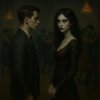
 The Woman I Once Saw in Milonga Media Luz (Part I)
© 2025 Luis Eduardo Azmitia. All rights reserved. No part of this work may be reproduced without the author’s permission.
Part I
I don’t know if anyone will believe me, but the events I am about to recount took place the year I began dancing Argentine tango in Vancouver. For those unfamiliar with this port city at the far edge of the Pacific, winter is not a season but a temperament—clouded, sodden, and weighted with fog so dense it seems to swallow sound. Weeks can pass without a glimpse of the sun. The nights are colder still, all rain-slick streets and restless wind. There were evenings when the fog thickened in a way that felt older than the city itself, as if it had drifted inland from another century.
In a place like this, loneliness does not visit so much as it settles. You can drift through an entire day without a single meaningful conversation, untouched by another human being, moving through the city like one more shadow dissolving in the rain. Looking back, I sometimes wonder whether it was loneliness that led me toward what happened, or whether something else—something quieter, older—was waiting for me to step into its half-light.
After a few weeks of tango classes, that loneliness finally pushed me to call the organizers of what everyone said was the most popular milonga in the city. A woman answered—her British accent precise, her tone warmly old-fashioned, as though it had drifted forward from another era. She gave me the address and mentioned that the event was held in the Polish Hall, only a few blocks from Mountain View Cemetery, Vancouver’s only burial ground, founded in 1886. The way she said cemetery lingered a heartbeat longer than the rest of her sentence, soft yet deliberate, as if the word carried a meaning I had not yet earned.
When I told her I lived nearby, she paused—just long enough to be felt—and then gently suggested I walk instead of drive. Parking could be difficult on those nights, she added, though something in her voice made the advice sound like a warning disguised as courtesy. As she spoke, I became aware of a faint, dry floral scent—lavender or something like it—though I could not say whether it came from her, the phone, or the thought of her.
I could hardly wait for Tuesday to arrive. I had never been to a large milonga before, and even its name intrigued me—Milonga Media Luz. The night began with me standing too long in front of the mirror, choosing a suit and tie as though fabric could steady my nerves. Before stepping out, I looked for the moon, hoping for even a sliver of light, but the sky was empty; it was a moonless night, the kind that makes the city feel older than it is.
The cold struck the moment I opened the door. I walked briskly for a few blocks to warm my body, and soon found myself facing the entrance to the cemetery. I could have taken the long way around, but that felt like delaying something I already sensed I needed to face. So I stepped toward Mountain View—and regretted it almost instantly, though not enough to turn back.
Fog drifted low across the ground, pooling between gravestones as though the earth itself were exhaling. The trees shifted in the wind, letting out a hollow, restless sound that pressed my coat against my back. My breath clouded faintly before me, a pale bloom dissolving into the fog. I quickened my pace, aware of the silence deepening behind me, and then—footsteps. Soft. Unhurried. Too close. I turned. Nothing. Only the shifting fog. My heartbeat quickened, pushing my walk into something closer to flight than stride. When the glow of Fraser Street finally appeared ahead, it looked like a narrow ribbon of safety cut through the dark.
When I reached the Polish Hall, its windows glowed with that unmistakable half-light—amber, muted, neither bright nor dim, as if the room were illuminated by memory itself. The sound of bandoneón, piano, and violins pulsed through the walls, low and melancholic, vibrating faintly beneath my feet. I stood at the entrance for a moment, catching my breath, trying to quiet the echoes the cemetery had left in me, and letting the warmth of the music settle my nerves. The door was heavy, and I had to push with both hands to open it. Warm air spilled out in a soft exhale fragrant with perfume, polished wood, and the faint sweetness of rum.
Inside, silhouettes moved in slow circles, bodies gliding in the half-light as though guided by something older than music. I stepped forward—only a single step—and something in me shifted. The outside world fell away. The cold, the fog, the footsteps behind me… all dissolved at the threshold.
What remained was the half-light and the strange certainty that I had just entered a place I was meant to find, though I could not yet understand why.
A woman at a small table near the door was checking people in. She was elegant in a way rarely seen now—black dress, dark hair pinned neatly, a brooch catching the light like a drop of frozen flame. Her accent was European, but not from any place I could name; it seemed stretched across centuries, its vowels softened by time. As she handed me a small ticket, I noticed something unusual: even in the warmth of the room, no breath escaped her lips.
“Welcome,” she said. “Your entrance, please.”
I paid, and she gave me the ticket with a faint, unreadable smile. As she did, she leaned in the smallest amount and lowered her voice.
“Be mindful of whom you choose to dance with.”
Before I could respond, she turned to the next couple, her expression giving no sign of whether her comment had been a jest, a courtesy—or something else entirely.
I moved quietly to a corner chair and changed into my dance shoes, my attention drawn again and again to the dancers on the floor. Their steps were precise, their embraces intimate, and their movement so unhurried it seemed as if time itself slowed to keep pace with them. I had intended to dance, but instead I found myself watching—entranced by the quiet grace with which they moved.
At some point, I became aware of someone watching me. I turned and saw a woman seated alone near the far wall. Her dress was deep red and black, catching the half-light like embers smoldering beneath ash. Her skin held the cool sheen of porcelain—faintly luminous, as though lit from within by something the room did not provide. She sat perfectly still, yet her presence felt impossibly vivid, as though the air tightened around her. Our eyes met. The moment was brief—her gaze intimate and distant at once, a look that seemed to regard not only me but something beyond me, or behind me, as though testing whether I belonged in that room at all.
Then a dancing couple passed between us, and when they moved on, she was simply gone. Not hidden—gone, erased, as though she had stepped out of the half-light itself.
A flicker of red and black caught my attention—the hem of a dress disappearing behind a partially closed door near the back of the hall. I stood, moving through the crowd, but when I reached the door the hallway beyond was empty. Only the faint echo of light, quick, almost weightless footsteps drifted down the stairs toward the building’s basement.
Curiosity—unsettling, insistent—pulled me forward. I descended a few steps into the dim passage, where the sound of my own breathing felt too loud in the stillness. Then a man appeared at the bottom of the staircase, blocking the way. His suit was dark, his face expressionless, and for a moment I realized, with a sudden chill, that I couldn’t hear him breathing either.
“The milonga is upstairs,” he said. “There is nothing for you down here.”
“I thought I saw a friend,” I replied, though the words felt thin in the cold air.
“There is no one here,” he said again, gently but firmly, as though reciting a rule. “You must be mistaken.”
There was nothing to do but turn back. When I reached the main hall, the dancing continued as though I had never left, the music steady, the lights unchanged, the dancers moving in patient circles through the half-light.
I did not dance that night.
In the weeks that followed, I returned to Milonga Media Luz again and again, certain I would see her—the woman in red and black who vanished as though the shadows themselves had claimed her. With each visit, the nights grew more enchanting, the music more intoxicating, and I felt myself drawn deeper into a place where the city’s ordinary rules no longer seemed to apply. Sometimes, standing at the edge of the dance floor, I would catch myself searching the half-lit corners, listening for the soft trace of breath that wasn’t mine.
But she never appeared again.
Not then.
And yet I left each night with the unmistakable feeling that someone had been watching me from just beyond the glow of the half-light.
(To be continued)