Burda 7879 (Amazon carries it) has a nice pattern that is easy to modify. It is basically two layers (bodysuit/dress) I have a small waist and it works great for me. It attaches the two parts at the neck and arm hole. Simplicity 3912 and McCall's M5136 are also dress patterns. They have some neckline and skirt variations. Now I just make a bodysuit and attach a skirt at the low waist since that is the line that looks best on me. These patterns got me started and now I just make my own pattern. (of course any skating pattern would work too) Or a Kwik-Sew bodysuit with a skirt attached

Join Dance Forums
Ask questions, meet dancers, and be part of the conversation.
You are using an out of date browser. It may not display this or other websites correctly.
You should upgrade or use an alternative browser.
You should upgrade or use an alternative browser.
Sprucing up my Standard gown - sewing questions!
- Thread starter musicbrain
- Start date
BallroomSparkle000
New Member
When I was making gowns I basically used a bodysuit and "overdress" where the overdress/top skirt and bodysuit had the same cut at the top—because it could have had a low back and only gone up to the bust line—so not necessarily the neck. That avoided any bunching at the hips, because the bodysuit and overdress weren't connected there. If I needed underskirts I stitched them to the seams of the overdress, below the hip, where the top skirt started to flare out.
That makes sense - and you're right, would avoid the problem of the fabric bunching around the hips which was the biggest issue with my last dress!
 Did you ever have any problems with skirts swinging freely around the body during dancing? The underskirts can be so heavy, so I'm wondering whether they would end up swinging the whole layer around my body rather than being anchored and flaring out below the hips?
BallroomSparkle000
New Member
I have a Jalie pattern, 3465 where there are no shoulder seams, and has bodice and sleeves in one - side seams only.
Brilliant thank you!!

Joe
Forum Master
LOL, I never wore the dresses so I can't really definitively say. But those for whom I made dresses didn't seem to complain. There was some up-and-down bounce, but that's really unavoidable when you use stretch fabrics and weigh it down with rhinestones—like holding something up with a rubber band.Did you ever have any problems with skirts swinging freely around the body during dancing? The underskirts can be so heavy, so I'm wondering whether they would end up swinging the whole layer around my body rather than being anchored and flaring out below the hips?
But the key to keep everything from swinging around is to make the dress fit very well. If the bodysuiit fits snugly, and the dress is well-fitted, friction will help keep things from sliding around too much.

flying_backwards
Well-Known Member
No new posts on this thread since 2020? Hope it's ok to add an almost-on-topic question.
I'm modifying a simple practice dress to use in a comp where costumes are allowed but half the ladies will not be wearing real gowns. The practice dress itself hangs straight down with no floof or flare. I want to add some volume at the hem and a contrasting color so it's not solid black. Black is great for my waistline but I'd like some pop at the topline and hem, distracting from the waistline.
My question:
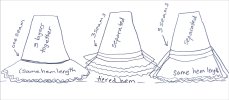
Is it more effective to add 3 layers of floofy fishing-line-hemmed chiffon together at the same seam (same height above hem) or should I stagger them at 3 offset heights? I will be attaching the floofy ruffles to an underskirt which I guess I'll baste onto a leotard worn under the practice dress.
I got the cheapo pseudo-chiffon by buying a $29 amazon belly dance skirt and just using the bottom 6 to 12 inches of each of its 3 layers. Waaaay cheaper than buying fabric and the fishing-line-hem is already sewn in. The leftover "chiffon" can be made into floats, or just take up space for years in my leftover fabric cabinet.
I'm modifying a simple practice dress to use in a comp where costumes are allowed but half the ladies will not be wearing real gowns. The practice dress itself hangs straight down with no floof or flare. I want to add some volume at the hem and a contrasting color so it's not solid black. Black is great for my waistline but I'd like some pop at the topline and hem, distracting from the waistline.
My question:
Is it more effective to add 3 layers of floofy fishing-line-hemmed chiffon together at the same seam (same height above hem) or should I stagger them at 3 offset heights? I will be attaching the floofy ruffles to an underskirt which I guess I'll baste onto a leotard worn under the practice dress.
I got the cheapo pseudo-chiffon by buying a $29 amazon belly dance skirt and just using the bottom 6 to 12 inches of each of its 3 layers. Waaaay cheaper than buying fabric and the fishing-line-hem is already sewn in. The leftover "chiffon" can be made into floats, or just take up space for years in my leftover fabric cabinet.
Attachments

Reach
Well-Known Member
Suggestion: can you pin or baste the 2 different versions, and see which you like best?
I would guess the staggered layers would be my choice. But, you may like all the floofy together.
Let us know what you chose. And maybe a picture of the final results.
Congratulations on the fabric find.
And good luck at the competition.
I would guess the staggered layers would be my choice. But, you may like all the floofy together.
Let us know what you chose. And maybe a picture of the final results.
Congratulations on the fabric find.
And good luck at the competition.
flying_backwards
Well-Known Member
Brilliant!pin or baste the 2 different versions
Yes I can use opposite sides of the underskirt.
My preferred style is tiered with the same length hem. But it's not likely to be the fluffiest of your options - so do the one you love most.
And, I agree with @Reach ... please share with us the final result and what made you choose it. You might change some minds...
I'm "some"... you might change my mind.
And, I agree with @Reach ... please share with us the final result and what made you choose it. You might change some minds...
I'm "some"... you might change my mind.
flying_backwards
Well-Known Member
I "pinned" (clipped with tiny plastic clips because pins & chiffon don't play well together).
I photographed. Really hard to get a good pic since there's so much clutter abounding.
But the conclusion is solid:
None of the above!
The actual winner is to gather the 3 layers down to 3:1 length and sew that to the underskirt base layer.
This is WAY floofier (floophier?) more floofy. The curls pile atop each other in a spirally tangle that juts outward abruptly.
If you want a softer yet still some floof, three layers reaching the same hem line but separately sewed CLOSE to each other works. If you space the layer attachment heights more, it really dampens the "boa" shape. Of course that's a preference. I'm just going for the dramatic, not-subtle, jut-out at the last 6 inches of hem.
A disadvantage of gathering, rather than using the circle-shape of the hem, is that it's nearly impossible to iron. The fishing line would melt under the iron and my iron is too big to fit the 6" ruffle. So I guess I'll finally have to learn how to use the steamer.
I photographed. Really hard to get a good pic since there's so much clutter abounding.
But the conclusion is solid:
None of the above!
The actual winner is to gather the 3 layers down to 3:1 length and sew that to the underskirt base layer.
This is WAY floofier (floophier?) more floofy. The curls pile atop each other in a spirally tangle that juts outward abruptly.
If you want a softer yet still some floof, three layers reaching the same hem line but separately sewed CLOSE to each other works. If you space the layer attachment heights more, it really dampens the "boa" shape. Of course that's a preference. I'm just going for the dramatic, not-subtle, jut-out at the last 6 inches of hem.
A disadvantage of gathering, rather than using the circle-shape of the hem, is that it's nearly impossible to iron. The fishing line would melt under the iron and my iron is too big to fit the 6" ruffle. So I guess I'll finally have to learn how to use the steamer.
Reach
Well-Known Member
So glad you found "your look".I "pinned" (clipped with tiny plastic clips because pins & chiffon don't play well together).
I photographed. Really hard to get a good pic since there's so much clutter abounding.
But the conclusion is solid:
None of the above!
The actual winner is to gather the 3 layers down to 3:1 length and sew that to the underskirt base layer.
This is WAY floofier (floophier?) more floofy. The curls pile atop each other in a spirally tangle that juts outward abruptly.
If you want a softer yet still some floof, three layers reaching the same hem line but separately sewed CLOSE to each other works. If you space the layer attachment heights more, it really dampens the "boa" shape. Of course that's a preference. I'm just going for the dramatic, not-subtle, jut-out at the last 6 inches of hem.
A disadvantage of gathering, rather than using the circle-shape of the hem, is that it's nearly impossible to iron. The fishing line would melt under the iron and my iron is too big to fit the 6" ruffle. So I guess I'll finally have to learn how to use the steamer.
And yes, a steamer is often better/safer than an iron. That's what I use.
A friend of mine who also competes melted part of her Standard dress night before comp. Had not brought another one with her. Had to buy one at comp. She did find a lovely dress, in her size, at a "reasonable" prics. But still an expense she was not planning on!
Good luck at the comp. And maybe a photo of the finished dress.

ProgressNotPerfection
Forum Master
Since floof, the noun form of the adjective floofy, is spelled with an f instead of a ph, I'd go with "floofier" as the probably more correct spelling than "floophier," although your solution of changing it to "more floofy" is the obvious workaround. And then, when you want to use the adverb "floofily" (as in, "the floofier floofs on the skirt floofed around floofily"), the spelling for all the versions will be consistent.WAY floofier (floophier?)
Consistency, after all, is important.
Joe
Forum Master
This is the English language we're talking about, right?Consistency, after all, is important.
flying_backwards
Well-Known Member
I finished putting the ruffle on the white dress last week but forgot to post a pic. I'm undewhelmed by the limited amount of floof created. I opted for a 3:1 gathering ratio but rather than tightly gather, I did a pleat. The ruffle I was using was cut off a 3-tiered belly dance skirt. The top tier had a smaller radius, middle tier more radius and longest tier of course longest radius so the three pieces being added, end-to-end, had different floof going in to the pleats. I adjusted the pleat overlap accordingly but I can still see a difference. Anyway, done is better than perfect.
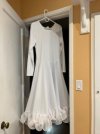
It's super cute and adds a pop of fun at the bottom. Mission accomplished!I finished putting the ruffle on the white dress last week but forgot to post a pic. I'm undewhelmed by the limited amount of floof created. I opted for a 3:1 gathering ratio but rather than tightly gather, I did a pleat. The ruffle I was using was cut off a 3-tiered belly dance skirt. The top tier had a smaller radius, middle tier more radius and longest tier of course longest radius so the three pieces being added, end-to-end, had different floof going in to the pleats. I adjusted the pleat overlap accordingly but I can still see a difference. Anyway, done is better than perfect.
View attachment 6343
Joe
Forum Master
I think the problem may be that gathering or pleating involves extra material, which adds weight. Also, a pleated seam adds bulk—another enemy of "floof."
For the maximum amount of floof, you'd want to chain small concentric circles—cut a circle of fabric, cut a circle out of the center, cut along a radial line, stitch the radius to the radius of an identical piece(s), so you have one long ruffle. Then stitch it to your skirt's hem (or above) along the edge where the smaller circles were cut out.
Obviously, the smaller the inner circle, the better the floof, but also the more pieces it'll take, so there's a balance.
For the maximum amount of floof, you'd want to chain small concentric circles—cut a circle of fabric, cut a circle out of the center, cut along a radial line, stitch the radius to the radius of an identical piece(s), so you have one long ruffle. Then stitch it to your skirt's hem (or above) along the edge where the smaller circles were cut out.
Obviously, the smaller the inner circle, the better the floof, but also the more pieces it'll take, so there's a balance.