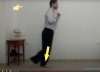
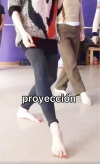
The dancer needs body tone so that internally
within her body her centre moves accordingly.
For me - at the moment - this is where i put the emphasis in my own thinking / practicing. There is a whole chain of different parts that need to be connected, and stay connected, to make good movement as a couple happening - from the leaders base, through their body, through the followers body, into the followers current/ future base.
I've been reading through these threads and cannot believe the disparity and contradictions in the descriptions of how to lead, where the impetus comes from, and so on: standing leg, hips, chest, solar plexus, upper chest, now upper torso and arms.
I think which body part / link between body parts gets emphasized is to some extent arbitrary. From my experience with other taught movement a lot of "general rules" are mostly addressing either a common problem, a specific problem of the person taught, or a specific issue that gets in the way with a teachers/styles favourite move. I don't think that anything 100% determines if a movement works or not. An impetus from the standing leg is not going to do anything if it dissipates at the hip, and arms are not going to work well if they are leaving the body behind.
So what i see people talking about step projection/emphasizing the followers free leg emphasize is that the followers leg is not moving independently by itself, but is part of this connected chain. As somebody who dances more downtown influenced i would talk about consistent, smooth counterbalancing using chest contact within the couple, but it is implicit that this is only possible if i as a leader am grounded and use footwork to keep my chest in place, and if the follower uses their footwork to go / be where is needed to keep this geometry intact.
Re: relative freedoms: I am somewhat of an advocate of downtown tango in my community, and i think this is one of the misunderstandings people have about it, and i am talking with other dancers quite a bit about this - if you take nuevo influences classes there is a lot of emphasis on the leaders setting the followers step length, setting the direction of the step, making their foot land exactly where one wants. A lot of the core vocabulary is single axis, off axis, or with the follower grounded/locked onto their middle axis - i.e. situations where the follower has no control. I don't see a lot of freedom there. (OTOH there is more emphasis on taking turns being the one who dances at the moment, and developing additional channels of expression like using upper body and arm movements, but i feel that this is something different than having freedoms within the dance)
In contrast people who dance counterbalanced tend to trust the follower to get where they need to be, to make choices that will get them there, and there is quite a bit of space to more or less subtly shape the dance - JohnEms language is pretty typical:
A lot of the vocabulary is predicated on momentum the follower generates, on how they shape the dance.I move both bodies together chest to chest, my partners free leg moves intuitively to where it is needed and my own does the same.
One interesting exercise is to do play with ocho cortados using nuevo, salon, and milonguero technique, and feel the differences in energy and where the interesting part of the move is.