Tango Diaries

..Tango Nuevo.. These new and popular things..
But with tango nuevo, things are somewhat different, it was an older style, even if the name suggests otherwise. Piazzolla saw his compositions in the second half of his life as a return to the beginnings of tango. It was a retro movement, the rhythm of tango criollo, the 332 riffs, the cross-rhythms. (This does not apply to Eduardo Rovira, who drew on Bach.)
 
A concrete example is Bachata Sensual. It is a new thing very little to do with the character of bachat itself. Both from music and dance perspective. Trying to justify it as bachata is an example of imposition. It is “something” sensual, it is popular, people want to dance it. Fine. Just don’t try to say it is bachata.

I think it's the inverse, calling it bachata sensual acknowledges its origins

I don't think how tango is danced today has much in common with how it was danced in the 30s and 40s either
 
I think it's the inverse, calling it bachata sensual acknowledges its origins
Not really. It is a falsely claimed origins.

Neither the dance nor the music was ever danced in DR or anywhere else that way.

At least Neuvo had its origins in stage tango. It took a lot of elements of stage tango.

Most of the elements of bachata sensual came from zouk, salsa and other dances. All kinds of body rolls, hardly were present in bachata. But were very much part of dances like zouk and salsa.

Since bachata was a simple dance or had intricate footsteps, the instructors started creating moves to differentiate themselves from other instructors. Before mid-late 2000s, hardly anyone was teaching bachata. Only when it started getting popular in late 2000s did the first generation of instructors started adding elements of salsa and other dances into bachata.


I don't think how tango is danced today has much in common with how it was danced in the 30s and 40s either
You are still dancing it to the music as then. The character of the music hasn’t changed. You are not dancing to pop songs. I have heard pop songs played as part of alternate tandas but as I said that is not tango to me.
 
..At least Neuvo had its origins in stage tango..
Sorry, I can't let stand what you're saying here!

- The dance elements of stage tango you mentioned rather are remnants of the old creole vocabulary before the Guardia Nueva reshaped tango in the European sense. Neo is retro!

- The same applies to bachata. You don't seriously believe that bachata originated in the Dominican Republic, do you? Bachata also has a history that led from Haiti to Cuba to Argentina (milonga). It is so legitimate to draw on older vocabulary that has been removed from the canonized form danced on an isolated island today. Sensual is retro!

Please broaden your perspective and don't just think in terms of only twenty years. That's why I confronted you with the difference between traditionalists and conservatives for your consideration: it's about evolution, but definitely not about museum display cases.
 
I don't think how tango is danced today has much in common with how it was danced in the 30s and 40s..
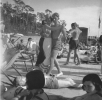
I don't think so. For me, the main styles have always existed side by side. Different periods have brought one style to the forefront, then another. This photo by Eva Besnyö (1910-2003) shows an open-air milonga at the Wannsee lido outside Berlin in 1931.
Look closely; the couple in the middle is dancing salón in a V-hold, exactly the way I usually dance tango today. (And the guy in the background looks like eternal beginners still look 90 years later.)

Wannsee 1931.png
 
Last edited:
You are still dancing it to the music as then. The character of the music hasn’t changed. You are not dancing to pop songs. I have heard pop songs played as part of alternate tandas but as I said that is not tango to me.

even dancing it to the music is debatable. The dance technique changed, and it was also a dance of figures back then, likely in set rhythm.
 
Sensual is retro!
See this

May, or may not, be historically accurate!

I'd say similarly for 'tango nuevo'. It was a different way of teaching and interpreting the existing, or old, style. But the object, or common understanding, of the terminology has evolved and is now sometimes taken as 'non-traditional', or alternative, music with 'grander' interpretive dance steps.
 
Last edited:
My agenda is completely different. I've been dealing with the subject for years now, and I know most of the sources. But I'm interested in reframing. It's about scaring people out of their comfort zone. What most people here in the forum are clinging to is just construction, and they don't want to admit it.
 
My agenda is completely different. I've been dealing with the subject for years now, and I know most of the sources. But I'm interested in reframing. It's about scaring people out of their comfort zone. What most people here in the forum are clinging to is just construction, and they don't want to admit it.
I'd guess most just want to dance, and are trying to resolve what they've been taught as AT and it's culture in their 'class' with what they find elsewhere, or multiple styles they find, or their perception of what AT is and should be. Simplistically, how do I invite and dance with other partners? And then, how do I improve to get, and have, the dances we want to enjoy together? It's not about some idea of 'reframing', beyond understanding how others picture it and resolving that with my perception.
 
now sometimes taken as 'non-traditional', or alternative, music with 'grander' interpretive dance steps.
Should have added that there have been several phases of 'nuevo' (new) in AT. Even Petróleo was nuevo at the time, but then we need new words (palabras nuevas) so we have 'neo' ('new' from Greek), or alternative terminology like electrotango, or... It's 'new' in many generations, but then some descriptor falls into common usage and we find other descriptors as it evolves. I guess bachata with 'sensual' took another way without the overused 'new'. But so what? AT and its culture continue to evolve - provided there's a flame to pass on.
 
I'd guess most just want to dance, and are trying to resolve what they've been taught as AT and it's culture in their 'class' with what they find elsewhere, or multiple styles they find, or their perception of what AT is and should be.
I agree!

Even among devoted students and hardcore debaters of tango, the fraction who want to spend their limited time and energy asking, "What is tango?", "What is (what is tango)?", "What is (what is (what is tango))?", ad infinitum rather than dancing is too small to be relevant. So they settle for a construct and . . . so what? Why challenge that? Why shake it up and cause something fun to become a source of tension and philosophical self-examination?

For the overwhelming majority, going deeper than what they can see at classes, prácticas, and milongas, and hear from coaches, instructors, and teachers isn't necessary to be a better dancer, and in fact a total waste of time. If they do have extra time to spare, it's better to devote it to physical workouts that train physical skills like strength, balance, and muscle engagement than to worrying about tango's framing and context. Indeed, worrying about social structure past "How do I get more dances?", musical structure beyond "Tango is in 4/4 and has a rhythm, implied beat, and melodies," or historical context crosses a line into wasted time if all you want to do is dance more often with Cherie, Emma, Marie, Nikki, and Sarah – or Chuck, Ernie, Max, Nick, and Sam – at that place at X Street and Y Avenue.

My description is silly for silly's sake, but it's still most likely a fair description of reality for just about all but a rarified subset of the tango community.

And I don't say this lightly. I take tango seriously. I just got back from a private salon where teachers and students of various levels meet to discuss and practice different perspectives on the dance, and to approach learning in a holistic, level- and syllabus-free way. But one of the teachers said something very true: "Don't overthink it. Your body is smart. Let it learn through doing. And when you go out to dance, just dance." If you're thinking of something else but dancing, you're doing no favors to anyone, starting with yourself.
 
I guess bachata with 'sensual' took another way without the overused 'new'.
Incorrect comparison of parallel. Sensual was its own thing. It is a European (Spanish) invention. Part cultural appropriation. Part mislabeling it as related to bachata. Most of the sensual moves as I explained come from zouk and salsa. The music is some weird remix of popular pop music.

Bachata is still heard in Latino neighborhoods around major USA cities. No one dances it like sensual.

Sensual has grown popular among youngsters who go and learn it in class settings. However total number of sensual dancers get dwarfed by bachata dancers who don’t dance sensual.
 
Most of the sensual moves as I explained come from zouk and salsa. The music is some weird remix of popular pop music.
And this is it. You can "Sensualize" much easier almost every pop hit that "Zouk it". Learning curve for Bachata is easier then for Zouk. In reality, first lesson are novices introduced to basic steps and turns, second lesson they start to try waves. It is insane, it is like you try to dance Volcadas on second lesson of TA. But waves are atractive and everybody likes to imitate their YT idols. Nevertheless, if Sensual Bachata is popular among youngsters, great! More dancers start to dance social, lot of them sooner or later adopt next dances, like Salsa, Zouk, Kizomba and WCS. And then there is still open door to migrate to TA.
Bachata Dominicana was not able do such job like this artificial bastard called Bachata Sensual. :))
 
..sensual moves ..come from zouk and salsa. The music is some weird remix of popular pop music... Bachata is still heard in Latino neighborhoods ...No one dances it like sensual..
This shows a big difference compared to the situation in Europe. In my city, the Latino community dances exclusively sensually when slow Latino pop is played. Two or three couples dance to upbeat Dominican music. But that's changing because b.dominicana has benefited from the sensual wave. However, the new b.dominicana teachers are local natives without Latino roots. The born Latino community still sticks to b.sensual and Latino pop, at least here.
 

Dance Ads

Advertise on Dance Forums Reach dancers, teachers, studios, event organizers, and dance-friendly brands. View ad options
Back
Top