The apilado equation

..a volcano is always stationary, it has to be. The fact that you can follow it up with something that moves you forward doesn't change that fact.
First, its nothing wrong with stationary elements. The tango walk is not a continuous clockwork. I often stop, breathe, sway, decorate, just like the music suggests. Anything else would be boring or tasteless.

Second, there is no volcada as such, you should lock at them one by one. In my posts I did not refer to the front volcada, not to the calesita, carpa, split, or other fance stuff. I had the back and side volcada in mind.

Of course the back volcada also contains a little delay, or hesitation. But you can fit it in fluently into the normal caminada just to spice it up. Thus the back volcada is a means to increase cadencia, rhythmical walking, alternating between parallel and crossed system.

So that you know which move I'm talking about. And don't let the video put you off. They begin with an improper side step just for didactic reasons. They also make the figure very large.

Or jump right to 5:28 of this one by Homer and Christina.
 
The ronda is a modern dance school atavism. It kills all musicality.
When I start to interpret the music in a modest way (nothing controversial for people on these forums!) and then the couple in front of me suddenly stops completely off the music (a jarring halt, not a pause), blocking me completely, it can murder my musicality for a measure or two by forcing me to react to people rather than music. Predictability is a good thing. By that I mean, "Moving to something that actually exists in the music, even if it's hidden or a background theme."

I realize that for lots of people, a crowded floor is fun. Some have told me they consider it traditional. When I'm being honest, though, I kind of hate crowded floors because so many dancers do the above and so few look where they're going.

At an outdoor event Sunday evening, there was a vals I didn't dance, and I was counting (approximately, of course!). Out of ~25 couples: ~15 leaders were looking at their feet (!) and ~5 were dancing with their eyes closed (!!). Less than half of the couples were dancing in a close hug, so they were taking up a ton of space. I could see only three couples dancing vals timing; the rest were dancing "tango with an imaginary fourth" . . . I saw very little syncopation that suggested the majority were aware of 3/4 timing. And despite vals being a constantly progressing dance with no paradas, I saw a ton of dead stops.

So, lots of not looking where they're going and lots of not dancing the actual music. Nothing to do with big volcadas or in fact any fancy steps. Well, not quite: One guy wearing elephant pants, dangling keychains (yes, plural), and other things that could catch heels was leading huge steps that didn't even clearly descend from tango movements all evening. At least he pulled his partner off the floor to another area, even if he did cut me off while doing it. While looking at his feet, of course.
 
I prefer Homer and Cristina's version because Homer doesn't rock back on his trailing leg, possibly stomping the imaginary couple behind him.

The problem with volcadas of any flavor are leaders who insist on moving a leg back to resolve the movement. The entire thing can be set up by leading the follower to step farther than you (so you're both still moving down the line of dance, but she ends up farther away from you, setting up the volcada) and then using pure torso movement to move her free leg. Works with any front or back volcada, the difference being the timing. A visiting Argentine teacher once said that he prefers the "belly lead," literally "punching" his follower's leg out and letting it spill back using just his abdominals.

But I think the idea of leading walks different from one's own – walking in counterpoint (her, then me, then her, then me), stepping different distances (usually none or tiny for me, modest or large for her), stuttering and doubled steps, slides and drags, etc. – stops at basic cross-system walk at most dance schools.
 
The ronda is a modern dance school atavism. It kills all musicality. In the golden age, people danced in an uncoordinated manner.

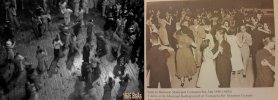
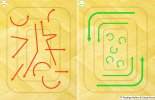
I somewhat agree, somewhat disagree. I would say that "lanes", and the "constant stately pace" are artifacts of teaching (or trying to teach) social dance in an environment where there is quite little actual social dancing. OTOH i would not call what one sees in the old snippets of social dance (either in tango or in other social dances - i have found more early foxtrot than tango) uncoordinated. There certainly exists a flow on these dancefloors, and it is _very_ coordinated, though more in the manner of a school of fish than parallel queues in dedicated lanes moving at the same speed. And for that to happen organically you need a certain minimum shared musicality and density on the dancefloor.

To some extent i am thinking of social dance as a dance of couples with other couples, and this is hard to experience. I have experienced whole dancefloors sharing a flow, and it was exhilarating to me, and i think creating this flow is one of the pinnacles of dance. For social dance it might be the pinnacle. And we as a community are doing a bad job at creating an environment where people can even try to excel in that aspect of the dance, and a lot of beginners are not even aware that this is one of the cores of what tango is about, and even when they are aware of it there are no places where they can even get glances of this experience. A lot of "traditional" events might look a bit more like they have a flow, but when you are in it it sometimes feels more like an imitation of the form, and not the content. Moving in strict lanes with a constant pace doing "excellent floorcraft" has nothing to do with this "there is a shared pulse connecting us all" feeling - i would even argue that it is further away from it than the (mostly imaginary) free-for-all tango nuevo brawls.

(as an aside i wonder if we have such a hard time with these ideas because we come to unstructured social dance with a background of not dancing, solo dancing, and highschool romantic slowdance/ cuddling while standing, while the people who used to dance socially came from a background where they either saw or danced line and circle dances (either formal or folkloric). So they were loosening up the strict rules of how they could move around, and there were strong concepts of how dancers/couples can interact with each other spatially, while we are tightening up and creating artificial rules to organize solo dancers in a limited shared space, which is a very different mindset.)

I said this in another thread, but i think it bears repeating: one of the more enlightening cross trainings for tango is any kind of line or circle dance. I uses to think that it taught me about freedom within the strict form, and how predictability of forms allows dancers within a couple to collaborate and play and be paradoxically more free than when being trapped by being continously behind in the ooda loop, but writing this made me consider the idea that these dances are really all about the flow on the dancefloor, how coordinated movement can be fun in itself.


Muchachos, comienza la ronda
que el tango invita a formar
 

This is a great example - impeccable tight close embrace/milonguero vocabulary, technically dancing very compact, but completely breaking the dance of everybody around them.
(though i suspect this is a artificial situation where the person with the camera asked them to stay in the corner, and what we are actually watching is them being quite uncomfortable and trying to negotiate this - i read the little loop through the middle as " i really want to move with the dancefloor, but i also need to stay in this corner, lets do a compromise")
 

Re: social dance: this showed up on my youtube radar recently
(i know, it is not tango, but from what i have seen elsewhere it is a pretty a good example how floorcraft / lanes used to look (also: least some people (mostly germans) at that time didn't think there was a difference between tango and foxtrot anyway ;) )
 
I would say that "lanes", and the "constant stately pace" are artifacts of teaching (or trying to teach) social dance in an environment where there is quite little actual social dancing.
Yes. In another realm the space in the middle is for 'teaching', or where some maestro (or would-be maestro) would dance away from the general plebs.

Lanes and the ronda, and codigos, are basically like driving on a motorway for a larger dance space. We follow the rules and keep safe. You're in a small bar/saloon/pub and space is constrained. You dance in whatever space is available, maybe avoiding tables and columns for roof support. It also depends whether it's a practica, a milonga, or just some opportunity to dance. I think too much is being read into this.

I've been at some milongas following 'festivals' where the invited 'maestros' may do a tanda in some free space in the middle, or they may join the rest of us and even dance a tanda with us. Can't object to either depending on the circumstances, but it can be annoying when someone thinks they're good and deserves their very own reserved space to do their own thing, and that not very well.
 

Re: social dance: this showed up on my youtube radar recently
(i know, it is not tango, but from what i have seen elsewhere it is a pretty a good example how floorcraft / lanes used to look (also: least some people (mostly germans) at that time didn't think there was a difference between tango and foxtrot anyway ;) )

Because you opened up the Nordic historic social dance I'll add these two examples from 1984, Finland. :)

A value! It's filmed from an unusual angle so the crowd moving together is visible


This jenka dance pattern is an advancing/turning combo and the crowd is moving forward; not in lines but more as a front.

The video should start at 1min


Isn't tango an advancing dance and should have some kind of organized movement forward?
 
To some extent i am thinking of social dance as a dance of couples with other couples, and this is hard to experience. I have experienced whole dancefloors sharing a flow, and it was exhilarating to me, and i think creating this flow is one of the pinnacles of dance. For social dance it might be the pinnacle. And we as a community are doing a bad job at creating an environment where people can even try to excel in that aspect of the dance, and a lot of beginners are not even aware that this is one of the cores of what tango is about, and even when they are aware of it there are no places where they can even get glances of this experience. A lot of "traditional" events might look a bit more like they have a flow, but when you are in it it sometimes feels more like an imitation of the form, and not the content. Moving in strict lanes with a constant pace doing "excellent floorcraft" has nothing to do with this "there is a shared pulse connecting us all" feeling - i would even argue that it is further away from it than the (mostly imaginary) free-for-all tango nuevo brawls.

Even though my focus is much more on my partner and myself than the rest of the room, I have experienced that shared flow feeling on a densely packed floor. I don't think being really crowded is necessary. Everyone pausing at the same time with the music and then restarting can create it too. And even people trying to walk along the side of the dance floor can be part of the flow.

side note - after doing a lot of 1:1 dancing outdoors during the pandemic I came to the conclusion that, at least for me, the couples dancing with other couples experience isn't necessary because the dancing was completely satisfying without any other couples there. The connection to the surrounding environment still exists in the absence of other dancers (the particular characteristics of the space, positive interactions with people passing by or watching, etc).

I've been at some milongas following 'festivals' where the invited 'maestros' may do a tanda in some free space in the middle, or they may join the rest of us and even dance a tanda with us. Can't object to either depending on the circumstances, but it can be annoying when someone thinks they're good and deserves their very own reserved space to do their own thing, and that not very well.

Never seen that, in my experience the maestros happily share the same space as everyone else when they are dancing socially. The only people I've seen get territorial about "their" space were bad local dancers.
 
Never seen that, in my experience the maestros happily share the same space as everyone else when they are dancing socially. The only people I've seen get territorial about "their" space were bad local dancers.
It is a minority, and I'm not going to deny someone who's much better, and with a much greater vocabulary of steps, and experience, the opportunity if they want to dance as they want with some other good partner. Just saying it happens sometimes - and then they do a tanda with one of us lowly plebs. As you say, the usual problem is/was some local dancer whose personal perception of their skills far exceeds reality.

Another explanation in specific cases could be simple awareness of being being recorded.

Either way: if you're not causing a problem then it doesn't matter.
 

Dance Ads

Advertise on Dance Forums Reach dancers, teachers, studios, event organizers, and dance-friendly brands. View ad options
Back
Top