My friend hurt his back (bulging disc) while tenderizing meat.
And your ideal position for him not good.
He got some insole that push centre forward (middle of feet).
Now he is more active in posture.
Since he has black belt in tae-kwon-do I don't think he had bad posture before.
I can relate to all that although the risk inherent
in his treatment is a sway back instead. But I agree
whole-heartedly to a more active posture, indeed
an increased awareness of the body, the whole
and its parts. Adopt real exercise aimed at stabilising
the pelvis and thus also the lower back.
I don't think you can infer anything much about his posture
from your friend's Taekwondo Black Belt. Posture is
dynamic and changeable for all sorts of reasons. I've known
a taekwondo instructor for probably 20 years, his formerly
good posture is not now what it once was.
I don't recommend Noelia's posture to use it 24/7 and find it unhealthy.
That's a new response, it is indeed unhealthy.
Unfortunately adopting it in the dance seems
to result in dancers adopting it permanently;
that seems to be the case with Noelia (and others).
To use it during the dancing in close embrace
I find it highly useful and effective.
There is static and dynamic posture.
And every activity requires suitable posture.
But such postures should be safe, healthy and manageable.
Hence the many warnings and instructions today from
the health & safety wombles about safe lifting and safe limits.
The way I dance, and my partners who dance, can be
sustained for hours. I'm even dancing with someone
who broke her femur, now plated and pinned but still
in pain and she limps slightly. She loves to dance
so you can imagine what a blow such an injury was.
On the other hand I don't think that Noelia's stance
is helpful at all, perhaps you should read Melina's
blog on this one:
Silly, eh?
When dancing with a partner in a close embrace, it might not look
quite as crass and some even find it sexy. But I can tell you: it is not healthy.
Dancing with a constant backbend compresses the vertebrae uses a lot of
muscular tension, inhibits natural dissociation and does actually interrupt
the flow of the leading signals from top to down. If a communicative signal
is supposed to „run through“ the axis, should it not remain unbroken?
Let us not speak about the long-terms downsides of such a posture.
Many yoga teachers nowadays abstain from encouraging their students
to aim for hyper-flexibility because they know about the risks of such a practise.
So please keep in mind: You (or your lovely partner) will not be young forever,
but you might still want to dance Tango without hurting.
Copied from the much longer article here:
http://melinas-two-cent.blogspot.co.uk/2015/12/beanpoles-backbends.html
I agree with much of the article except and until she blames leaders
for it. Probably both are equally to blame, men less intentionally.
One day I might write an article at more length about how a natural
and functional dance embrace can be managed with a natural
and pain free posture.
Unfortunately Melina then destroys all her good work with this:
(Please don‘t tell me, that I stick out my butt as well.
What you see are the natural curves of my spine and well...
the rest of my body.
The only way to get rid of those would be to go on a stricter diet.)
No Melina - your body needs deep-core exercise unless:
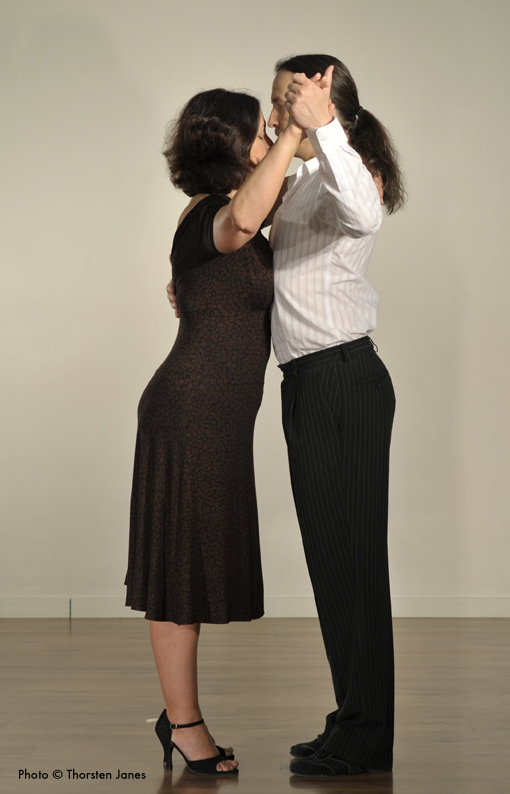
Strangely their together embrace results in both of their upper bodies
being upright, both of them verging on lordosis, neither of them
appearing to be forward weighted as they themselves suggest.
Simple all this may be, easy it is not.
And thanks for the more constructive response,
I hope you take this rather long post in the same vein.