Has Buenos Aires lost its tango soul?

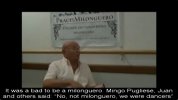
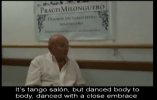
Cacho Dante said something like this in the interview: "There were the milongueros... and there were the dancers."
I remember that sentence differently, kind of: there were those milongueros.. but we considered ourselves to be real dancers. And at that time, Cacho, according to his own perception, danced tango de salón. From here I can't judge whether his self-assessment is accurate. However, he did mention in that interview an very important argument that supports this viewpoint: ...we only danced to Pugliese. I interpret that as to say, his clique was quite arrogant, because the milongueros could only dance to d'Arienzo. I was also confronted with d'Arienzo when I moved from milonguero style to Villa Urquiza: we here mainly dance to Pugliese, was the code of conduct my teacher back then asked for. Since you now want to explore the Mundial style yourself, you can share your experiences. The winners of the first competitions were trained by Rosa Forte, the flagship of Villa Urquiza.
 
Last edited:
I came across this 2007 post from the (old?) Tango-L that I participated in Until I was unceremoniously kicked off the site.

"In 1987, and probably for decades or a century previous, a very simple form of
close embrace was prevalent in the center of town, but not in other barrios. "

The next few posts are also kind of interesting.

Here's another share that I learned about from one time frequent contributor JanTango.
It's given me a bit of insight into why I prefer and miss the weight sharing style I learned years ago.

 
The next few posts are also kind of interesting.

Here's another share that I learned about from one time frequent contributor JanTango.
It's given me a bit of insight into why I prefer and miss the weight sharing style I learned years ago.

Who created the content, who is shown there, and above all: what exactly is displayed on the board?!
 
Who created the content, who is shown there, and above all: what exactly is displayed on the board?!
All of the channels abusing the name of Richard Feinman are AI generated and most of the explanations are way outside what was his actual expertise - physics. It is a mystery how he has created all these videos when he died in 1988. The throwawy of all those pictorial diagrams is a also a giveaway. Watch the appearance and disappearance of a multitude of unexplained formulae, I have even seen Einsteins E=etc
formula come and go. It's not that you might learn something because they are obviously AI summations of whatever topic has been thrown at it. Just don't be bemusded by the unwarranted, even false, attribution and definitely not by the constant diagram bombardment.
 
Cacho Dante said something like this in the interview: "There were the milongueros... and there were the dancers."

I don't believe that the sophisticated construct called "Milonguero Style" here in Europe has much to do with the robust dance style of the historical milongueros.
Interesting. In what ways do you think they differ? Aside from the fact that old-school milongueros are not doing the dancing?
 
To be precise, it was a bit different than in our memories:

View attachment 6494


And regarding the "tango milonguero":

View attachment 6495
Thanks for the clarification. He's not criticizing milongueros, he's simply stating that they were had a bad reputation. Which has been reported elsewhere many times before. He's making a distinction between what he and other milongueros did and what Mingo Pugliese and others like him did.
 
Who created the content, who is shown there, and above all: what exactly is displayed on the board?!
Don't know who created it, although there are plenty of other videos from the same source. I never thought it was actually something the real Feynman created. I could actually start checking the text for accuracy, but the main point for me is that what I refer to as an "embrace" with significant weight sharing feels good. I really only looked at the first few minutes.
Maybe I should have added a disclaimer like "The following video is for entertainment purposes only, although some of it may be factually correct."
And, it was cool to see a post by jantango after all these years.

I'll write again that I never thought the video was actually by THE Feynman. I did read at least one or two of his books and remember his recollection that while some of the guys in his fraternity told people they had never taken any dance lessons, they had in fact taken dance lessons. The few of his explanations of aspects of physics that I read were VERY good.
I wonder, too, if his family or estate has an opinion of the use of his name and image.
 
Last edited:
Interesting. In what ways do you think they differ?
The *milongueros* learned largely without structured instruction; the resources available today - ranging from tango teachers to smartphones - simply did not exist. You either had the talent to learn by watching and imitating, along with the charm, or you were lost; it was a matter of natural selection. Cacho Dante himself says he didn't know the details of how he danced.

Susana Miller observed him closely, and that alone would have altered things somewhat. Naturally, she viewed it all through her own lens, incorporating her own ideas. By eight years ago, she was already nearing the end of her active teaching career in Europe. The focus was heavily on sensitivity and feeling; the technique for men and women was essentially the same. She also led at the milonga, and that looked nothing like the style of the old milongueros, apart from any age-related limitations.


Aside from the fact that old-school milongueros are not doing the dancing?
One can focus either on the nightlife or on the dancing itself, and this leads to different perspectives and priorities.
 
...that looked nothing like the style of the old milongueros, apart from any age-related limitations..
Oh, that was a good joke, you're basing the style on age-related spinal curvature. But there are also dancers who danced very straight and upright well into old age.
One who never called himself a milonguero was Osvaldo Cartery. He saw himself as a salonero.

 
The *milongueros* learned largely without structured instruction; the resources available today - ranging from tango teachers to smartphones - simply did not exist. You either had the talent to learn by watching and imitating, along with the charm, or you were lost; it was a matter of natural selection. Cacho Dante himself says he didn't know the details of how he danced.
Well, this is not entirely true. They may not have gone to modern workshops but they studied with a mentor and with their peers. And a mentor, I would argue, is a much better way to learn. (Obviously, I'm assuming the mentor is someone experienced in the dance, someone respected for his abilities.) They also practiced with friends and mentors, and, later on, probably with girlfriends, et cetera. Depends on the period, but I assume we are referring to people who learned to dance in the 1950s and later. So, their learning was not exactly unstructured, just not as formalized as today.
 
..and with their peers. And a mentor, I would argue, is a much better way to learn..
I don't think you can describe a deficiency as an advantage. What are mentors if they can't teach effectively? Maybe they'll integrate you into their clique, and eventually you'll be allowed to use their name.
I prefer European teachers who can explain biomechanical principles in a way that's easy to understand. In my early years, I had lessons from two old milongueros. Apart from the anecdotes I heard, it was a complete flop in terms of dance technique.
 

Dance Ads

Advertise on Dance Forums Reach dancers, teachers, studios, event organizers, and dance-friendly brands. View ad options
Back
Top