

PNP,
I love that spiral.
New Young Guy tried a "new way" of discussing movement which was interesting. And it helped me "get" something-- even though he had said something only half right (and which applied to the swinging leg.) But it really helped me "get" and pay more attention to the standing leg. (You know... the one should have your weight on? ) He used the word "traction". Not going to explain further....
I love that spiral.
New Young Guy tried a "new way" of discussing movement which was interesting. And it helped me "get" something-- even though he had said something only half right (and which applied to the swinging leg.) But it really helped me "get" and pay more attention to the standing leg. (You know... the one should have your weight on? ) He used the word "traction". Not going to explain further....
We actually ended up with a LONG text in which we went back and forth translating "what is happening physically" in what would be "simplified" dance, getting down to just walking. Anyway, he'd had a discussion with a colleague who had concluded Newton's laws didn't apply in dancing!!!
And he knew the other guys was saying *some things* that were correct-- and other things that must not be! Because even though New Young Guy hasn't had much physics and whatever he took in high school was long long ago, he knew there couldn't be a "dancing" exception to Newton's laws!
Anyway... he gave his version of what the other guys said which seemed to be...."We want to move at constant velocity so we can't accelerate" ..... Which is true as far as it goes. (We sometimes want to move at costant speed in a straight line and if literraly did exactly that, we could not accelerate.)
And yet, New Young Guy knew his coach had a goal of "moving in a straight line at constant speed", but also told him "you need to accelerate in a certain point". So what gives? I ended up discussing approximations (the constant speed goal), the fact that we have two legs -- we aren't sleds or trains-- and ....
The discussion ended up with "cartoons" of situations like the ones below. (The horizontal line is "the goal" of constant forward velocity-- i.e. constant speed in a straight line.) The wiggly line is the cartoon of "closer to what really happens" -- small oscillations around constant. Seems constant.. but it's not... Then the cartoon of the foot shows a position when that food could cause force that accelerates.
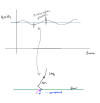
There was a bunch of discussion of leg/ foot position, weight and so on... (by me) ending with " The acceleration is biggest when the slope is greatest."
and then him
"Yes from the beginning of down swing ". So he could see that his notion that Newton's laws must apply was not wrong. But he could see how someone would get confused about this.
Anyway, given the conversations he's having, he seemed glad to have a discussion of this issue that involved understanding the physics of dancing (or even just walking) is complicated because we have two legs-- we aren't trains. And also why certain things have to happen at these points. (Heck... it's also complicated by the fact that our bones aren't connected by pins, and have muscles attached... yada, yada... but...)
One of the best lines from New Young Guy in the middle of the long text was "I also can see why I should never get into any discussions about this. Because you need to really consider the 2 legs situation " ( I think either when trying to actually dance, and/or with people who aren't used to thinking more specifically about physics.)
Of course WE continued texting... and discussed
What positions and weights are "bad" during certain point in dancing -- from a physics point of view. (My cartoon -- see next, my paragraph discussion about why situation in cartoon is counter productive from physics pov, followed by him.... "Correct that’s why we aim for delaying the heel lead".)
He knew the "what we want to do", and some consequence you can observe while daicing. But I know the "from a physics pov, doing this slows us down because of blah... blah... ... prevents us from moving forward )" I could show "forces", associated with shin angle/ foot position , etc. (All oversimplified....)
But we both agree this type of is not something you can do in a lesson-- and should usually avoided.
But every now and then it helps -- and in the "spiral" fashion. He only wondered about it because he's getting into doing things and having coaches explain "why"-- but not quite getting "the physics". Oddly, for me, it helped because it gave me more "a ha... yeah, I really need to keep weight on the "standing/power" leg. But it might not help any one else. Normal people can just observe that putting weight that way results in a better outcome..... )
It was sort of a 'spiral' for both of us!
And he knew the other guys was saying *some things* that were correct-- and other things that must not be! Because even though New Young Guy hasn't had much physics and whatever he took in high school was long long ago, he knew there couldn't be a "dancing" exception to Newton's laws!
Anyway... he gave his version of what the other guys said which seemed to be...."We want to move at constant velocity so we can't accelerate" ..... Which is true as far as it goes. (We sometimes want to move at costant speed in a straight line and if literraly did exactly that, we could not accelerate.)
And yet, New Young Guy knew his coach had a goal of "moving in a straight line at constant speed", but also told him "you need to accelerate in a certain point". So what gives? I ended up discussing approximations (the constant speed goal), the fact that we have two legs -- we aren't sleds or trains-- and ....
The discussion ended up with "cartoons" of situations like the ones below. (The horizontal line is "the goal" of constant forward velocity-- i.e. constant speed in a straight line.) The wiggly line is the cartoon of "closer to what really happens" -- small oscillations around constant. Seems constant.. but it's not... Then the cartoon of the foot shows a position when that food could cause force that accelerates.
There was a bunch of discussion of leg/ foot position, weight and so on... (by me) ending with " The acceleration is biggest when the slope is greatest."
and then him
"Yes from the beginning of down swing ". So he could see that his notion that Newton's laws must apply was not wrong. But he could see how someone would get confused about this.
Anyway, given the conversations he's having, he seemed glad to have a discussion of this issue that involved understanding the physics of dancing (or even just walking) is complicated because we have two legs-- we aren't trains. And also why certain things have to happen at these points. (Heck... it's also complicated by the fact that our bones aren't connected by pins, and have muscles attached... yada, yada... but...)
One of the best lines from New Young Guy in the middle of the long text was "I also can see why I should never get into any discussions about this. Because you need to really consider the 2 legs situation " ( I think either when trying to actually dance, and/or with people who aren't used to thinking more specifically about physics.)
Of course WE continued texting... and discussed
What positions and weights are "bad" during certain point in dancing -- from a physics point of view. (My cartoon -- see next, my paragraph discussion about why situation in cartoon is counter productive from physics pov, followed by him.... "Correct that’s why we aim for delaying the heel lead".)
He knew the "what we want to do", and some consequence you can observe while daicing. But I know the "from a physics pov, doing this slows us down because of blah... blah... ... prevents us from moving forward )" I could show "forces", associated with shin angle/ foot position , etc. (All oversimplified....)
But we both agree this type of is not something you can do in a lesson-- and should usually avoided.
But every now and then it helps -- and in the "spiral" fashion. He only wondered about it because he's getting into doing things and having coaches explain "why"-- but not quite getting "the physics". Oddly, for me, it helped because it gave me more "a ha... yeah, I really need to keep weight on the "standing/power" leg. But it might not help any one else. Normal people can just observe that putting weight that way results in a better outcome..... )
It was sort of a 'spiral' for both of us!
 . Working on foot shaping + hip pendulum and overall actions and positioning in rumba. And body action in rumba/cha walks

 ! BUT, you are absolutely right about heel height being an issue with small feet. I have small feet and cannot dance at all in 3 inches, not at all. I prefer 2.25, like you, and put up with the 2.5. That's because if you have long feet you can maintain foot contact and pressure with higher heels, but you lose that with short feet. There are three things I would change about my body if I had a magic wand, and one if them is having longer (and more flexible) feet, precisely because of this issue.
