Low vs. High boleo - leader's choice or follower's choice?

Umm... honestly, that sounds simply like another way of describing the same thing...

Well, it is and it isn't, depending on what your definition is. The end result for both is the structure we call a boleo. That's why it's perfectly find to call them the same thing, and I won't argue with you about that. ;) It's just a different way of leading the boleo, like dchester and Bastet said. One will create more force, but is less controlled.
 
..would generally define a boleo as being a free leg movement which happens as a result of the leader leading a change of energy / direction....

Technically speaking it is rather an interrupted step that is catched up.

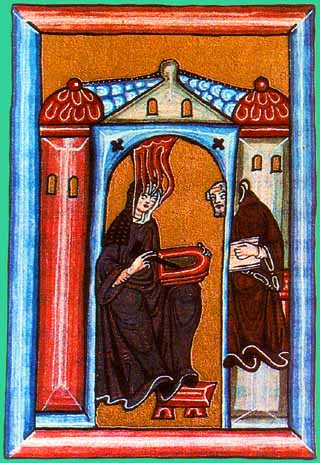
i dont know many followers .. except Hilda van Bingen ...I mean Sigrid Van Tilbeurgh ....

Blessed Hilda was a medieval abbess, ...and how old are you actually?

Concerning Sigrid I have a say in this matter: she is really a very good follower. I love to dance with her if she´s around.

mg62649,1273697014,Hildegard_von_Bingen1.jpg


http://en.wikipedia.org/wiki/Hildegard_of_Bingen
 
Technically speaking it is rather an interrupted step that is catched up.


Blessed Hilda was a medieval abbess, ...and how old are you actually?

Concerning Sigrid I have a say in this matter: she is really a very good follower. I love to dance with her if she´s around.

mg62649,1273697014,Hildegard_von_Bingen1.jpg


http://en.wikipedia.org/wiki/Hildegard_of_Bingen

of course i know she was a medieaval abbess....

she occassionaly gets covered too by Garmana for instance

not telling you how old i am....
 
I'm not much of a follower, but in my class on Sunday I started by:
1. Having the followers swing their leg back and forth freely
2. Getting the leaders to synchronise with that motion
3. Getting the leaders to lead that motion - damping it down and enhancing it.

The best exercise to experience that feeling of a "free leg" was one workshop where he had us all lined up standign about 3 feet from the wall with our hands at our sides, and asked us to fall against it, catching ourselves by essentially doing a push-up against the wall. Then we were supposed to free up one of the legs, and let it fall forward with our center of gravity, so it essentially stayed vertical under the hip, and experience how it traveled while we were falling, how much/little work we had to put into it to keep it free by bending it enough so it didn't get stuck on the floor. This was the first time that i understood in my body the difference between swinging the leg by using muscles, and freeing it up and just letting it swung by gravity/impulse and use the muscles to direct this swinging.

That is one of the reasons that i am not that fond of the suspended boleos, and high boles that don't "ride" the energy of the leader but are activly powered by the follwer- i think they are technically a quite different, and i think it is confusing for a lot of followers. I am actually quite fond of them when done right, but very few people do it right - i am speculating that instead of mastering the free leg and then tightening and exporing their control over the movement some followers start with controlling the movement, and seems to me to be more difficult to find the way to the free leg from there. When exploring the free---control continuum that exists in almost anything going from free to controlled is at least for me easier to start free and then tightening and cleaning things up than the other way round. There is nothing i find more frustrating to me than a teacher telling me that i should relax and let if flow, and i am really bad at letting go of muscular control.

Gssh
 
The best exercise to experience that feeling of a "free leg" was one workshop where he had us all lined up standign about 3 feet from the wall with our hands at our sides, and asked us to fall against it, catching ourselves by essentially doing a push-up against the wall. Then we were supposed to free up one of the legs, and let it fall forward with our center of gravity, so it essentially stayed vertical under the hip, and experience how it traveled while we were falling, how much/little work we had to put into it to keep it free by bending it enough so it didn't get stuck on the floor. This was the first time that i understood in my body the difference between swinging the leg by using muscles, and freeing it up and just letting it swung by gravity/impulse and use the muscles to direct this swinging.
Gssh

Gssh, good points and wellwritten!

There is quite a lot work needed to understand in your body the different inputs of dynamics, directions and other elements included in boleo mechanisms.

Logically there should be some kind of tightening of muscles in the loose leg at the turning point just before it returns to the loose state again. followers is it so - any comments?

I have tried to understand the loose leg and the other changes during boleo process by standing in the door opening. Having my hands on the door-frame and swinging my body/torso to the room before and behind me. How can I release my leg? What happends in the turning point? What makes my feet go up? .... and so on!
 
Technically speaking it is rather an interrupted step that is catched up.
Not always - what about leading a forward linear boleo, immediately after a back one? (i.e. swinging the lady's leg back then forwards)

In that case, yes you're interrupting the step to get the swinging started, but you're simply enhancing the energy from that point on.

Similarly, a forward boleo from a forward ocho is not an interrupted step, you're simply adding more energy to the pivot.
 
Not always - what about leading a forward linear boleo, immediately after a back one?

mmmh, ok ;) the Saludo is lead by a counter movement, too. And (sticking to the said didactics) the counter movement could be seen as a interrupted front8 (exit to the front left side in Xsystem). So, honestly, if the theory makes it easier, than stick to it. If you like the chinese way (pictures, postures, sequences) take the latter one. I am not dogmatic, at all ;) What counts is, that it feels comfortable for the follower.
 
mmmh, ok ;) the Saludo is lead by a counter movement, too. And (sticking to the said didactics) the counter movement could be seen as a interrupted front8 (exit to the front left side in Xsystem). So, honestly, if the theory makes it easier, than stick to it. If you like the chinese way (pictures, postures, sequences) take the latter one. I am not dogmatic, at all. What counts is, that it feels comfortable for the follower.


:cheers:
 
low or high voleo?

If you're dancing socially, keep it low or forget them entirely.

If you're on stage performing, do whatever your choreography requires for the most applause.

The butt-kicking voleos which have become so popular are for those who want back problems. The twisting you have to do insures it.
 
Re: ..to do insures it.

The butt-kicking voleos which have become so popular are for those who want back problems. The twisting you have to do insures it.

One by one:

The butt-kicking voleos which..

Bingo, Graciela once told me that Puppy used to put a lot of coins into his trousers pocket and led boleos with every woman of that class one by one. Afterwards the guys had to rate which one attained the loudest jingling...

..are for those who want back problems..
Indeed, I would not recommend neither of the two to learn the technique of boleos.

..which have become so popular...
Not true, any more. Since Neotango declined a few years ago, they get more and more out of fashion over here. Because BsAs lags behind you will experience it later.

od
 
The butt-kicking voleos which have become so popular are for those who want back problems. The twisting you have to do insures it.

I'm seeing a different version becoming more popular where you aim for the opposite elbow (ie: left leg kicks towards right elbow) Kicking your own butt really doesn't take much flexibility since it doesn't require lifting the thigh very much, but kicking your opposing raised elbow takes quite a bit of flexibility. (and, no, I can't do it)

That brings me to a question/point I've been wanting to make since this thread started, but haven't had time... Are we all meaning the same thing by "low" and "high" in this discussion?

For some people low definitely means the foot never leaves the floor. For other people, (not necessarily on this forum) "low" means the knees stay together, but the foot raises, and therefore hign means the thigh raises as well (making the foot REALLY high... like maybe aiming for the head in a back inline boleo).

Should we assume for this discussion that we all mean "foot stays on the floor" for "low" and anything that raises the foot more than an inch off the floor is "high"?

Is that the meaning behind the OP's post?
 
Man, you totally lost me....

Graciela once told me that Puppy used to put a lot of coins into his trousers pocket and led boleos with every woman of that class one by one. Afterwards the guys had to rate which one attained the loudest jingling...

How does her boleo make coins in his pocket jingle except by how much HE moves when leading it?

Since Neotango declined a few years ago, they get more and more out of fashion over here. Because BsAs lags behind you will experience it later.

Apparently the States lag behind too, because alternative and neo styles are far from "declining"

You guys must be talking about some form of boleo that I'm not visualizing very well. Video, please?
 
The butt-kicking voleos which have become so popular are for those who want back problems. The twisting you have to do insures it.
Is this a recent fad? When I was in BsAs (a couple years ago), I didn't see any high boleos at all in the milongas. Granted, I didn't go to any of the nuevo milongas/practicas.

In the places I frequent in the US, you see a fair amount of both high and low voleos.
 

Dance Ads

Advertise on Dance Forums Reach dancers, teachers, studios, event organizers, and dance-friendly brands. View ad options
Back
Top