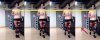
Step projection - Proyección del paso

The video is listed as unavailable. Oh, wait, it's available at her Website. Very, very nice. Léna Lamorelle, the woman leading in the video, has got a beautiful walk. I really like the way she uses her upper body and leans in toward her partner]
This (top video) is so far the best I’ve seen. They were actually Leading!
 
No change, we still differ! :)


The most serious problem that this idea of step projection causes
is an inability of the dancers to dance in small spaces but it makes
rhythmical connection unlikely, or difficult at least, because all the
time interval is occupied with movement and weight transfer.
My dance maximises the time spent on one foot and minimises
the time spent on weight transfer. This way of dancing produces
something else entirely - a way of connecting or "feeling" the music.

I simply don’t agree that step projection causes an inability to dance in small spaces.

There is a difference between practicing a walk alone using projection (when you may be exaggerating the movement) and how you dance, when the projection gets softened, but is still embedded in your walk. It can be long or short, or more of a weight shift to the side, but it’s still there, and it’s critical in the embrace because the energy forward comes off the back foot.

Now my opinion is worth little, but I am being taught in the way OpenDoor describes, and I have no intention of contradicting my beautiful teacher! :)
 
I simply don’t agree that step projection causes an inability to dance in small spaces.
This is relative. What is a small space to you could be quite large
to me. My small space is the size of a floor tile or the space of the
close embrace couple. The minority interest that dance now is
means the constraints imposed by overcrowded dance floors
doesn't exist in the way of the Golden Age. Step projectionists
do not happily co-exist on busy tango floors even in Buenos Aires.
The very name of the method should tell you that.
There is a difference between practicing a walk alone using projection (when you may be exaggerating the movement) and how you dance, when the projection gets softened, but is still embedded in your walk. It can be long or short, or more of a weight shift to the side, but it’s still there, and it’s critical in the embrace because the energy forward comes off the back foot.
Only if you are doing steps from one two footed position to the next.
If I was asked that (in my way, rather irrelevant) question then I would say
the movement energy comes from the standing, axis-weighted, foot.
But the constant forward intention does not, that comes from
the posture being forward weighted towards the front of the foot.
Now my opinion is worth little, but I am being taught in the way OpenDoor describes, and I have no intention of contradicting my beautiful teacher! :)
What you describe comes from show and competition tango,
it's less about how the dance feels but how the dance moves
and how it looks. Step projection goes with dance projection.
Exhibitionism in the teaching context gains pupils.

I come from a range of dances and I've experienced many ways
of dancing. And there are indeed many ways of embracing and
dancing tango, possibly as many ways as there are of teaching it.

One thing is for sure, there is no one right way . Having learned to dance
with a partner students were encouraged to find their own way to make it
work best for them and their partners. What teachers seem to do now
is find the best way to teach steps.

The way I dance doesn't concentrate on steps but more on how to step.
It's not very profitable for teachers. But if I had not discovered this
very Argentine way I would not be dancing tango but something else.
 
..Step projectionists do not happily co-exist on busy tango floors even in Buenos Aires..
I will leave this statement as it is John. But there might be two possible explanations to this fact:

a) the reason runs deep into the technique itself (I would suppose that is your stance),
b) those who do projection got a different mindset concerning space, unfolding, expressing.

Think you know that projecting with the torso 3° upwards means tiny steps. Thus it is possible to lead in a reserved manner by projection. But I would tend to explanation b) because (perhaps like me) all those who had a rather academic education in dancing know of their possibilities and feel imprisoned in the single file of the ronda. I would argue this way round: both types of tango dancers simply do not share the same mindset. Not the technique itself is the reason. Furthermore, projection not only works with the torso, it also works with the arms, the head, and even with the eyes. Have you ever had a lesson with Gustavo Naveira? He calls his leading technique "open the space", and the follower goes this way. And already a small saccada of the eyes can open the space. And of course this space is in most cases not found within the lane. Very often we now have milongas with two floors, one with lanes (and restrained music), and one floor for expressive dancers (and motivating music). Perhaps our community will split.
 
Last edited:
I will leave this statement as it is John. But there might be two possible explanations to this fact:

a) the reason runs deep into the technique itself (I would suppose that is your stance),
Partly. It is the ballroomisation of tango, making it more like other dances
set apart mainly by its signature moves which many want to learn
and commercial teachers are only to happy to teach.
b) those who do projection got a different mindset concerning space, unfolding, expressing.
This too. The idea that they can freely express even when there is no room
for such extrovert behaviour. And if there really is no room, step projecting
two footed dances become anchored on the spot doing trancy things,
even maybe with their eyes closed. Tango is the only dance I know that
pretends that you can dance with closed eyes.
Whatever it is, it isn't dance.
Think you know that projecting with the torso 3° upwards means tiny steps.
Thus it is possible to lead in a reserved manner by projection.
If projectionists did dance tiny steps they might learn that there is
something else which goes back to the roots of Tango.
Your execution of tiny steps needs explanation.
A reserved manner by projectionists often results in my above description -
slow, on the spot and the eyes-closed follower being lead like a little dog.
But I would tend to explanation b) because (perhaps like me) all those who had a rather academic education in dancing know of their possibilities and feel imprisoned in the single file of the ronda. I would argue this way round: both types of tango dancers simply do not share the same mindset. Not the technique itself is the reason.
The technique is opposed to crowded social dancing,
it is all about movement - ballroom style.
I agree that step projectionists also often have a different mindset
which you sum up by describing your own dilemma. But Tango
social dancing is in a ronda which imposes co-existence or leave
the floor. Some dancers I know leave the floor, thankfully.
What they often don't realise is that their self-expression
selfishly expressed on the dance floor make them intrusive
even when the fewer sardines in the ronda have more space.
Furthermore, projection not only works with the torso, it also works with the arms, the head, and even with the eyes. Have you ever had a lesson with Gustavo Naveira? He calls his leading technique "open the space", and the follower goes this way. And already a small saccada of the eyes can open the space. And of course this space is in most cases not found within the lane. Very often we now have milongas with two floors, one with lanes (and restrained music), and one floor for expressive dancers (and motivating music). Perhaps our community will split.
Well, thank you for that understanding.

As for Naveira, Rick McGarrey called his style "Kung Fu Dancing".
You can see his threatening effect in a video on TangoandChaos.
 
Very often we now have milongas with two floors, one with lanes (and restrained music), and one floor for expressive dancers (and motivating music). Perhaps our community will split.

Well, I for one disagree with your rather alienating dichotomy. The music of traditional tango (Golden Age music) is far from restrained and, I would add, highly motivating for those who dance tango. I also have never found tango nuevo dancers to be all that expressive, no matter how much room they have on the floor.
 
Furthermore, projection not only works with the torso, it also works with the arms, the head, and even with the eyes.

I think Violet would probably somewhat disagree with this statement - browsing through what she has been writing (btw, thank you for pointing towards her webpage) she probably would point towards what she is calling the "arch of connection" as the complementary fundamental skill (which is an image i will probably steal - the dancers as a gothic arch where the connection (chest/embrace) may be the capstone, but the stability/structure is actually dependent on the integrity of the feet/core/skeletal and tendon structure connecting that capstone with the ground - a much better image than leaning on each other).
 
Still try to see all aspects, styles and approaches to tango.
Thanks for the advice! But what makes you think that I haven't?

In fact I started with ballroom tango years ago now and loathed it
for its fixation on contrived staccato and its artificiality.
Later I learned some nuevo style before I knew any better.
By request of a partner we progressed to what the teachers called
"Authentic Salon" Tango. While I did learn from them that Tango was
capable of emotionally moving people the dance they taught
changed from close embrace to open, something you will rarely
see on a milonga floor. They then seemed to have learned from
Roberto Canelo who is undoubtedly a commercial step projector .

Because of circumstances irrelevant here, I then went on a search
about all kinds of Tango, looking for the key which eventually
brought me, via Buenos Aires which is not obligatory although helpful,
to how I dance now. It was a positive decision based on knowledge
of all the tango ways, and also quite a lot experience of other dances.
But I found that you have to persevere and, contrary to expectation,
it is physically demanding of all of the body and posture.

What's your experience to feel able to prescribe advice like that?
 
I simply don’t agree that step projection causes an inability to dance in small spaces..
I agree with this. There is a linkage between step width and amount of projection: The more projection, the more leg extension. The step width is predetermined by the downward movement of the torso. Reversely, projecting the torso upwards will lead to small or double steps.

You can follow how the torso movement determines the leg extension in Chrisa Assis' excellent video "Argentine Tango Technique - Balance, Posture, and Projections" from 2:06 on.

3877
 
I agree with this. There is a linkage between step width and amount of projection: The more projection, the more leg extension. The step width is predetermined by the downward movement of the torso. Reversely, projecting the torso upwards will lead to small or double steps.
This makes me think about what my partner and I are currently working on: Opposition within the body.

People are most familiar with this as contrabody movement, which is essentially twist in the horizontal plane, but there's a vertical version. You can extend your torso upward from the waist, "reaching for the sky" with the top of your head, at the same time as you press more heavily into the floor, effectively extending everything below the waist downward. The result is that you can have significant projection from the waist to toe of the free leg without necessarily taking up more room from the toe of the front foot to the heel of the back foot.

I quite like the results but it involves a lot of bodily awareness . . . good thing our tango teacher is also a Pilates and yoga instructor.
 
I agree with this... The step width is predetermined by the downward movement of the torso. Reversely, projecting the torso upwards will lead to small or double steps.

I disagree with this...dancing the vertical plane is (mostly) independent of the horizontal plane. Yes, there are some mechanical limitations, but some people (e.g. me ;)) dance with bent knees and bounce, which means that i could reach much further with my steps than i do, and that i can vary the length of my step independent of my upper body. I don't really understand this idea that we have to reach as far as possible all the time - one of the big mysteries to me is how people managed to sell the "milonguero dip" as an advanced technique and build whole workshops around the amazing insight that there even is a vertical plane.
(this is really interesting in this context, (starting at :45 if the link doesn't work properly) - I am completely conditioned to people sticking their leg out as far as humanely possible (not sure why, really?) , and seeing this as a compact, maybe even social dance possible move is somewhat confusing - i don't think it looks all that attractive, but that might be my conditioning speaking - it certainly looks like it could be fun, though).
 
(this is really interesting in this context, (starting at :45 if the link doesn't work properly) - I am completely conditioned to people sticking their leg out as far as humanely possible (not sure why, really?) , and seeing this as a compact, maybe even social dance possible move is somewhat confusing - i don't think it looks all that attractive, but that might be my conditioning speaking - it certainly looks like it could be fun, though).
Oh boy, whatever they're doing is making me dizzy. Nothing about it looks attractive from beginning to end.
 

Dance Ads

Advertise on Dance Forums Reach dancers, teachers, studios, event organizers, and dance-friendly brands. View ad options
Back
Top