A good sylabus for close embrace Tango learning

Here's how I see it. Women (generally speaking) learn Tango much faster than us men do. There are two possible reasons as I see it. Either the women's role is easier than the man's role, or women are just better dancers than men. ..
And there is of course a third possibility. To be even an 'acceptable' lead takes quite some time (a year or two? or more?) whereas to be an 'acceptable' follow can happen very rapidly (a few months to a year?).

But I have observed that at the next level, although to be a very good lead takes longer (perhaps three to seven years, depending?), it is also the case that to be a very good follow takes very long time (the same three to seven years, depending?).

Of course, much depends on what one is trying to achieve in the dance as well and how much demand the leaders place on the follower's technique. As a lead, you can always simply accommodate or be happy with the uncomplicated dance that a follow can master in those several months.
 
And there is of course a third possibility. To be even an 'acceptable' lead takes quite some time (a year or two? or more?) whereas to be an 'acceptable' follow can happen very rapidly (a few months to a year?).

But I have observed that at the next level, although to be a very good lead takes longer (perhaps three to seven years, depending?), it is also the case that to be a very good follow takes very long time (the same three to seven years, depending?).

Of course, much depends on what one is trying to achieve in the dance as well and how much demand the leaders place on the follower's technique. As a lead, you can always simply accommodate or be happy with the uncomplicated dance that a follow can master in those several months.
I have two points:

1) I listed 2 reasons for why followers pick up tango quicker than leaders. I never found what your third reason for this was.

2) The smiley -->
icon7.gif
<-- indicated I was trying to be humorous, rather than this post being terribly serious. (I really hate it when no one gets my jokes.)

:headwall:
 
So rather than giving us guys low self esteem, why not just tell us that the women's role is easier (like we tell ourselves).
I'm reading the autobiography of Malcolm X, who was around the Savoy in the glory days, and was a hustler at the time. He notes that certain women learn that after their twenties men do certain things to boost their egos. And the wise women know this and get along with men a lot better. He wasn't writing about dancing, but he was onto something there.
I didn't grow up in an enviornment where tact was valued, and am constantly challenging myself to master the art.

That said, let me add in reaction to this one...
Of course, much depends on what one is trying to achieve in the dance as well and how much demand the leaders place on the follower's technique. As a lead, you can always simply accommodate or be happy with the uncomplicated dance that a follow can master in those several months.

"NOOOOOOO!!!" running away from practica.

How'm I doin'?
Maybe I need a Smiley there?

(Actually I LIKE dancing with women who haven't had many lessons!)
 
I have two points:
2) The smiley -->
icon7.gif
<-- indicated I was trying to be humorous, rather than this post being terribly serious. (I really hate it when no one gets my jokes.)
...
I actually did manage to get that, which is why

1) I listed 2 reasons for why followers pick up tango quicker than leaders. I never found what your third reason for this was.
I didn't give another "reason." I thought you summed those up nicely (yes, in jest and with a smiley).

Hence I was responding by changing the subject slightly to suggest that a third option was that the follows do not actually pick up the dance any faster than the leaders, at least if they go on to become advanced follows. The issue for me is that my partner, who is an advanced follower, who leads better than many "leaders", who has worked on her follower's technique for many years, and who continues to do so, actually finds it slightly offensive when one suggests that follows have it easy, even if the suggestion is in jest.

I'm sure it is possible to imagine that such perceived slights based on gender, race, chosen role in life, in dance, etc. can be viewed as offensive by some, especially when not entirely true.

Wow. I didn't mean to lecture, but I see that I did.
 
...
That said, let me add in reaction to this one...
"NOOOOOOO!!!" running away from practica.

(Actually I LIKE dancing with women who haven't had many lessons!)
No you don't need a smiley. I got that too.:)

I too enjoy dancing with women who haven't had many lessons. But find even more enjoyment dancing with those who have monster technique. This generally makes it easier to dance melodically with abandon rather than just carefully skating along on the rhythmic structure.
 
...follows do not actually pick up the dance any faster than the leaders, at least if they go on to become advanced follows. ... finds it slightly offensive when one suggests that follows have it easy...

Leaders have a more difficult task if you count the number of things they need to learn in class and on the dance floor. Followers have an easier task if you count the number of things they need to learn in class.

However, followers have to learn a great amount that can never be taught in a class, and that is how to dance with the infinite number of variations in leaders that they will encounter on the social dance floor. That, I think, requires many years of experience, and is not at all easy.
 
These are all good points, but you left out what I think is one of the most important fundamentals to be taught early... the ability to walk backwards while maintaining a forward intention or pressure. To put it simply, leaders don't learn this very early on (and some never do!) Its a vital part of tango following, because anything else results in the follower repeatedly falling/pulling backwards away from the leader, as well as stepping back instead of crossing front in certain leads to crusada. Its really hard to lead someone to cross in front when they are falling back.

Crusada isn't all that "advanced" for followers... if her posture is correct and its led well, she can't NOT cross.

I would like to know your thoughts on this as I've heard different views and I myself have played with different ideas. :-)
 
Leaders have a more difficult task if you count the number of things they need to learn in class and on the dance floor. Followers have an easier task if you count the number of things they need to learn in class.

However, followers have to learn a great amount that can never be taught in a class, and that is how to dance with the infinite number of variations in leaders that they will encounter on the social dance floor. That, I think, requires many years of experience, and is not at all easy.


Simply "ditto"

'Thought bubble'. Wonder if that's why males teaching/preaching (whatever) at practicas is a minefield? Because followers do 'help' the leaders in class because its easier for them and they think they're being helpful. But then the lead is frustrated when it doesn't work on the dancefloor with partners who don't know/remember the sequence.
 
Fortunately, I don't see myself making these kinds of false corrections...

Being such a smart cookie as you are, I'm convinced you wouldn't make a false correction once you have noticed you are wrong. On the other hand who would do that, anyway. :roll:

I have a great respect for your dedication towards tango, but a strong disdain for the exploit of your partner.

Learning separated from any community is brave but as helpful as sitting in a rubber boat on your village pond and training for High Sea Yachting. The excuse of the far distance to the Sea and the high price for the Yacht is as understandable as it is pitiable. It will not, however, redeem the forlornness of that action. Remember your sacada thread. The scada is a rather simple move, often taught about the 8th or 10th class, you don’t need to study 2 years, given some kind of qualified person is around in real life.

No matter how much you read and experiment, Tango can only be learned on a - at least decently - crowded dance floor. Even regular courses can only prepare you that much. Everything else is floundering about the non-swimmer pool. If you spend daily time on training something without correction, you will become very good a being a bad dancer. BTW, this is such a common phenomenon, it's almost a stereotype at the Milongas: The older gentlemen with little experience, but big confidence, a complete Youtube collection and a preference for teaching – a horror for all female attendees - and for the organizer as well. You might save yourself such a future.

A flight Mexcio City to Buenos Aires is about 350 € / 500 $, that will be money well spend.
 
Here's how I see it. Women (generally speaking) learn Tango much faster than us men do.
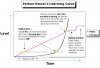
I see it as a bit more complex than that - women / followers initially have a "shallower learning curve" than men / leaders. This is natural, and happens in any lead-and-follow dance to an extent, although probably more in tango than in many other dances.

I reckon a reasonably-talented beginner follower can get up to "minimum social dance" level with a couple of hours of tuition; assuming she's partnered with a good enough leader, and assuming we're just talking about close embrace, simple movements.

Whereas it could take months for a leader to get to that level.

That said, I think there then comes a point where the follower really has to work hard to improve, more so than the leader.

In other words, exactly what Tangonuevo said...
 
I see it as a bit more complex than that - women / followers initially have a "shallower learning curve" than men / leaders. This is natural, and happens in any lead-and-follow dance to an extent, although probably more in tango than in many other dances.

I reckon a reasonably-talented beginner follower can get up to "minimum social dance" level with a couple of hours of tuition; assuming she's partnered with a good enough leader, and assuming we're just talking about close embrace, simple movements.

Whereas it could take months for a leader to get to that level.

That said, I think there then comes a point where the follower really has to work hard to improve, more so than the leader.

In other words, exactly what Tangonuevo said...


its like this... the beginners hell
 

Attachments

  • learning_curve.jpg
    learning_curve.jpg
    67.3 KB · Views: 23
goals

this is from a sals site but it applies equally here:

"GOALS

What do you expect from your dance experience? How good a dancer do you want to be? Are there dancers that inspire you ( if so, talk to them. If they’re friendly, they might give you some valuable advice and instruction)? How much time are you willing to invest to make your dancing better?

Someone once told me there are two types of dancers: those that dance for how it makes them feel, and those who dance because they like to perform around others. The first type likes to dance for what it brings to themselves and their partner, while the second type is just as concerned with how others view their dancing. Of course, in the real world no one is solely one type or the other. But even still, be true to your own personality. If you want glitz and flash, then find instructors who add this to what they teach. If you’re more conservative( is there such as thing as a conservative salsa dancer?), find an instructor that better suites this perspective in their teaching style. The goal here is to build a realistic mental image of what you want to become with your dancing.

Finally, determine what amount of time you can and will invest to learn salsa. Forget people who brag that they are naturals. ALL GOOD DANCERS PRACTICE. They practice with their partners, with other partners, by themselves, and at different clubs and venues. This is exactly what makes them so good. So taking the time to practice is a must if you are going to improve.

How much time you spend depends on how quickly you want to learn. Some dancers spend several hours practicing for every hour of instruction they receive. At this rate, it won’t take but a few months before you’re in an intermediate group class leading the women quite nicely. I wouldn’t take less than one group lesson per week for the first two months to attain this, and at least two or three privates to tighten things up. If you can’t manage this kind of time investment, do what you can, but set the time goal nonetheless."
 
Leaders have a more difficult task if you count the number of things they need to learn in class and on the dance floor. Followers have an easier task if you count the number of things they need to learn in class....
I think that this may also be a function of what your vision of tango is. If it is CE on a very crowded floor, you might be right. However, one of the hallmarks of "modern" tango is the level of technical demand it places on the follow, see for example the Chicho Y Juana video recently linked into the forum.

This is in fact a portion of why I dance 'nuevo' if floor conditions allow - it is much more enjoyable for my partner than only doing simple walks - which she does enjoy. But as a ballet dancer, she also enjoys a challenge to her technique.
 
I think that this may also be a function of what your vision of tango is. If it is CE on a very crowded floor, you might be right. However, one of the hallmarks of "modern" tango is the level of technical demand it places on the follow, see for example the Chicho Y Juana video recently linked into the forum.

This is in fact a portion of why I dance 'nuevo' if floor conditions allow - it is much more enjoyable for my partner than only doing simple walks - which she does enjoy. But as a ballet dancer, she also enjoys a challenge to her technique.

I would agree with that; I dont find many followers who are good enough/balanced to dance open and nuevo. but the choice would come from the music and a suitable dance partner who can deal with the more lanquid form of say narcotango.
 

Dance Ads

Advertise on Dance Forums Reach dancers, teachers, studios, event organizers, and dance-friendly brands. View ad options
Back
Top