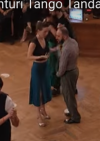
The "stomp" definitely doesn't convey musicality. It seems a bit like he's dancing to a military march meanwhile you've got the violin strings conveying something much more flowing.
Yes, that's quite an accurate description; to play the devil's advocate though, if you try and perceive it as a movement that emphasises a beat, explicitly marked by the music or otherwise, it might make more sense.
One thing that struck me is she seems to have very good balance herself. (?) This is perhaps the reason she can move with confidence. I admire follows like that in all dances. They can deal with anything.
In general, I find that followers in tango tend to be more technically proficient, especially in the realm of balance. I've danced with professionals with an exquisite sense of balance and grounding, that it almost feels like you couldn't topple them over with a sledgehammer if you swung at them a thousand times. I like taking advantage of this; varying and contrasting our stability gives my follower myriad different sensations and feelings, and it makes the feeling of our dance richer and more nuanced, especially when I do it with the music. A little risk here and there, teetering on the edge of disaster, paired with superb sensitivity and knowing exactly where to toe the lines... All that adds spice and shatters monotony.
The pictures of non-body contact embrace I showed above make me think a bit about "practice hold". That's sometimes used in lessons allow the follow to concentrate on some things while not having to concentrate on the full hold. Practice hold can also help prevent a lead's lack of balance from propagating to much into the follow. So I thought maybe that's why we were seeing so many couples doing that.
(In smooth, 5 proximities are all allowed-- so not being in body contact isn't necessarily a practice hold. But my impression is in AT, it's supposed to be more body contact nearly all the time?)
I don't want to be a gatekeeper, so for me, within the spectrum of embraces, from wide open to intimately (not necessarily in the romantic sense) close, they're all tango (AT). Practice holds tend to be with the follower's left hand on her leader's upper arm, with the leader's right hand on her back, around the level of where her bra strap would be or her shoulder blade. Arms and shoulders relaxed, but still with a minimum level of tenseness that is required for communicating. If you look at this performance, you'd see a lot of usage of what you'd call a "practice hold"; of course, you almost never see this level of dance on a social dance floor, but there are plenty of experienced dancers who do employ this a lot.
The video is Tsbilisi, right? I would have expected more European style?
You are correct.

I have had a very unconventional background when starting out tango — I essentially had teachers who taught very traditional AT:
One who taught what most people call "Salon-style tango", which is a misnomer of sorts (long story):
And another who was outright "nuevo", essentially what Chicho and Juana were doing.
But the way I dance is essentially Argentine style.
Anyway, it's interesting to watch. This is a marathon. Does that mean all these dancers may be tired out from a long, long session of uninterrupted dancing? Or does marathon mean something else in the context of AT?
A tango marathon tends to involve:
A pre-party milonga (social dance event) on Thursday (Most, but not all have this) (4, 5 hours)
An opening milonga on Friday night (5, 6 hours)
Afternoon milongas on Saturday and Sunday (5, 6 hours)
Evening milongas on Saturday and Sunday (5, 6 hours)
Maybe after-party milongas
after the evening milongas (3, 4 hours, depends on the number of participants)
"Official" after-party milonga on Monday (4, 5 hours — usually a collaboration with a local milonga)
Of course, no one dances all the time, but it's still about what, approximately 10 hours a day over the whole weekend, with 8 on the side?